- Place
- Paliukai, Panevėžys District Municipality
- Region
- Aukštaitija
- Type
- a state-protected reconstructed log birthplace with documentary photographs, reproductions of the sculptor's work, and educational visits
- Address
- 8A Paliukai, Paįstrys Eldership, Panevėžys District
- Coordinates
- 55.86257, 24.31909
- Visit duration
- 45-60 minutes for the house and yard; 60-90 minutes with a pre-booked educational programme
- Best time
- in daylight after arranging a time in advance; in summer it can be combined with Zikaras memorial sites in Paįstrys
Juozas Zikaras Museum in Paliukai, Paliukai Juozas Zikaras Museum, Birthplace of Juozas Zikaras, Juozo Zikaro memorialinė sodyba
The Paliukai birthplace is not the same museum as the Zikaras family home in Kaunas
Juozas Zikaras Memorial Homestead is at 8A Paliukai, about 3 km from Paįstrys, and preserves the sculptor's birthplace and childhood setting. Another museum occupies the family's later house and studio at 3 J. Zikaro Street in Kaunas. Whenever a map or article simply says Juozas Zikaras Museum, check the town and address before travelling.
The Paliukai house is Cultural Heritage Register property 10531. It is a state-protected individual site of regional significance, valued for its memorial association and representative architecture. The Geoportal coordinate 55.862568, 24.319087 marks the house itself, not the centre of Paliukai, a road junction, or a parking space.
KVR's dating is precise but needs interpretation. It places the house in the late nineteenth century and states that it was reconstructed in the second half of the twentieth. The register links the museum opening with 1972 and records restoration of the birthplace house and installation of the exhibition in 1981. The birthplace site and the recovered form of a traditional cottage are authentic, but the interior must not be marketed as an entirely unchanged room from 1881.
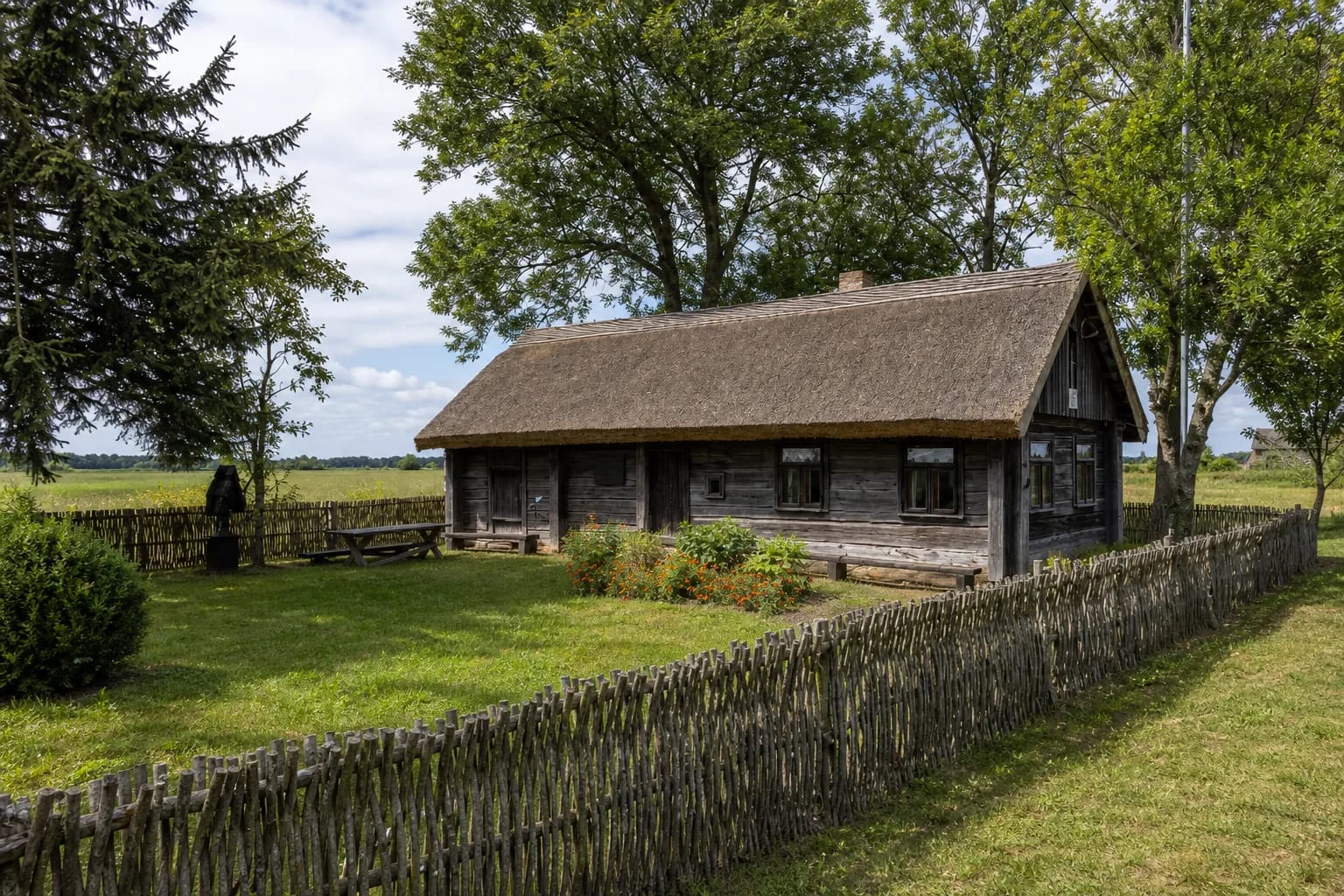
The log cottage and wattle fence retain the scale of a modest late nineteenth-century homestead
The cottage is low, rectangular, compact, and single-storey with an attic. KVR identifies a fieldstone foundation, sawn-log wall type, timber beam floor, and timber rafter roof. Dark horizontal logs define the long elevations; its small windows retain traditional timber subdivisions, while vertical boards clad the triangular gable.
A simple gabled roof carries reed-type thatch and a small brick chimney. KVR recorded the roof in poor condition in 2021, while the municipality reported museum renewal work in 2022; KVR photographs from October that year show the repaired reed surface. Thatch is a living material that requires periodic maintenance, so its colour and texture naturally differ between photographs.
A protected type of woven wattle fence encloses the yard. Inside are a flower bed, simple benches, and small memorial accents, with flat cultivated fields opening beyond the trees. This landscape is not incidental. It makes the distance between an austere childhood in Paliukai and Zikaras's later symbols of national representation intelligible.
The path from Paliukai shepherd boy to professional sculptor was anything but direct
Juozas Zikaras was born here on 18 November 1881 to the poor rural household of Viktoras and Ona Zikaras. His father worked as a carpenter, while accounts of the future sculptor's childhood repeatedly return to herding, learning woodwork, and a late route into formal schooling. The programme title From Shepherd Boy to Young Carver compresses that change into a memorable phrase, but it is not a substitute for the full biography.
VLE records that Zikaras attended drawing schools in Vilnius in 1904-1906, studied at the Imperial Society for the Encouragement of the Arts school in St Petersburg in 1906-1910, and graduated from the Imperial Academy of Arts in 1916. Back in Lithuania, he taught at Panevėžys Gymnasium from 1919 to 1928, later worked at Kaunas Art School, and became a professor in 1944.
That chronology defines what this museum is and is not. Paliukai was not his mature studio, the workplace where he modelled coins, or the Kaunas family residence. Its purpose is to show the point of departure for a life that moved through Vilnius, St Petersburg, Panevėžys, and Kaunas.
Liberty, The Book Smuggler, and the coins appear through images, not purported originals
Zikaras created Liberty in 1921, and the sculpture was erected in the garden of Vytautas the Great War Museum in 1928. The same garden received his busts of Jonas Basanavičius, Vincas Kudirka, and Simonas Daukantas, the relief By the Grave, and The Book Smuggler in 1939. His Panevėžys years also produced the Christ the King sculpture for the cathedral and atlantes for the Bank of Lithuania building.
The artist modelled Lithuania's interwar litas and centas coins. VLE distinguishes the 1924 and 1936 series, while Bank of Lithuania research documents his common mounted-knight image and denomination models. The story shows how a sculptor's work entered everyday circulation, but the original wax models belong to national collections and should not be claimed as objects in this cottage.
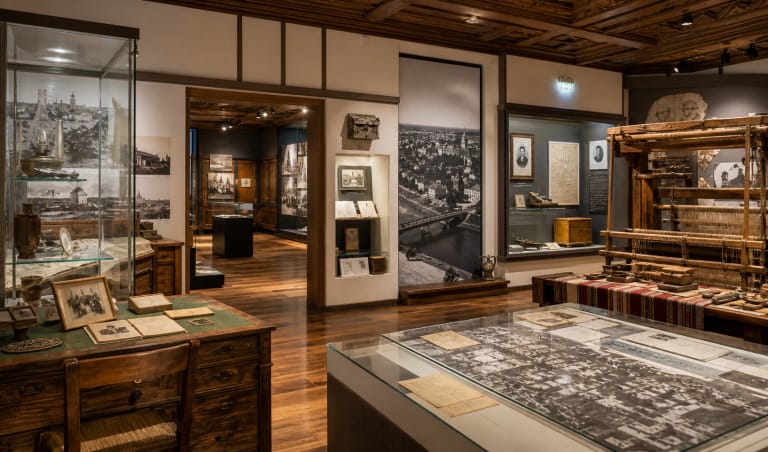
The Paliukai display is based on documentary photographs, images of Zikaras's works, and reproductions. The official visitor profile does not promise a large holding of original sculptures, and the display renewed and digitised in 2021 was explicitly titled Moments from the Life and Work of Sculptor Juozas Zikaras in Old Photography. That honesty strengthens the museum: in a tiny birthplace, the place and a well-told biography are the central exhibits.
Educational activities and the Zikaras Route extend the visit beyond one small room
Panevėžys District Public Library's current profile calls the most popular programme Nuo piemenėlio iki drožėjėlio, or From Shepherd Boy to Young Carver; the municipality's 2021 material used the variant From Shepherd Boy to Craftsman. Both names connect his childhood, works, and creative development. When booking, confirm the current title, practical activity, duration, and intended age group.
A Zikaras Pancakes activity, clay work, drawing, and family workshops were documented during the 2021 programme. They were events of that year, not a guaranteed weekly menu. Ask staff for the current choice, particularly if you require a specific material, a food tasting, or delivery in English.
The official 2026 fee schedule also lists a Zikaras Route overview lasting up to one hour for a group of up to 20 people. It costs EUR 50 per group. Agree the content and starting point: the wider Paįstrys story can connect the birthplace, Zikaras works in the church, a timber memorial, and the carved Zikaras Geese, but not every stop is automatically open.
The 2026 ticket prices are clear, but a visiting time still has to be booked
Following the 2026 reorganisation of district cultural institutions, the official unit is the Juozas Zikaras Museum of Panevėžys District Culture Centre. The current district-library profile instructs visitors to arrange access in advance on +370 615 90967. An older Paįstrys Culture Centre page once stated weekday hours of 10:00-14:00, but that page no longer works after the reorganisation and the schedule should not be treated as confirmed.
The fee schedule effective from 5 May 2026 sets admission at EUR 1 for a child or young person under 18, EUR 2 for an adult, and EUR 3 for a visit with an educational programme. The same document grants free or half-price entry using terminology from the previous work-capacity assessment system. Ask when booking which current disability document is accepted, whether an accompanying person enters free, and how a group can pay.
The house is single-storey, but no public access audit gives exact information on the grassed yard, wattle gate, historic threshold, door width, toilet, or parking. A ground-floor display does not by itself prove a step-free route. Discuss wheelchair or walking-aid access, toilet provision, and a vehicle drop-off before visiting, and do not block the narrow rural road or gate.