- Place
- Panevėžys City Municipality
- Region
- Aukštaitija
- Type
- city and regional history museum
- Address
- Vasario 16-osios g. 23, Panevėžys
- Coordinates
- 55.73007, 24.35840
Panevėžys Museum
A centre of city history
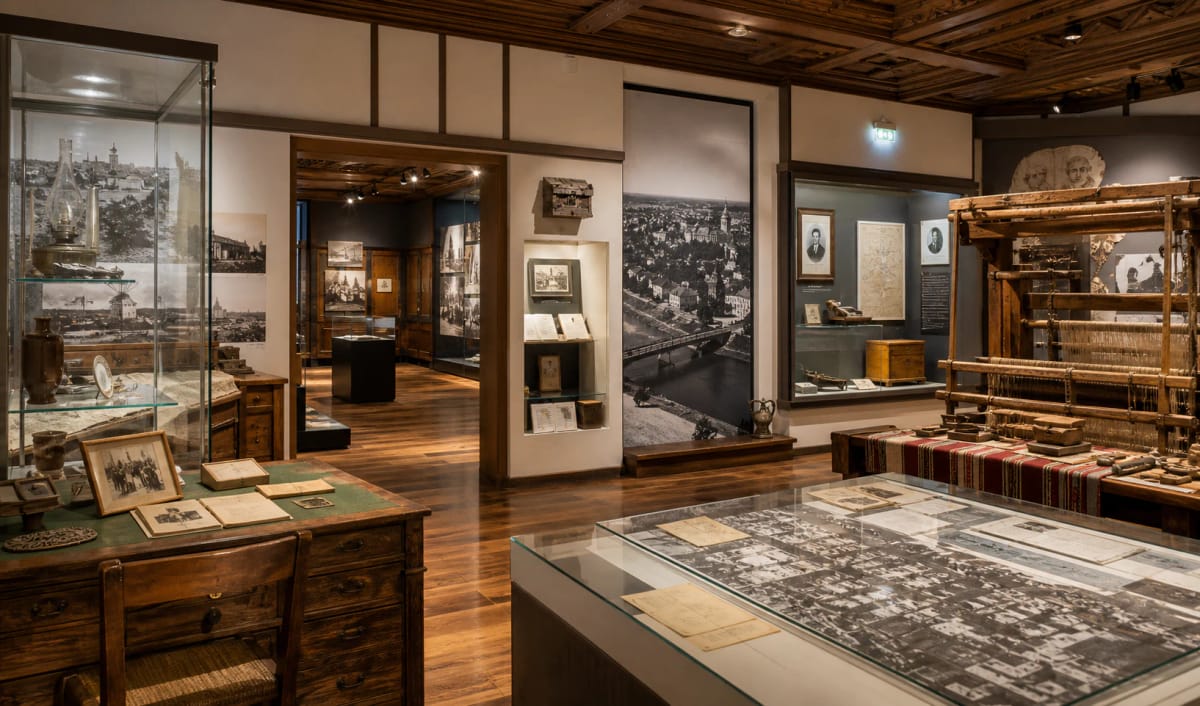
Panevėžys Regional Museum now operates at Vasario 16-osios g. 23 in the reconstructed Moigiai houses. It is the main institution for the history of Panevėžys city and region, and is worth visiting before a deeper walk through the city.
The current main exhibition is called Dialogues of Epochs. It presents Panevėžys history not merely as chronology, but as a conversation among different periods, people, and urban changes.
Regional studies and the 1925 founding
The museum's roots reach back to 1908, when the city Duma discussed the need for a museum and library. In 1923, a group for studying the native region formed at the boys' gymnasium; museum history describes it as Lithuania's first regional local-studies society.
According to VLE, the museum was founded on 18 January 1925 through the initiative of Petras Bliumas, P. Būtėnas, J. Elisonas, Jonas Moigis, and Vladas Rozmanas, with the collection based on exhibits donated by the founders. From 1925 to 1947 it was called simply Panevėžys Museum, and its first director was Stasys Banelis (1925-1934). The museum held about 2,000 exhibits in 1925, more than 12,000 in 1939, and about 51,000 in 1983.
Buildings and the 1614 archive
After the Second World War, in 1945, the museum moved to Respublikos g. 3 and remained there for 40 years. In 1985 it moved to the reconstructed Moigiai houses at Vasario 16-osios g. 23, where a new exhibition opened in 1987. The Smilgiai ethnographic homestead was transferred to the museum in 1993 and, together with J. Zikaras House-Museum, was later transferred to Panevėžys District Municipality in 2009.
One of the most important branches is the former Upytė county court archive, built in 1614: the oldest surviving building in Panevėžys and the oldest archive building in Lithuania. The Upytė Nobility exhibition opened there in 2007. For that reason, it is important not to reduce Panevėžys Museum to a single hall; it works through a network of historic places.
Collections and notable exhibits
The museum has five departments: Education and Information, Ethnic Culture, History, Collection Accounting and Protection, and Restoration and Conservation. In 2022 its holdings included more than 120,530 exhibits: archaeology, numismatics, ethnography, natural history, photography, books, periodicals, documents, and audio-visual archive material.
Among the better-known finds is a hoard of 36 silver ducats from the United Provinces, found in Panevėžys around 1974. The museum not only exhibits material but also restores and conserves collections, runs archaeology, history, nature, and ethnography education, and organises conferences and public events in city spaces.
Twentieth-century memory
The Soviet Occupation and Sąjūdis exhibition opened on 23 August 2004. It is especially important for understanding twentieth-century Panevėžys, because the city's memory includes not only older regional studies but also Soviet rule, resistance, Sąjūdis, and the restoration of independence.
The restoration and conservation department, founded in 2000, shows that the museum does more than exhibit: it protects and maintains collections. This is a key function of a regional museum as infrastructure for memory.
Opening hours and tickets
During research, the official museum listed main-exhibition hours as Tuesday-Friday 10:00-18:00 and Saturday-Sunday 11:00-16:00. Sunday entry was listed as free.
During research, a main-exhibition adult ticket cost 4 EUR, with a 2 EUR discounted ticket for school pupils, students, seniors, and soldiers, and an 8 EUR family ticket for up to five people. Branch prices and rules may differ, so check the official price list.