- Place
- Stanioniai village, Panevėžys District Municipality
- Region
- Aukštaitija
- Type
- private aviation museum with outdoor aircraft and indoor technical exhibitions on a working airfield
- Address
- 4 Įstro Street, Stanioniai village, Paįstrys eldership, Panevėžys District
- Coordinates
- 55.82727, 24.35983
- Visit duration
- 1-1.5 hours for the outdoor and indoor displays; around 2 hours with a pre-booked educational programme or a separate visit to the Porcelain Gallery
- Best time
- a dry day with good daylight for the outdoor aircraft; recheck opening hours and bookable services before setting out
Įstra Aircraft Museum, Įstros lėktuvų muziejus, Įstros aviacijos muziejus, Įstra Aviapark Museum
A private museum on the working Panevėžys/Įstra airfield
The public name on the museum website is Įstros aviacijos muziejus, or Įstra Aviation Museum, while its legal Lithuanian name is VšĮ Įstros lėktuvų muziejus. Both identify the same visitor attraction in Įstra Aviapark at Stanioniai, about 10 km north of central Panevėžys. The district municipality likewise identifies an aircraft museum operating here in Paįstrys eldership.
This is neither only a hangar nor only an outdoor equipment yard. The private museum, established on the initiative of aviator V. Puidokas in 2016, has two principal parts: a large open-air display and two indoor rooms containing smaller equipment, documents, and accounts of pilots' lives. A Porcelain Gallery operates in the same complex, but the posted price list treats it as a separate attraction and lists separate and combined tickets.
Lithuania's VFR Aeronautical Information Publication effective on 16 April 2026 still listed Panevėžys/Įstra as EYPI, a day-VFR airfield with a 600 x 20 m asphalt-concrete runway. For visitors, the practical consequence is simple: remain on museum paths, respect fences and staff directions, and never enter the runway or any aircraft movement area.
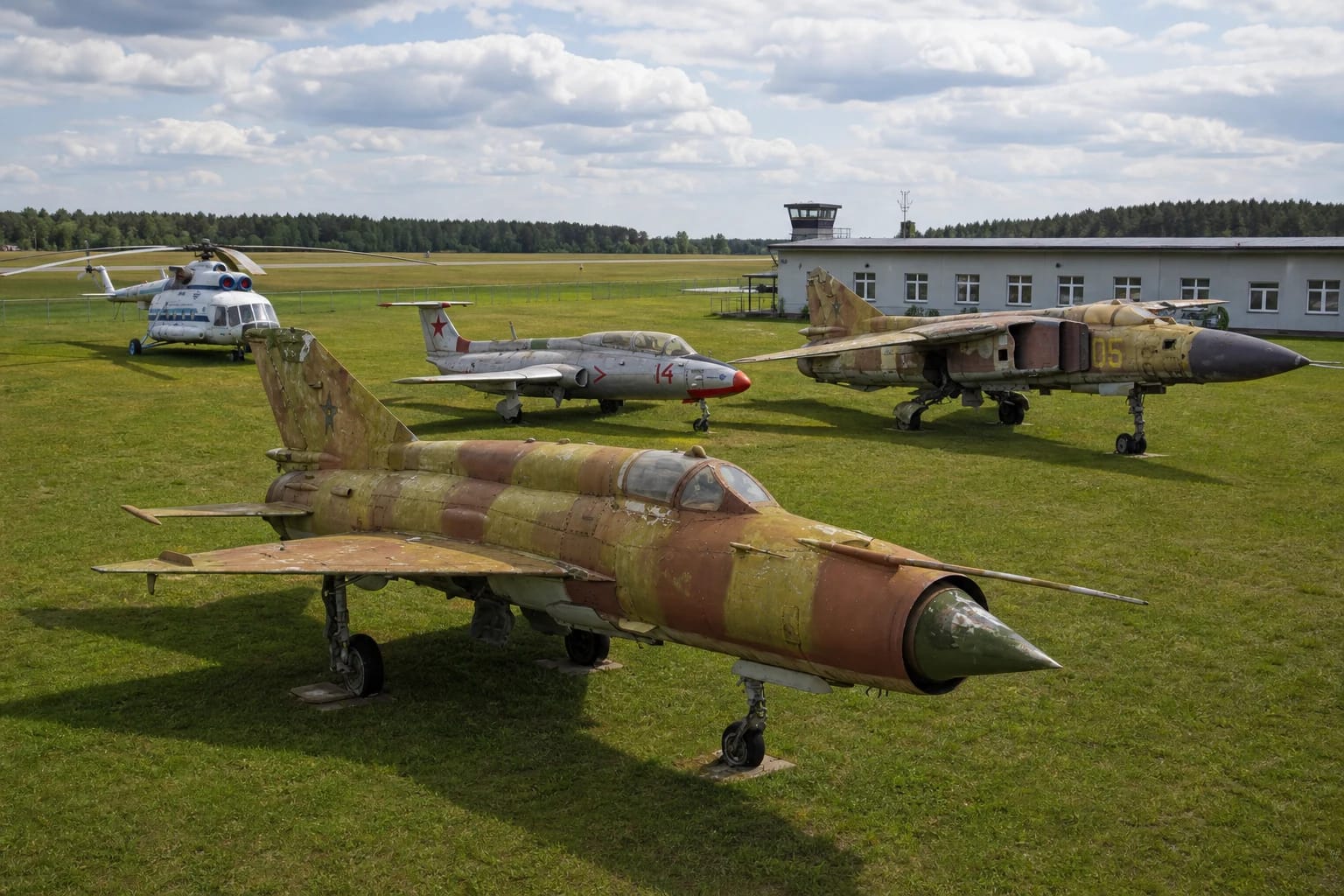
Six aircraft and an AORL-85 radar stand outdoors
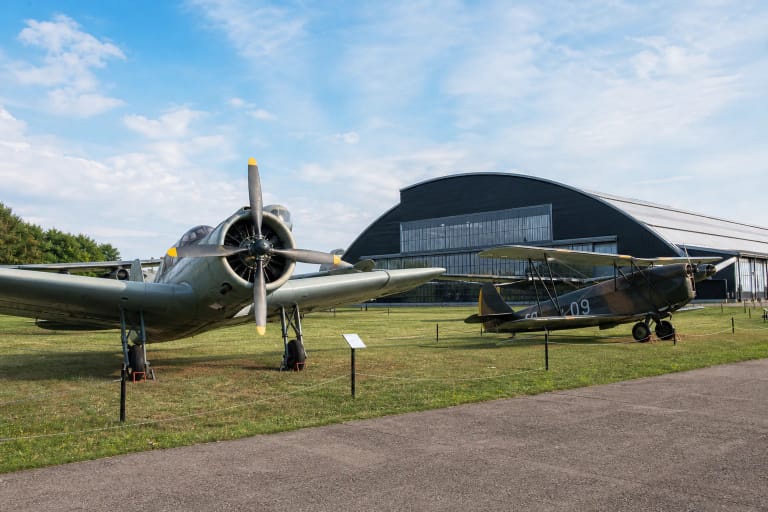
The museum's official outdoor list names four aeroplanes: a Su-15 interceptor, MiG-21 and MiG-23 fighters, and an L-29 jet trainer designed in Czechoslovakia. Two helicopters stand nearby, the smaller Mi-2 and the twin-turbine Mi-8. The seventh large object is an AORL-85 airport surveillance radar, also known as Ekran-85.
Keeping that exact list helps because visitor descriptions variously call this an aircraft, mock-up, or military-technology museum. The careful interpretation is a static outdoor display of retired airframes and aerodrome equipment, not a flying collection. The museum does not promise entry into every cockpit, so do not cross barriers, open hatches, or climb on an exhibit without explicit staff permission.
The real Įstra exhibits have not all been cosmetically restored to the same finish. Official photographs show faded paint, successive markings, and surface wear typical of equipment kept outdoors. That patina is part of what visitors see, but maintenance can move an aircraft or close access around it temporarily. A dry day is best both for photography and for crossing the grass.
The indoor rooms shift attention from aircraft to people and instruments
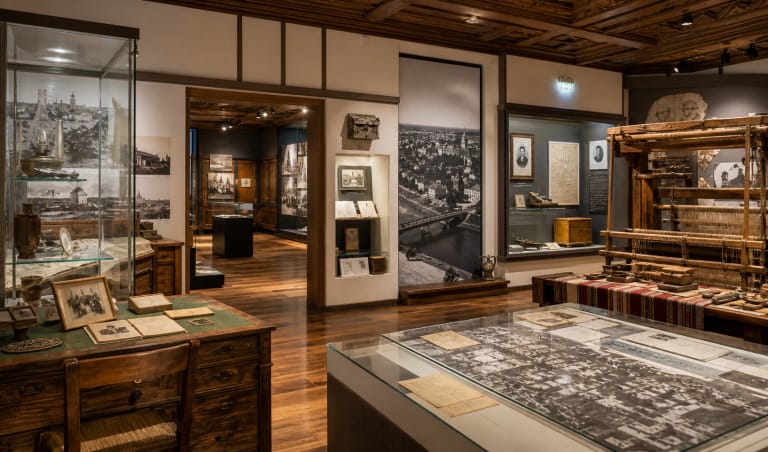
Inside, the collection moves from the outline of an aircraft to the everyday work of pilots and technicians. The museum lists propellers, speed and other measuring instruments, avionics, tape and wire flight recorders, ejection seats, radio equipment, compasses, transmitters, helmets, oxygen equipment, goggles, boots, gloves, and a PLP-60 rescue parachute.
The Darius and Girėnas theme is represented by copies of rare documents, newspaper material, and interwar photographs. Separate displays recall Vytautas Lapėnas, Rimantas Stankevičius, Darius Išganaitis, Levas Jonys, and other aviators. This is not an exhibition of Lituanica wreckage, which belongs to other museum collections. At Įstra, personal objects and individual accounts provide the distinctive perspective.
The museum highlights a restored stained-glass work brought from an aviation institute in Riga and a damaged Yak-50 wing linked to instructor Levas Jonys's emergency landing. Detailed provenance is not published online for every object, so a guided visit is a good opportunity to ask which pieces are originals, which are copies, and precisely what event each one documents.
Agricultural aviation and Vytautas Lapėnas shaped the airfield
The museum's timeline traces the airfield to agricultural aviation in 1984, when the site had an approximately 400 m strip, a chemical-fertiliser store, and aircraft that spread material over surrounding fields. Around 1990 Vytautas Lapėnas and Jurgis Kairys acquired it with plans for a flying school. Lapėnas became sole owner in 1995, converted the former store into a hangar, and developed further flight infrastructure.
The sources define the flying school's date differently. VLE says Lapėnas founded his school at Įstra in 1989, whereas the museum timeline identifies 2000 as the stage when he established and led an aerobatic flying school. These probably describe different phases of one evolving operation, so neither date should be forced into a single uncontested opening moment for the whole airfield.
VLE supplies the more precise sporting context: Lapėnas won the individual Soviet aerobatics championship in 1985, individual bronze and team gold at the 1989 European championship, and team silver at the 1988 world championship. Įstra hosted the European Unlimited Aerobatic Championship in 2002. Aviators created Įstra Aviapark after taking over the airfield in 2006, and the present museum followed a decade later.
Recheck the opening hours and the price list dated 2021
On 19 July 2026 the official homepage listed the museum as closed on Monday, open Tuesday-Saturday from 10:00 to 18:00, and open Sunday from 12:00 to 18:00. Several internal pages on the same site still displayed an older Tuesday-Sunday 10:00-19:00 block. This guide treats the homepage as newer, but visitors should confirm it on +370 618 39936 before setting out.
The posted museum price list was still labelled effective from September 2021. It showed EUR 6 for an adult, EUR 5 for school pupils, students, seniors, and disabled visitors, and free entry for a child under seven accompanied by an adult. A 90-minute educational programme was shown at EUR 80 and required advance booking. Because the museum itself has not updated the date, these figures should not be treated as guaranteed 2026 prices.
The official contact for educational visits, groups, and other bookable services is registration@aviapark.lt or the museum telephone. A sightseeing flight is a separate service subject to weather, aircraft, and pilot availability, not part of museum admission. Ask in advance about the Porcelain Gallery, photography, wheelchair access, and toilets as well, because the website does not provide a comprehensive accessibility audit for the full complex.