- Place
- Inturkė, Molėtai District Municipality
- Region
- Aukštaitija
- Type
- active timber Catholic church formed in the eighteenth and nineteenth centuries, with a historic bell tower and sacred art
- Address
- 17 Bažnyčios Street, Inturkė, Molėtai District Municipality
- Coordinates
- 55.15935, 25.56299
- Visit duration
- 20-40 minutes for the church and churchyard; 1-2 hours with a walk through Inturkė and toward Lake Galuonai
- Best time
- Sunday Mass for the best chance of seeing the interior; dry daylight for examining the timber architecture
Inturkė Church, Inturkė Church of the Dormition, Inturkė Church and Bell Tower
A restrained timber ensemble in central Inturkė
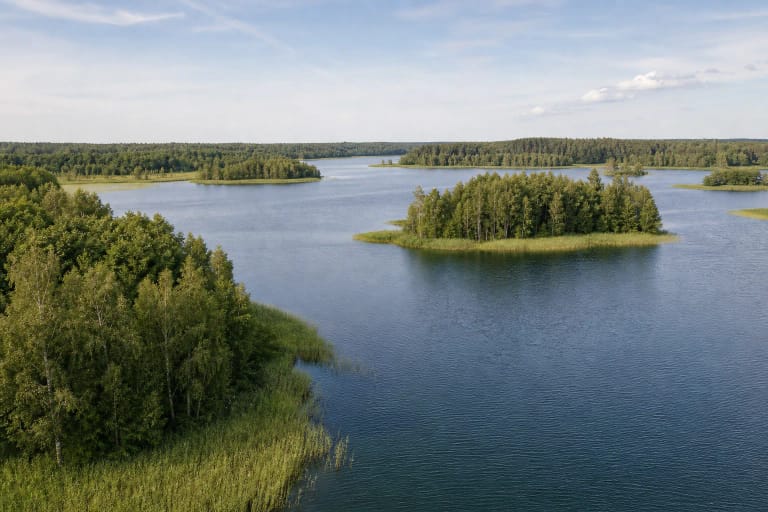
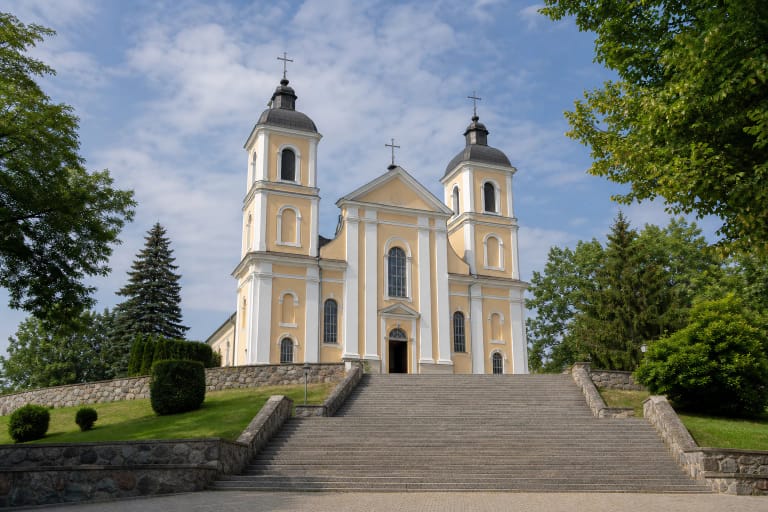
The church stands on Bažnyčios Street near Gėluotas Bay of Lake Galuonai. The coordinate 55.1593535, 25.5629869 marks the main entrance side. A fieldstone wall encloses the churchyard and a separate timber bell tower stands beside its gate.
The main building has an elongated rectangular plan, three-sided apse, and low roof turret. Vertical dark boards, lighter window frames, and a metal roof form a restrained rural silhouette, while a portico introduces a Classical note.
VLE describes its architecture as folk Romanticism. The term does not imply abundant ornament here: the value lies in traditional timber work, proportion, and a blend of vernacular and professional design formed through successive rebuilding.
Why the church has no single simple construction date
Inturkė has been documented since 1373 and its first church was built in 1555. It was later rebuilt: VLE mentions work in 1668, while other heritage accounts record a second church by 1674 and a new building in 1739.
Sources differ when dating the present volume. Shorter catalogues often give 1855, while VLE more cautiously spans the mid-eighteenth to first half of the nineteenth century. In the early nineteenth century, work under parish priest Antanas Laševskis repaired the roof, added interior columns, and introduced the portico.
The most accurate reading is therefore a multi-period building, not an object erected from scratch in one campaign in 1855. The Cultural Heritage Register confirms this layered significance: the regionally significant complex is registered as 1514 and its constituent parts were later defined separately.
Coffered ceiling, altars, and paintings
The strongest architectural feature of the single-nave interior is its ceiling divided into deep coffers. They give a flat timber structure rhythm and optical depth, so remember to look upward on entering.
A group of folk-Baroque altars survives inside. Architectural columns, carving, and saints' images create a richer setting than the restrained exterior. That contrast is characteristic of historic Lithuanian timber churches, whose sacred programme is concentrated within a simple outer form.
VLE highlights eighteenth-century paintings of St Barbara and Our Lady of the Rosary, a late-eighteenth-century St Anthony, a nineteenth-century St Casimir, an 1873 composition of St Ambrose, and Stations of the Cross painted by Butkevičius in 1878. View them respectfully and avoid flash photography.
The bell tower and a bell's journey from 1671
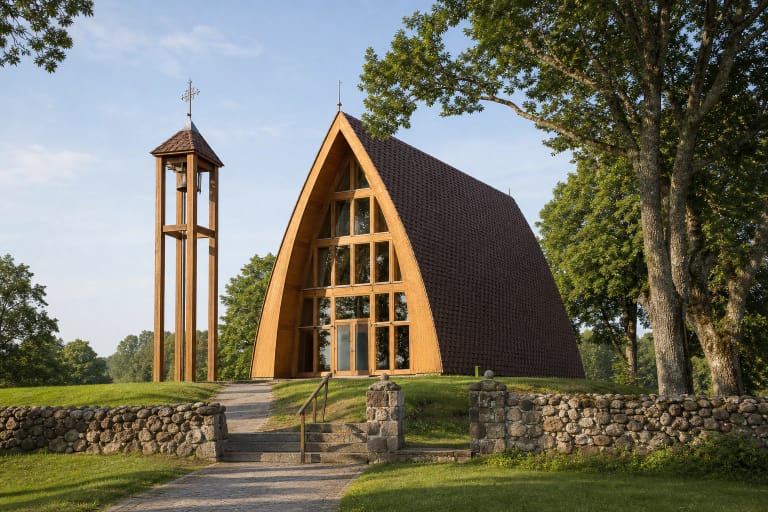
The separate eighteenth-century timber bell tower is an important element in its own right, not simply a service building. Its plain tiered volume, timber boarding, and pitched cap echo the church's material character.
Its brass bell was cast in 1671. It only came to Inturkė in 1973, when it was transferred from Rūdesa cemetery chapel. The bell is therefore older than the present form of the church and connects two sacred sites in the same parish.
The ensemble was restored in the second half of the twentieth century, particularly in 1974-1986. Today, see the composition as a whole: church, bell tower, fieldstone wall, gates, and mature trees.
Mass, access, and conduct inside
On 27 July 2026, the Diocese of Kaišiadorys listed Sunday Mass at 10:00. Times can change for the Assumption feast, local devotions, funerals, or when one priest serves several parishes, so check the official diocesan page before a dedicated journey.
This is an active church, not a museum open to a fixed daily schedule. The churchyard can be seen outdoors, but the doors may be locked beyond services. There is no ticket and parish donations are voluntary.
Inside, silence your phone, do not touch paintings or altars, and avoid flash. Inturkė also has an Orthodox Church of the Intercession of the Mother of God dating from 1868; it is a separate religious and architectural site and should not be confused with this Catholic church.