- Place
- Molėtai, Molėtai District Municipality
- Region
- Aukštaitija
- Type
- three-aisled plastered masonry Neo-Baroque basilica built in 1905-1907, with twin towers and Neoclassical furnishings
- Address
- Šv. Jono Pauliaus II g. 1, Molėtai
- Coordinates
- 55.23405, 25.42371
- Visit duration
- 25-45 minutes for the architecture and interior; about one hour when attending Mass
- Best time
- daylight for the facade and towers, and shortly before an advertised Sunday Mass to see the interior respectfully
Molėtai Church, Saints Peter and Paul Church in Molėtai, Molėtai Parish Church
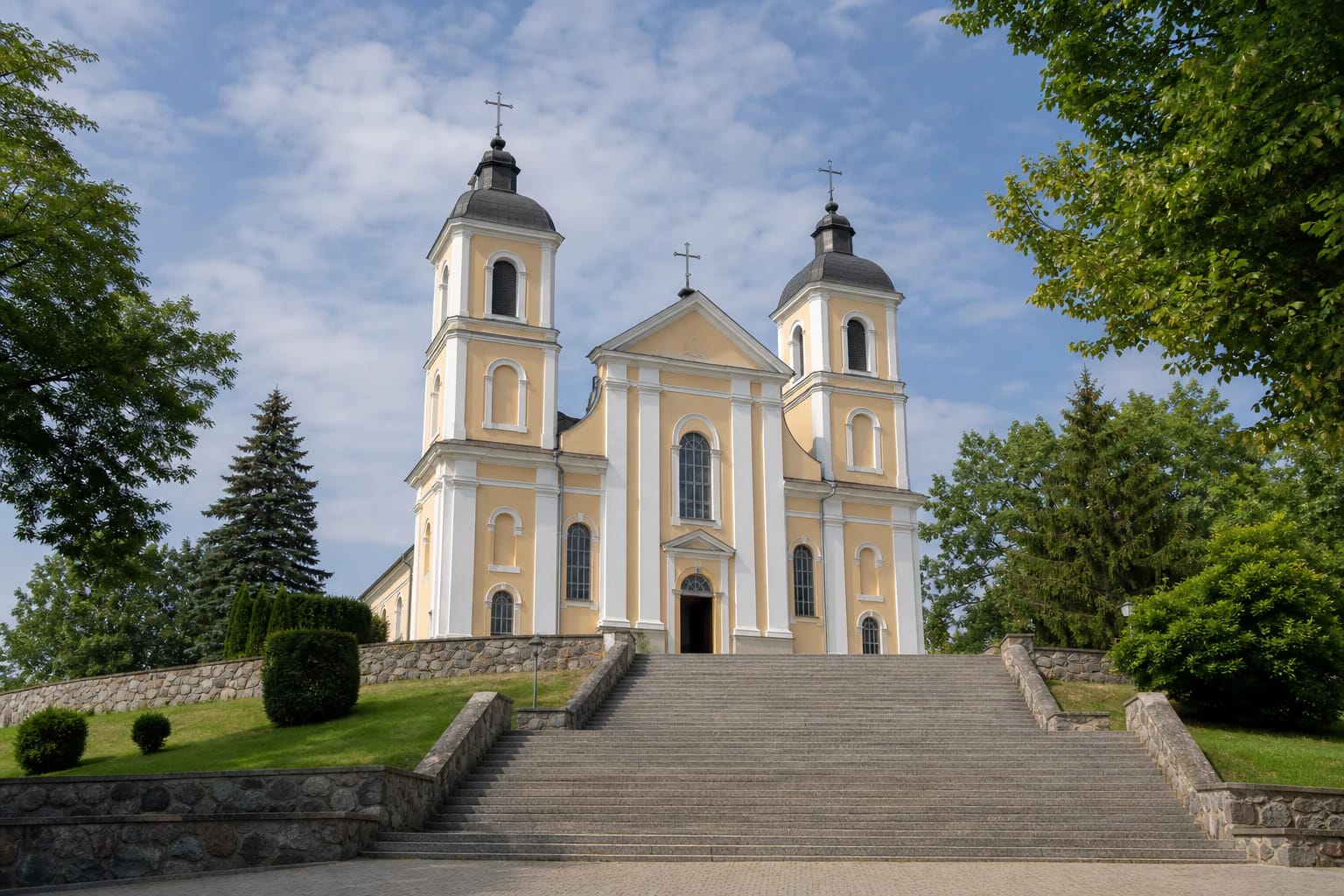
Twin towers above broad stone steps
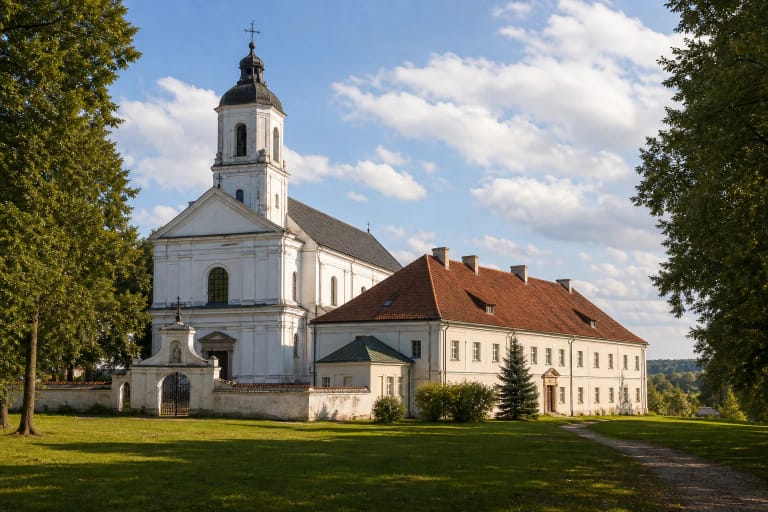
The church stands above street level, and its principal facade is best understood from the foot of the broad stone staircase. Pale yellow or peach plaster contrasts with white pilasters, cornices, and window surrounds. Two towers of matching rhythm frame the central triangular pediment.
The architecture is consistently yet soberly Neo-Baroque. Round-headed openings, a projecting central bay, and broken cornices recall Baroque design, while symmetry and clear articulation reveal a Neoclassical influence. The church is a basilica with a Latin-cross plan close to a rectangle and a transept that projects only slightly.
It was originally built at what was then the edge of town and remains surrounded by the old cemetery. Molėtai has since grown around it, but the relationship between churchyard and graves survives. Do not cross graves or rest camera equipment on memorials while looking for a viewpoint.
From a parish recorded in 1522 to the present church
Written sources mention a church at Molėtai in 1522. The first sanctuary was probably timber. It was destroyed during the Great Northern War in the early 18th century, and a masonry replacement rose around 1720.
By the early 20th century the older building was too small for the growing parish. Father Kazimieras Bandzevičius initiated the present church, erected with parishioners' funds in 1905-1907. Sources also name engineer Stepan Sestrzencewicz as supervisor of the work.
Although short descriptions often give 1905 alone, the new church did not rise in a single building season. The more accurate 1905-1907 range also explains varying catalogue dates and the documented demolition of the earlier structure in 1906.
Towers destroyed in 1944 and reinterpreted twice
The church suffered severe damage during the fighting of 1944. Both towers were blown up, the roof and windows were damaged, and the organ was destroyed. For decades, the church presented a lowered facade that had lost its original vertical emphasis.
The towers were rebuilt in 1977, despite a Soviet environment unfavourable to restoring sacred landmarks. This phase recovered the twin-towered composition, but the upper stages did not reproduce their pre-war proportions exactly.
Another exterior project concluded in 2022, reconstructing the tower tops in forms closer to historical photographs. Older images can therefore show a different outline. The visitor sees a modern restoration of the historical form, not original 1907 fabric at the tops of the towers.
A bright interior and twelve significant artworks
Piers and pilasters divide the three aisles and carry decorated arches and vaults. Light surfaces and tall windows produce an airy interior, while the Neoclassical order of the altars and organ case balances the more expressive Neo-Baroque architecture.
A municipal heritage study identifies twelve significant works of art. It highlights the paintings Mary among Angels, Saint Lawrence, and The Farewell of Saints Peter and Paul, along with five liturgical chasubles. These do not form one conventional museum display, so some may occupy liturgical or protected spaces.
The Cultural Heritage Department recorded acceptance of conservation and restoration work on the Marian altar in 2016. Restoration does not make it a hands-on exhibit: the altar remains part of a sacred interior and must not be touched or photographed with flash.
Worship, entry, and accessibility
Parish notices in 2026 confirmed regular Sunday Masses at 9 and 11 am, Saturday evening Mass at 6 pm, and evening worship on some weekdays. The timetable changes for indulgence feasts and major celebrations, sometimes leaving only one solemn Mass. Always check the latest parish calendar.
There is no tourist admission ticket or permanent daily sightseeing schedule. The most reliable way to see the interior is to arrive before an advertised service without disrupting preparations. Call the parish on +370 672 53515 for a group, guided visit, or special arrangement.
A long staircase leads to the principal facade, although Google Maps marks wheelchair-accessible entry and parking. Since the suitable route may approach another side of the building or depend on an unlocked door, confirm it with the parish before travelling.