- Place
- Glūkas, Varėna District Municipality
- Region
- Dzūkija
- Type
- stone abutments and piles of a historic railway bridge
- Address
- Giriaus g., Glūkas, Varėna Eldership, Varėna District Municipality
- Coordinates
- 54.28770, 24.54311
- Visit duration
- 20-40 minutes
- Best time
- daylight and dry ground; the Varėnė may run higher in spring and after heavy rain
Glūkas Railway Bridge Ruins, Varėnė Railway Bridge Remains
What actually survives beside the Varėnė
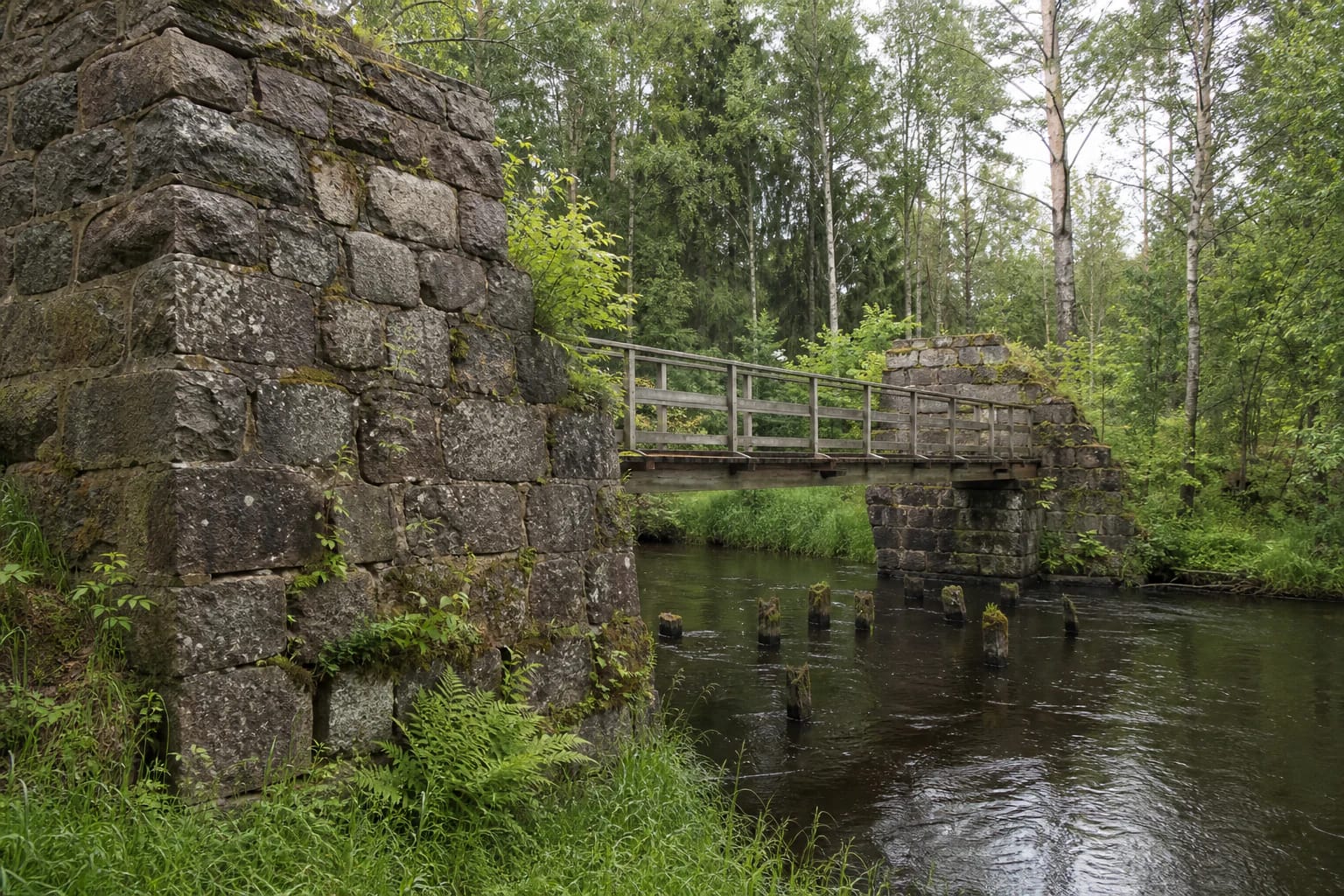
This is not an intact railway bridge where visitors can walk beside rails. Large dressed-stone abutments stand on both riverbanks, while piles from a former timber intermediate support can be seen in the Varėnė.
The roughly 30 m footbridge between the historic masonry is modern visitor infrastructure, not an original railway element. The municipality reported a major repair in 2025, but visitors should still assess the current deck and railings on site.
An 1894 structure on the Varėna-Alytus railway
The approximately 21 m bridge over the Varėnė, historically also called the Oranka, was built in 1894. It belonged to the military railway between Orany and Olita, the present-day towns of Varėna and Alytus.
The branch connected the Saint Petersburg-Warsaw main line and the artillery range near Varėna with Alytus. Completion of the wider route across the Nemunas at the end of the nineteenth century places Glūkas within an imperial strategic-infrastructure network, not the story of a small local narrow-gauge line.
Destruction, rebuilding, and the end of the line
The retreating Russian Imperial army blew up the bridge in 1915. German forces soon rebuilt it, adapting the damaged metal truss and using an additional timber structure to support the shortened span.
After the First World War, a political border separated Varėna station from the part of the route that remained in Lithuania. Trains ran only as far as Artilerija station for a time, but closure of the deteriorated Alytus railway bridge removed the line's purpose. The tracks and structures were dismantled, leaving abutments, embankment, and piles at Glūkas.
Protected heritage, not an adventure course
The Glūkas railway bridge remains are entered in Lithuania's Register of Cultural Properties under code 41994. Their value lies not only in isolated stones but in the relationship between the abutments, former embankment, river channel, and wider Olita-Orany route.
Do not climb high masonry edges, move stones, or try to walk on piles in the river. The coordinates mark the monument itself. A formed stopping area appears in a municipal study, but it should not be treated as a guaranteed formal car park; leave vehicles only safely and lawfully.