- Place
- Varėna District Municipality
- Region
- Dzūkija
- Type
- open-air park of boulders and symbols from Lithuanian history
- Address
- Merkio slėnis, Senoji Varėna, Varėnos r.
- Coordinates
- 54.24556, 24.54471
- Visit duration
- 45-90 minutes
- Best time
- in dry weather from late spring to autumn; on summer mornings or evenings when the valley is cooler
Senoji Varėna Stone Park, Varėna History Sculpture Park
Not a rock collection but a story of Lithuanian history
The stones were not assembled merely to display geological variety. Vytautas Butkevičius arranged boulders from Dzūkija fields as markers of remembrance. The compositions evoke dates in Lithuanian statehood, grand dukes, the partisan resistance, the signatories of independence, and major battles. The site is therefore best understood as an author's open-air history park.
Named features include a group for the twenty signatories of the Act of 16 February 1918, stones for the Battles of Grunwald, Saulė, and Durbe, an Avenue of the Grand Dukes of Lithuania, Three Brothers, Family, Sun and Moon, a National Anthem stone, and a 24-stone composition for the hours of the day. Inscriptions help visitors read the route, but this is the creator's interpretation rather than a chronological national-museum exhibition.
A symbolic mound in the Merkys valley
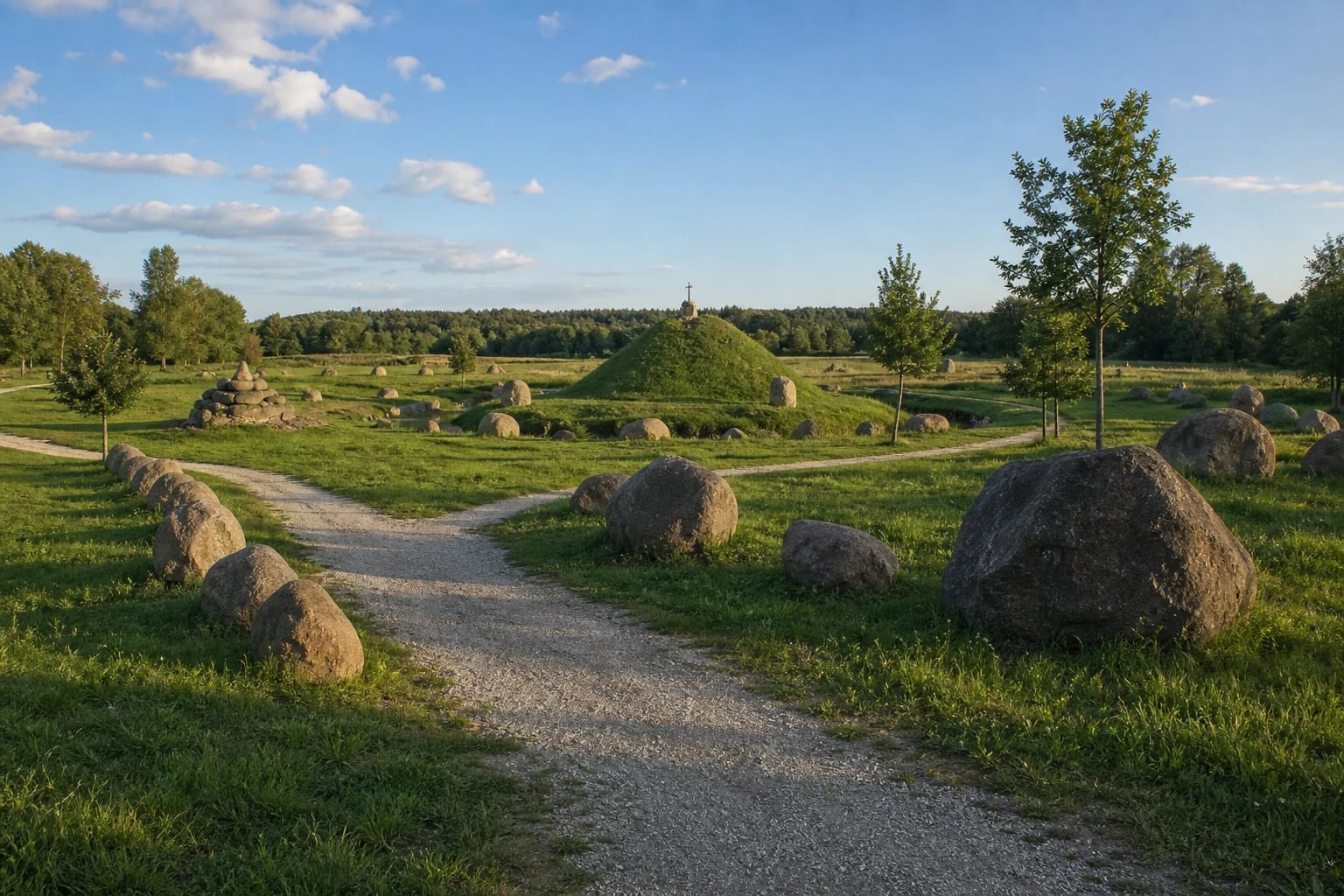
The park's most prominent constructed feature is a grass-covered hill raised in the centre of the valley to resemble a hillfort. A narrow water-filled ditch encircles it, and a large boulder bearing a sword symbol stands at the summit. The composition commemorates Lithuanian partisans, Vytautas the Great, and key dates in the state's history.
This is a modern symbolic artwork, not an archaeological hillfort. The distinction matters both in describing the site and planning a route: for a genuine regional hillfort, continue to Merkinė or another registered heritage location.
The scale of the boulders and the open valley landscape
The official place description counts more than one hundred large stones weighing roughly one to twenty tonnes, plus over a thousand smaller boulders of up to one tonne. They are distributed across a broad meadow beside gravel and grass paths, so the layout reveals itself by walking rather than from a single viewpoint.
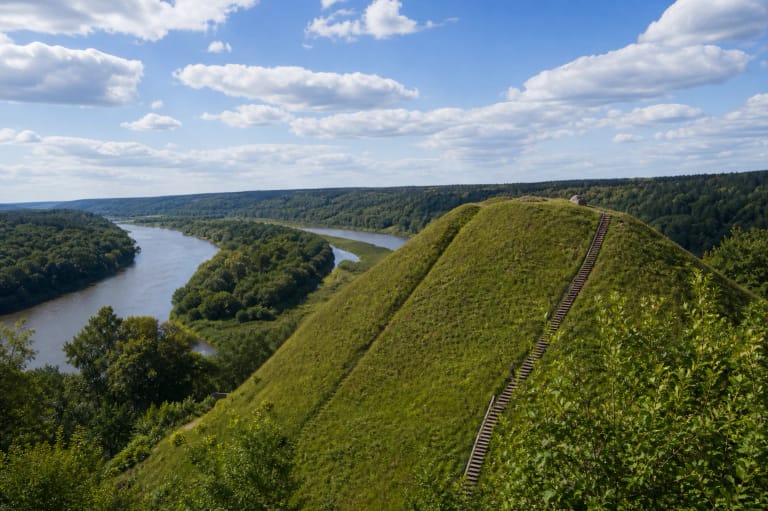
The Merkys valley is part of the experience. The Universal Lithuanian Encyclopedia explains that the river cuts through sand as far as Varėna, then reaches harder moraine below it, bringing more boulders and riffles into the channel. The park's stones came from Dzūkija fields, connecting its authored historical narrative with the region's glacial landscape.
Senoji Varėna and the park's place in its history
Senoji Varėna stands at the confluence of the Merkys and Varėnė. The Universal Lithuanian Encyclopedia links it with a hunting manor and castle of Grand Duke Vytautas from the early 15th century and with later layers of war, border history, and partisan resistance. That context helps explain the prominence of statehood and conflict in the park's compositions.
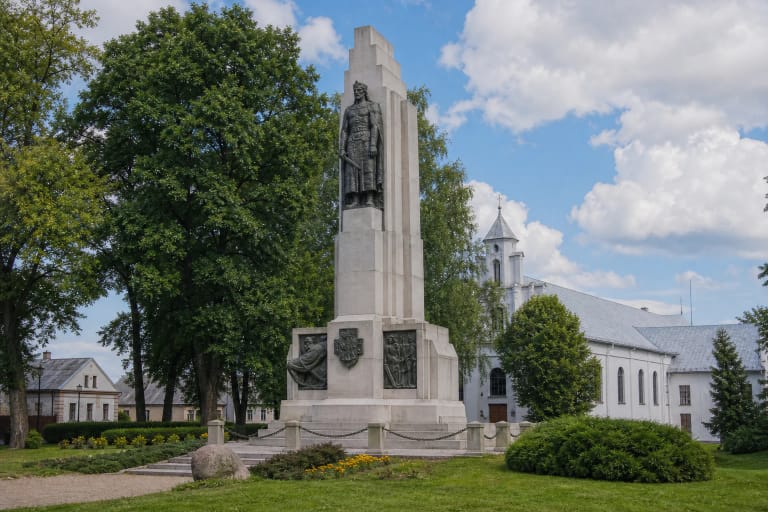
The Varėna District Municipality eldership page lists the site among local attractions as the stone marking Varėna's first written mention and the Varėna History Sculpture Park. Other nearby stops include the M. K. Čiurlionis birthplace memorial, Senoji Varėna church, and several monuments.
Visiting a space created through private initiative
The park is presented as an outdoor space open to everyone, with no separate admission fee or fixed opening hours published during this research. It was created through personal initiative, however, so check the latest map information before making a long journey and respect boundaries, signs, and any maintenance work on site.
Main routes use gravel tracks or mown grass, the ground is uneven in places, and the ditch can be wet. Not every composition is equally accessible to wheelchairs or visitors with limited mobility. Do not climb on boulders or the structures on the symbolic mound, and supervise children near water.