- Place
- Vilnius City Municipality
- Region
- Vilnius
- Type
- site of Merciful Jesus revelations and St Faustina memory
- Address
- V. Grybo g. 29A, Vilnius
- Coordinates
- 54.70510, 25.31760
Faustina's House, House of Saint Faustina, Šv. Faustinos namelis
A small house with major pilgrimage meaning
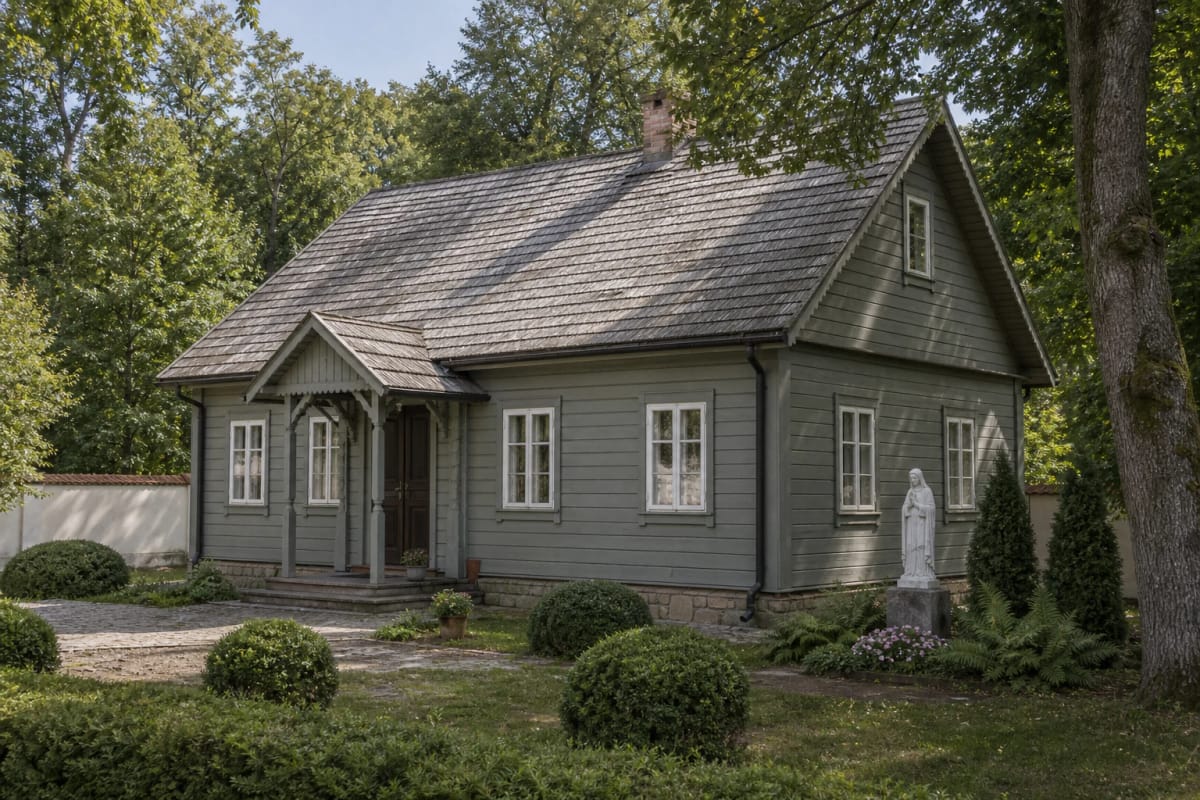
St Faustina's House in Antakalnis is not a large church or a representative museum. Its power is different: it is the only wooden building of the convent of the Sisters of Our Lady of Mercy to survive among Soviet-era apartment blocks, and it is where St Faustina, born Helena Kowalska (1905-1938), lived.
Because of this subject, the house matters not only to Lithuanian visitors. Vilnius has an international role in the Divine Mercy tradition, so pilgrims from around the world come here for whom the place is not merely a historical exhibit.
The convent and the house
The Sisters of Our Lady of Mercy moved to this site in the early twentieth century thanks to the generosity of Princess Maria Radziwiłł. In 1908 her envoy Anna Kulesza bought the houses of the former estate of Russian General Bykhovsky on today's V. Grybo Street, then Senatorių Street. The sisters established a home here for girls in their care; in the interwar period they had about 90 wards, called penitents, tended a large garden, baked bread, and cared for a military hospital.
Of the whole convent complex, only the wooden house where Sister Faustina lived has survived. It was restored in 2008, and a probable cell of Sister Faustina was reconstructed inside. Specific rooms should be discussed carefully: the most important thing here is the closeness and memory of the place, not an impressive facade.
St Faustina in Vilnius
St Faustina entered the Congregation of the Sisters of Our Lady of Mercy in 1925, took temporary vows in 1928, and perpetual vows in 1933. She lived in Vilnius in 1929 and in 1933-1936; in this very convent she worked in the kitchen and garden, served as the convent porter, and experienced personal revelations of Jesus. In 1934-1938, at the instruction of her spiritual director, Father Michał Sopoćko, she wrote down her mystical experiences in the Diary.
St Faustina was canonized in 2000, and her feast day is October 5. In 1934, according to Faustina's visions, the artist Eugeniusz Kazimirowski painted the Divine Mercy image in Vilnius. Devotion to Divine Mercy in the form she proclaimed was permitted for public practice in the Catholic Church in 1978.
Connection with the Divine Mercy image
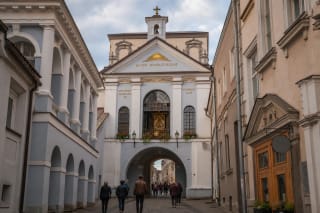
The Divine Mercy image and the tradition of St Faustina's visions are central to Vilnius' Divine Mercy story. The image was first publicly displayed in 1935 on the Second Sunday of Easter at the Gates of Dawn. Later it hung in St Michael's and Holy Spirit churches, and today it is kept in the Divine Mercy Shrine in the old town. The house is not the image itself, but it helps explain the environment in which this devotional history took a concrete Vilnius form.
For that reason, the best way to visit the house is to combine it with the Divine Mercy Shrine in the old town. One place gives biographical closeness; the other is the liturgical and iconographic centre.
How to visit St Faustina's House
Because this is a small pilgrimage place, visits should be planned around current admission arrangements and possible group visits. During research, no stable public opening hours or ticket prices could be confirmed from an authoritative source, so check the Divine Mercy Shrine information before going.
A visit usually takes 20-60 minutes. If you want time for prayer, a conversation, or a guided visit, arrange it in advance and do not leave it until the last minute.