- Place
- Vilnius City Municipality
- Region
- Vilnius
- Type
- mature Baroque palace, park, and contemporary art space
- Address
- L. Sapiegos g. 13, Vilnius
- Coordinates
- 54.69871, 25.31399
Sapieha Palace, Sapieha Palace in Antakalnis, Sapieha residence
A revived Baroque palace in Antakalnis
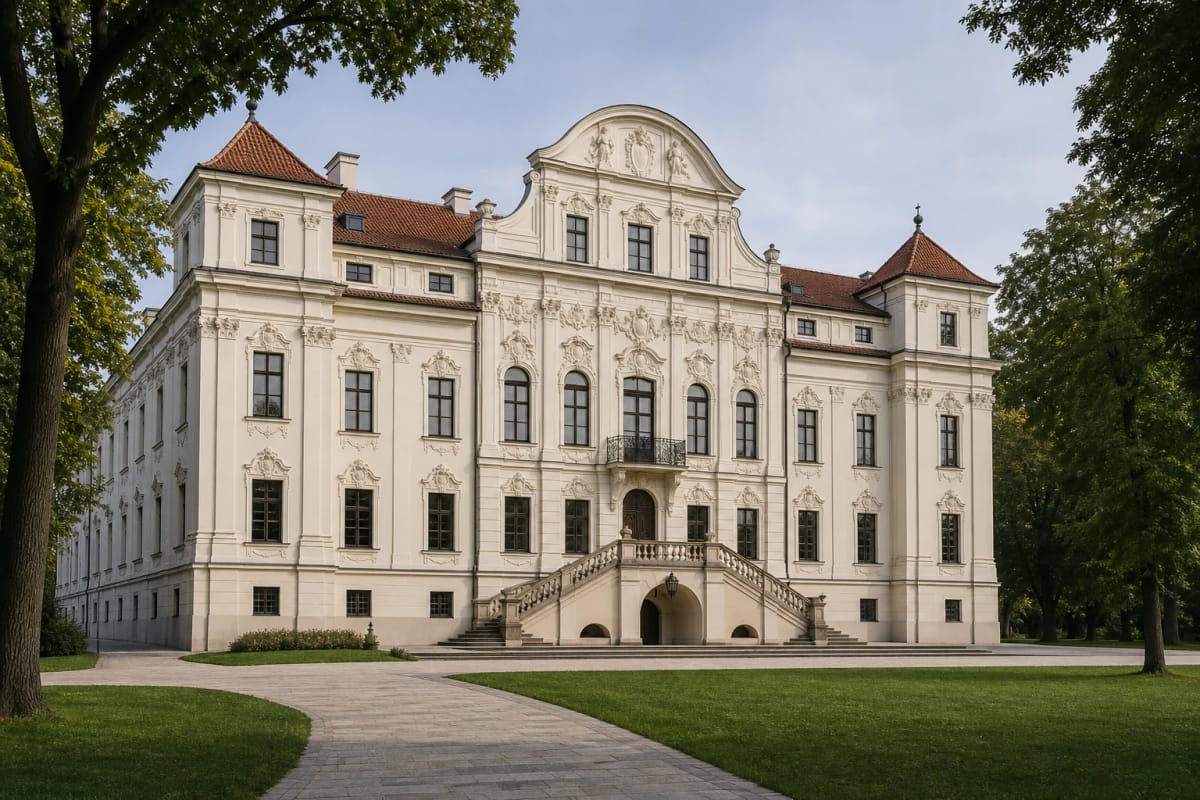
Sapieha Palace is one of those Vilnius places that asks for a slow first impression. Seen from Sapieha Park, the restored Baroque facade, tall windows, decorated openings, and stairs do not feel like a backdrop for an exhibition; they become the main character of the story.
The official palace history describes Sapieha Palace as a mature Baroque late-seventeenth-century suburban palace, part of a Vilnius residential and religious-building ensemble. It matters not only as a building but also because of its surviving relationship with the park, gates, courtyard, and the nearby Trinitarian monastery and church context.
What visitors see today
Today Sapieha Palace operates as a branch of the Contemporary Art Centre. The official palace page stresses that it is not a traditional museum collecting a permanent art collection. It hosts exhibitions, concerts, discussions, education sessions, and other events, while contemporary art is deliberately connected with the building's history.
The palace is therefore visited on two levels. One level is the exhibition and current programme, which changes. The other is the building itself: restored spaces, exposed historical architectural and decorative fragments, wall painting and stucco traces, and signs of how a representative residence was later reworked for hospital and military institutions.
Kazimieras Jonas Sapiega and the 1689-1692 residence
The most important stage in the palace history began when Kazimieras Jonas Sapiega, Grand Hetman of the Grand Duchy of Lithuania and Voivode of Vilnius, acquired the estate from the Jesuits. The official history page states that the palace was built in 1689-1692 by rebuilding an earlier masonry house on the site.
The residence was conceived on an almost royal scale. The ensemble is associated with architect Giovanni Battista Frediani, with sculptor Giovanni Pietro Perti, and with painter Michelangelo Palloni. These are the same names that help explain why Sapieha Palace is not only a local magnate's manor but part of a broader Baroque art network in the Grand Duchy of Lithuania.
Dating varies slightly by source: the official palace history gives 1689-1692, while VLE's Antakalnis article gives 1691-1697 for the Baroque palace built by K. P. J. Sapiega. VLE also notes that in 1693 Kazimieras Jonas Sapiega settled Trinitarian monks in Antakalnis and in 1694-1717 built for them the Trinitarian, or Redeemer, church and monastery.
The site before the Sapiehas
Sapieha Palace did not appear on empty ground. The official history states that the oldest manor buildings in the future palace territory are mentioned in documents as early as 1514. In the early seventeenth century the estate was owned by the architect and supervisor of Lower Castle construction works in Vilnius, Petras Nonhartas.
Architectural research revealed fragments of earlier masonry inside the present building. That detail matters: the 1689-1692 Sapieha residence not only transformed Antakalnis space but also incorporated remnants of older manor buildings. The palace is therefore a layered building, not a cleanly drawn Baroque project.
Park, Trinitarians, and representative ensemble
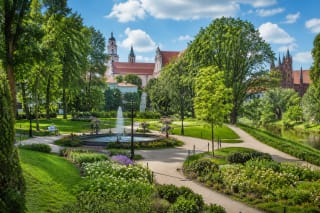
A French-style park was formed next to the palace, and the Trinitarian monastery and the Church of the Most Holy Redeemer Jesus, also called the Lord Jesus Church, were built nearby. The Sapieha Palace history page emphasizes that the palace and park are the only surviving Baroque-era magnate suburban palace and park ensemble in Lithuania that still preserves many essential elements.
This ensemble was more than a residence. It joined representation, devotion, political ambition, and the landscape at the city's edge. A present-day visitor feels this while walking through the park: the palace does not open directly from the street like an urban facade, but is reached through greenery that was part of the whole composition.
Civil-war shadow and the break in Sapieha power
Almost as soon as it was built, the palace entered a field of political tension. The official history mentions Kazimieras Jonas Sapiega's conflict with Bishop Konstanty Kazimierz Brzostowski of Vilnius and growing disagreements between the Sapiehas and their opponents. The defeat at Valkininkai in 1700 undermined Sapieha influence.
For that reason Sapieha Palace is not only a story of luxury. It is also a reminder that noble politics in the Grand Duchy of Lithuania around the turn of the seventeenth and eighteenth centuries was fragile, and representative architecture could quickly become a sign of internal conflict and lost power.
Hospital, clinic, military schools
After the Sapiehas, the palace changed functions for a long time. The official history states that in the nineteenth century it housed a hospital, in the interwar period an ophthalmology clinic, and in the Soviet period it became part of a military complex and was used by military schools. VLE specifies that in 1809 the palace was acquired by a Russian military hospital, and that after a new military hospital was built in 1844-1848, Sapieha Palace was reconstructed.
The largest architectural changes are tied to the 1843-1848 reconstruction, when the palace was adapted for hospital needs. The official history notes that corner towers were demolished, interiors replanned, interior decoration destroyed, and the palace volume changed. This explains why restoration had to deal not only with finishes but also with the building's logic.
The restoration decision
The Sapieha Palace restoration page clearly states the direction chosen: based on the principles of the Venice Charter and other heritage-protection documents, the decision was made to return the palace to the appearance of the 1692 project. This was not a cosmetic repair but the result of decades of research, stages, and choices.
Works carried out in 2011-2014 restored the authentic building volume, masonry, and roof. The 2014-2023 activation project, curated by the Contemporary Art Centre from 2017, adapted the building for public use. In the stage completed in 2023 the facades were restored and the interior adapted for exhibitions and cultural activities. In spring 2024 the palace opened to the public.
How to plan a visit
Sapieha Palace is at L. Sapiegos g. 13 in Antakalnis. The official visitor page states that the entrance is from the park side, up the stairs. By public transport, the most convenient stop is Leono Sapiegos; from the old town you can also walk or cycle along the Neris and through Antakalnio Street.
Before going, check the current exhibition and events programme. The palace's value does not depend only on a specific exhibition, but the programme determines how much time you will need inside. If you want a calmer experience, the official information identifies Monday 17:00-20:00 as quieter palace time without noisy events and sharp stimuli.