- Place
- Vilnius City Municipality
- Region
- Vilnius
- Type
- Vilnius Baroque church and former Lateran Canons monastery ensemble
- Address
- Antakalnio g. 1, Vilnius
- Coordinates
- 54.69400, 25.30600
Antakalnis Church of St Peter and St Paul, St Peter and St Paul Church in Antakalnis
The Baroque culmination of Antakalnis
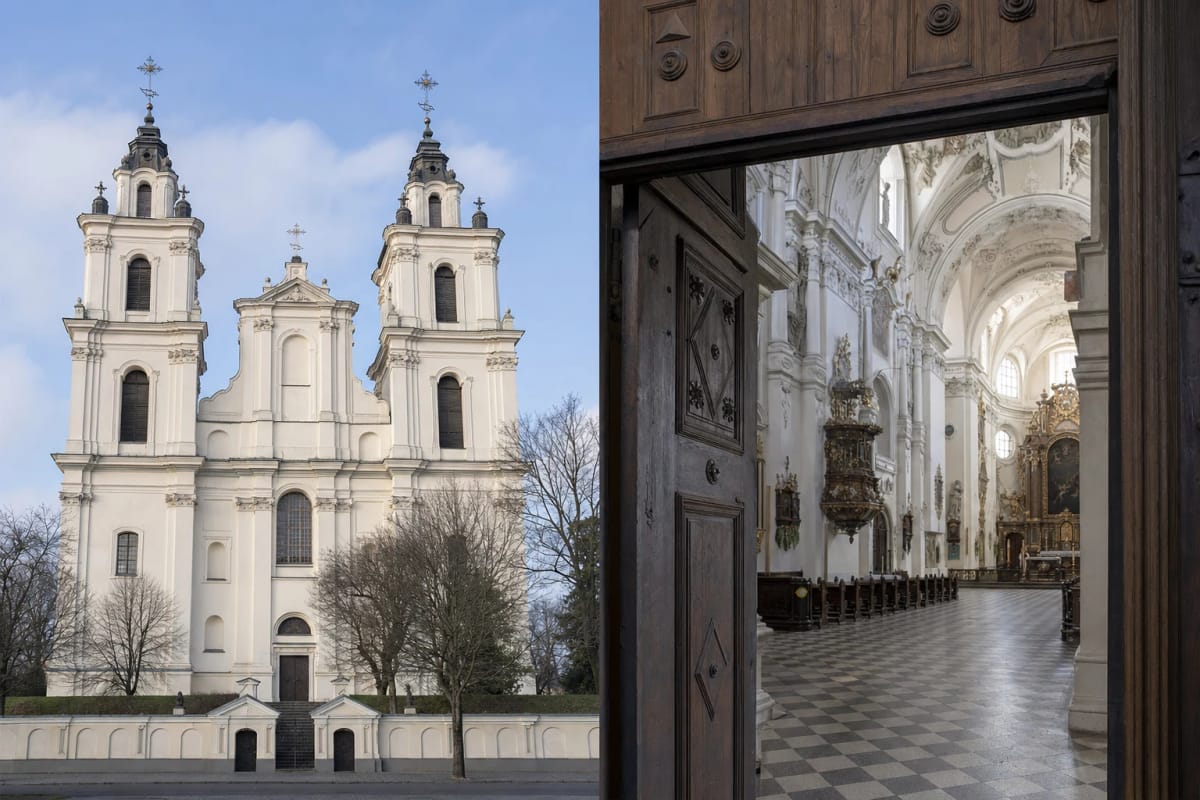
The Church of St Peter and St Paul stands in Antakalnis, slightly away from the main tourist flow of Vilnius Old Town. That distance often makes the contrast more surprising: outside, a calm twin-towered Baroque facade; inside, an exceptionally dense world of white stucco.
The Cultural Heritage Register connects the site with the former monastery ensemble of the Canons Regular of the Lateran. This matters for visitors: the church was not an isolated building but part of a monastic environment and the aristocratic-residence landscape of Antakalnis.
Pacas foundation and the seventeenth century
The construction of the present church is usually linked with the foundation begun in 1668 by Mykolas Kazimieras Pacas, Grand Hetman of the Grand Duchy of Lithuania. The commission turned Antakalnis into a representative place where political memory and religious meaning met.
The church was consecrated in 1701. Its architecture is associated with Jonas Zaoras and Giovanni Battista Frediani, while the stucco decoration of the interior is linked with Italian masters Giovanni Pietro Perti and Giovanni Maria Galli. These names explain why the Antakalnis church belongs to a broader European Baroque context, not only to Vilnius city history.
The white stucco interior
The main reason to enter is not one separate altar but the whole interior. Walls, vaults, chapels, and niches are filled with stucco figures, ornaments, angels, soldiers, allegories, and scenes of saints. Because of the light colour, the interior does not feel heavy; it reads almost graphically through light and shadow.
Move slowly from the entrance into the nave and look upward. The imagery includes early Christianity, martyrdom, virtues, death, and salvation. It is not simple decoration but a Baroque visual text meant to teach, persuade, and move emotions.
The Soviet-period episode of St Casimir's relics
The church also has a twentieth-century layer of Vilnius sacred history. During the Soviet period, when Vilnius Cathedral was taken from believers, the relics of St Casimir were moved to the Church of St Peter and St Paul. In 1989, after the cathedral's sacred function was restored, the relics returned to St Casimir's Chapel.
For that reason, the Antakalnis church is not only an ornate Baroque monument. For a time it served as an important support of Catholic memory in Vilnius when the city's main shrine was closed to the believing community.
How to visit
This is an active parish church, so visitors should follow the rhythm of services and the local community. Sightseeing is best planned outside Mass, with quiet behaviour, unobtrusive photography, and no movement through prayer spaces during rites.
The Vilnius Archdiocese page provides parish contacts and service information, but access can change. At the time of research, no stable museum ticket was found; this is usually a church visit without a separate ticket, but groups should check parish information before going.