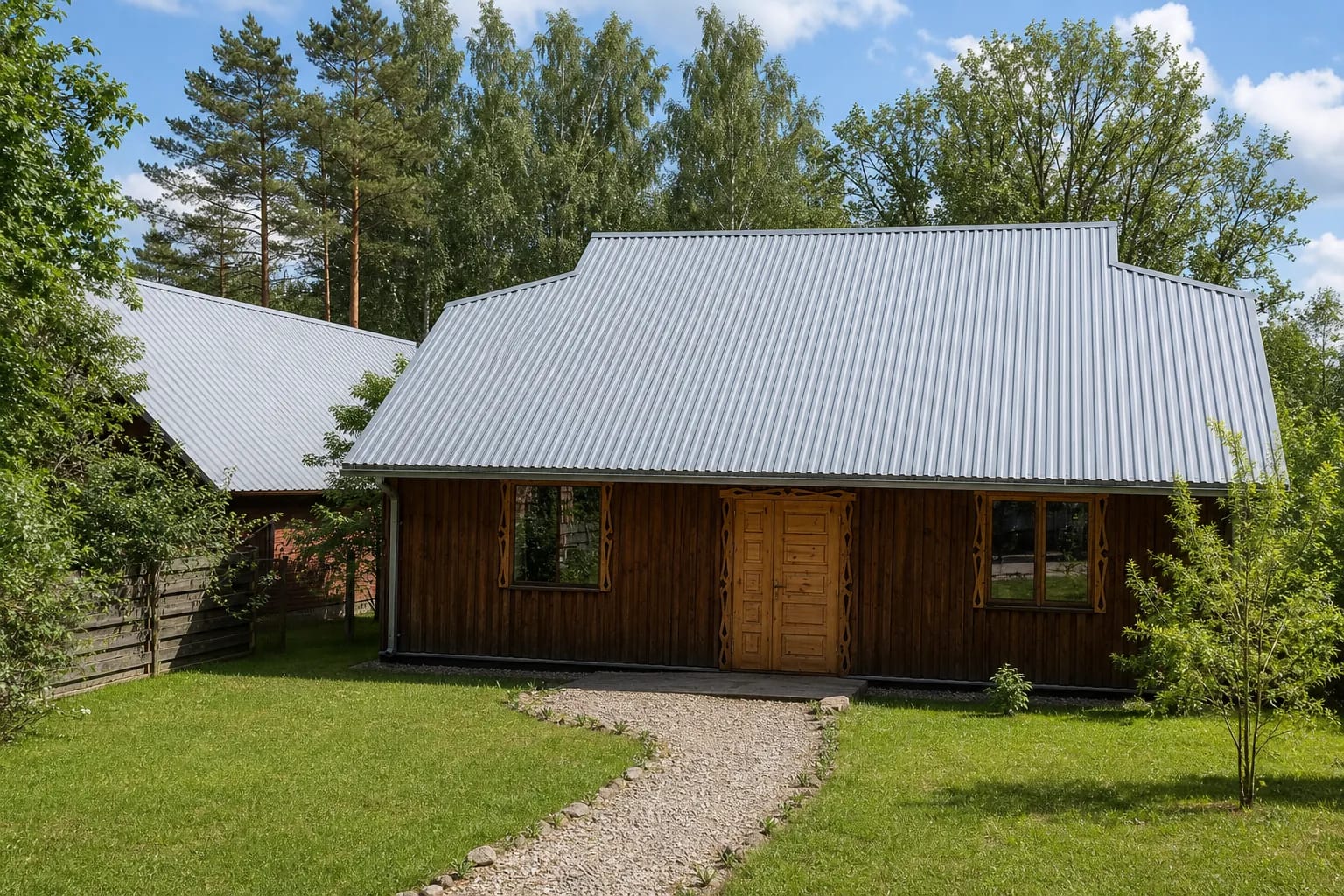
- Place
- Lekėčiai, Šakiai District Municipality
- Region
- Suvalkija
- Type
- a private ethnographic and living-craft museum founded by Gintas Čekauskas and operated through the same-name association
- Address
- 14 Pušyno Street, LT-71225 Lekėčiai
- Coordinates
- 54.98501, 23.50483
- Visit duration
- 30-60 minutes for a tour, or about one hour for a selected workshop
- Best time
- only at a time confirmed in advance by telephone or email; the tourism page mentions weekday evenings and weekend mornings but also a narrow lunchtime exception
Čekauskai Ethnographic Museum, Čekauskų etnografijos muziejus, Gintas Čekauskas Museum
This is a private Lekėčiai museum, not a Kazlų Rūda or municipal branch
The official address is 14 Pušyno Street in Lekėčiai, Šakiai District Municipality. The museum was founded and is led by traditional craftsman Gintas Čekauskas. Šakiai Tourism and Business Centre explicitly calls it a private museum, so it should not be confused with the municipally managed Zanavykai Museum or with an ethnographic open-air farmstead.
The legal entity and visitor attraction share the same name and address. Association Čekauskų etnografijos muziejus was registered on 9 January 2015; a 2026 Centre of Registers bulletin records submission of its 2025 annual report and no registered liquidation or other special legal status. The official heritage inventory names Gintas Čekauskas as founder and identifies the association as submitting body and custodian of the shingle-roofing tradition.
An automatically generated online directory wrongly relocates the museum to Kazlų Rūda Municipality and describes a nonexistent complex of historic farm buildings. This page does not use those claims. The point at 54.985011, 23.504831 comes from the official Šakiai tourism entry and marks the museum site at 14 Pušyno Street, not a separately surveyed visitor doorway.
Inherited planes grew into a museum with its own purpose-built space
The collection began in 2005 when Gintas Čekauskas inherited several planes of different forms and purposes, together with household objects, from his grandparents. Rooms for a future museum began to take shape that year in the unused loft of an outbuilding. Tools donated by friends from their parents and grandparents gradually extended a family inheritance into a repository of community memory.
The private museum received its first visitors in 2010. Its official gallery chronology subsequently records projects with Kauno kolegija, expansion of education, and travelling craft demonstrations. The place is therefore better understood as a centre for a craftsperson's collecting, practice, and teaching than as a static store of old objects.
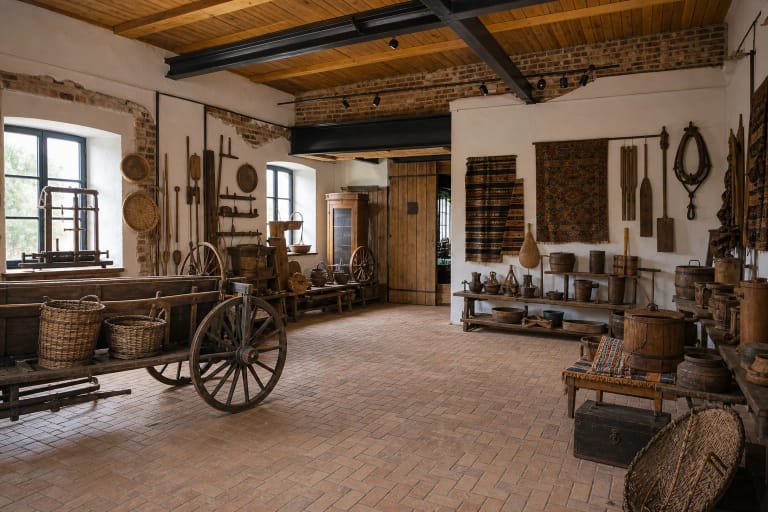
Construction of a new 80-square-metre museum building began in 2015, and it opened on 14 May 2016. It accommodates exhibitions, community events, activities, and a conference area; some objects moved from earlier stores while others were newly acquired. The official chronology also records completion of the upper-floor space in 2020, so not every museum area dates from the same phase or serves the same purpose.
More than 600 carpenter's planes reveal many different operations
The museum's signature holding is a collection of more than 600 wooden and metal carpenter's planes. Their sizes, bodies, iron profiles, and jobs differ: some levelled a surface, while others cut grooves, edges, or decorative mouldings. The oldest plane singled out by the official museum dates from 1838 and came to the collection from Panevėžys.
The planes sit alongside tools for sawing, measuring, marking, drilling, hewing, and turning. That context turns an unfamiliar wooden form into one stage of a complete sequence, from marking a workpiece to joining it and finishing its surface. A guided visit becomes particularly valuable when the craftsperson explains the trace that a specific cutting iron left in wood.
An older Lekėčiai tourism page still mentions more than 400 planes, whereas the present official museum and Šakiai tourism descriptions give more than 600. This most plausibly reflects an expanding collection counted at different dates, rather than two museums with similar names; this page follows the newer figure.
Flax, bread, ironing, and a Zanavykai farmhouse room broaden the story
Woodworking dominates, but this is not only a plane museum. The holdings include flax-processing equipment from brakes to a hand loom, the making of bread from sickle to kneading trough, ironing implements, mangling rollers, steelyards, scales, and both imperial Russian and Soviet weights. Together they reconnect specialised craft with everyday household and farm routines.
One display recreates part of the room of a prosperous Zanavykai farmer with late-nineteenth- and early-twentieth-century furniture. Nearby are a post-war wind-up gramophone, working reel-to-reel recorders from 1953 and 1986, and a small library. The museum says the latter contains collected works by 49 Lithuanian and nine Russian writers published before 1965.
The museum describes itself as peaceful and deliberately avoids collecting militaria. The narrow exceptions are several of Čekauskas's grandfather's awards with certificates and photographs of relatives in military service. This defines the collection's boundaries: the emphasis is labour, domestic family memory, and transmission of craft, not a general exhibition about twentieth-century wars.
Wooden shingle roofing is a living skill here, not merely a display
Gintas Čekauskas has practised wooden shingle roofing since 2005. The museum says shingles cut on a hand machine acquired in 2015 received Category A national-heritage-product certification, and that he was certified as a master of the traditional roofing craft in 2016. His 2024 book Medinė stogdengystė develops the subject in Lithuanian, English, and Polish.
The wooden shingle-roofing tradition entered Lithuania's national Intangible Cultural Heritage Inventory in 2022 under certificate NKPVS-51. Association Čekauskų etnografijos muziejus is identified as its submitting body and custodian. This is a Lithuanian national inventory entry, not a UNESCO World Heritage property or an entry on UNESCO's Representative List of Intangible Cultural Heritage.
The Senoji stogdengystė workshop explains the development of shingle making and roof laying before participants cut a first shingle themselves. The other advertised one-hour activities, Kalu kalu inkilėlį and Mano pirmoji lesyklėlė, turn wood and shingles into a nest box or bird feeder to take away. The Šakiai tourism page gives a minimum age of eight and a group maximum of 15 for the latter two.
Visit times, prices, and accessibility require direct confirmation
The museum website does not publish regular daily opening hours. The Lithuanian Šakiai tourism page says visitors are received after 17:00 on weekdays and after 09:00 on weekends, yet another sentence on the same page mentions weekend visits after 09:00 and a weekday 12:00-12:40 window by prior arrangement. The centre's English entry gives the simpler and safer rule: visits on weekdays and weekends are by advance arrangement.
On 19 July 2026, the Lithuanian tourism entry still displayed one-hour workshop prices of EUR 2.50 per person for Senoji stogdengystė, EUR 5 for making a nest box, and EUR 4 for making a feeder. It gives no effective date for the tariff and no separate price for a straightforward museum tour. Treat these as published reference amounts rather than guaranteed current charges.
The tourism page labels the attraction fully adapted for disabled visitors, while the museum website associates adaptation with the new building opened in 2016. Neither source maps the specific door, gradients, toilet, parking space, or access to loft and upper-floor areas. When booking, state the group size, selected activity, and access needs, and confirm which displays will be reachable.