- Place
- Šakiai District Municipality, beside the Kazlų Rūda municipal boundary
- Region
- Suvalkija
- Type
- birdwatching tower at the edge of Novaraistis Ornithological Reserve
- Address
- Novaraistis, Lekėčiai Eldership, Šakiai District, beside the Kazlų Rūda municipal boundary
- Coordinates
- 54.94285, 23.41648
- Visit duration
- 45 minutes-2 hours; during crane migration, allow time to stay until evening
- Best time
- September to mid-October for cranes, spring for nesting waterbirds, and a dry daylight visit for safer climbing
Novaraistis Ornithological Reserve Birdwatching Tower, Novaraisčio paukščių stebėjimo bokštelis
A separate visitor point at the edge of Novaraistis Reserve
Novaraistis Birdwatching Tower stands at the eastern edge of the large wetland, beside a visitor parking area. The protected area reaches across the junction of Kaunas and Šakiai Districts and Kazlų Rūda Municipality, so navigation should use the specific tower point rather than the general Novaraistis name.
The lookout is not another name for the reserve and not a second tower on the far side of the bog. It is one precise place from which visitors can survey open water, reedbeds, and the more distant Kazlų Rūda forest horizon.
The visitor point is at 54.94285, 23.41648. These coordinates mark the tower approach, not the centre of the 826.8-hectare protected area or every possible access track.
A green metal structure rises above reeds and water
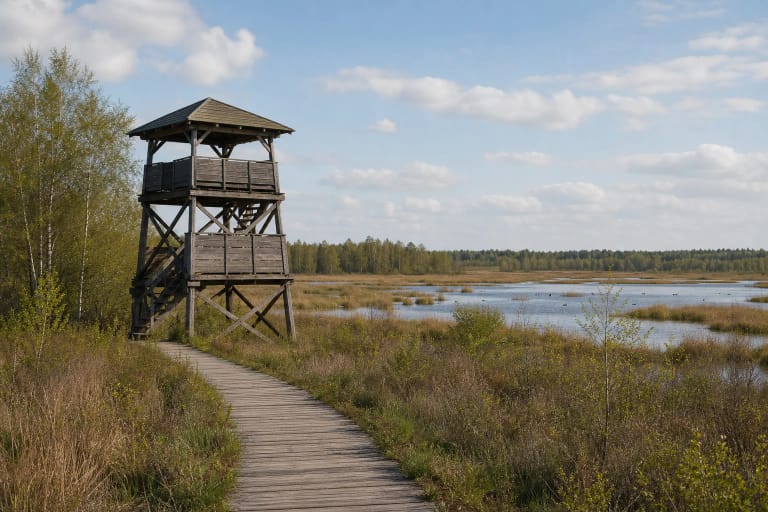
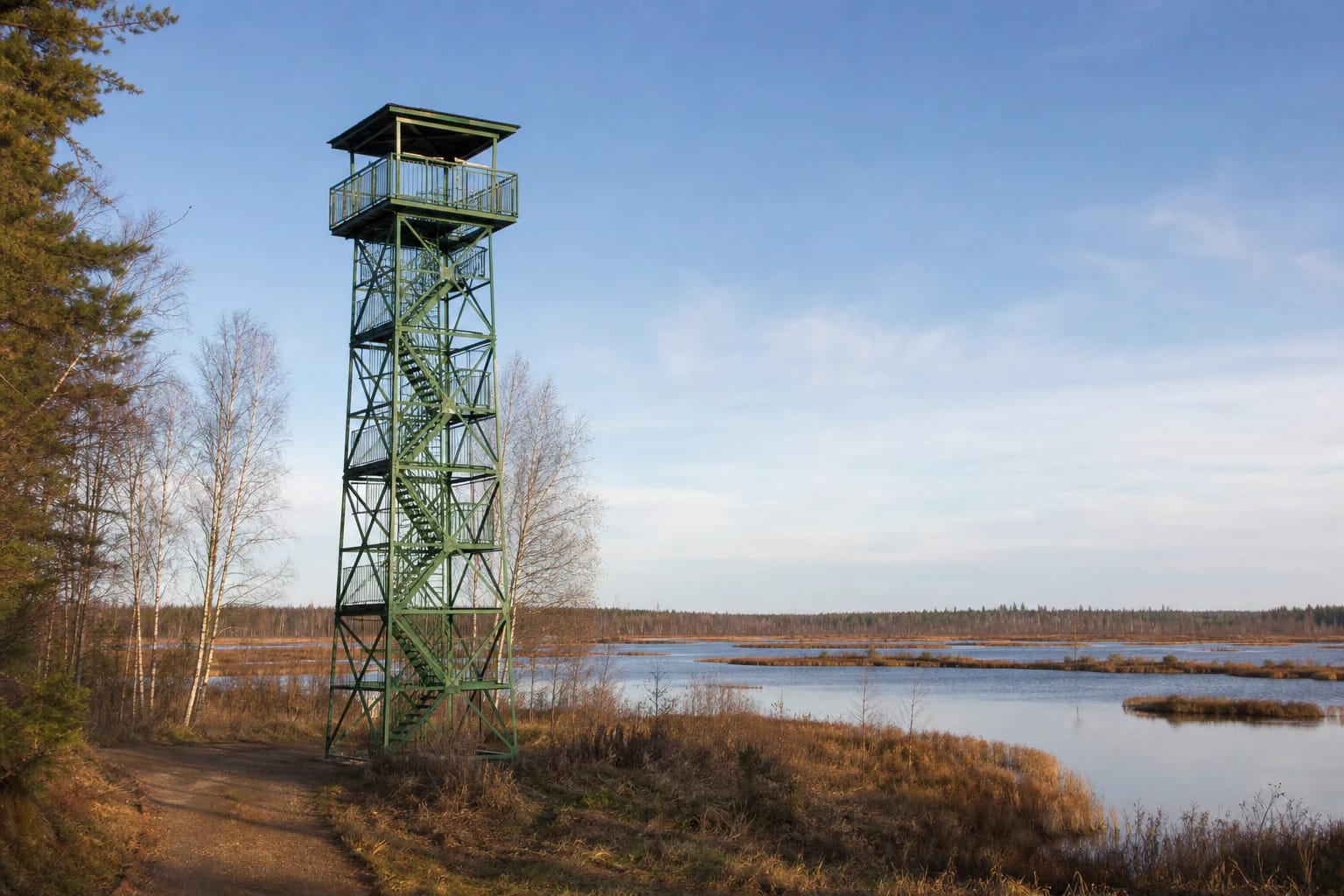
The tower is recognisable by its green metal frame, open zig-zag staircases, and a small roofed platform at the top. Real photographs show that it is not a timber woodland tower: the stairs and rails form a light, open silhouette on the wetland edge.
From above, the view opens across low reedbeds, open water, and small vegetated islands. In autumn, golden grasses and bare birches make the water mosaic legible, while the darker forest line gives the horizon scale. Bring binoculars because much of the wildlife remains well away from the tower.
The climb is short, but the structure is open to wind and has no enclosed stairwell. Use the steps calmly, do not crowd the platform, and keep children close. The approach and metal surfaces can be slippery after rain.
Former peat workings became a wetland bird habitat
Novaraistis developed from a raised bog where a lake had gradually filled in. Peat extraction began in the early 1960s and ended in 1979. After the Nova stream flowing out of the bog was dammed, open water bodies formed across the former peatland.
The state Novaraistis Ornithological Reserve was established in 1988. Its Saugoma.lt object page gives 826 hectares, the official zoological-reserve list gives 826.8 hectares, and VLE rounds the figure to 827 hectares. All describe the same protected bog with open water, reedbeds, and small islands.
The protected-areas directorate periodically manages reeds and other vegetation because expanding shrubs and trees reduce the value of open areas for birds. The view can therefore change from year to year: management alters visibility, but it does not mean that the site has lost its purpose.
Autumn cranes are the most dramatic, but not the only spectacle
From September to mid-October, migrating common cranes gather at Novaraistis for the night. VLE mentions around 2,000 cranes at one time, but this is an estimate of a natural event whose scale depends on weather, water, and the particular day of migration. The most dramatic moment is often evening, when flocks fly from surrounding fields into the bog.
Spring and early summer are more rewarding for nesting waterbirds. VLE records 33 bird species included on European Union lists of protected animals; birds it mentions include black-necked grebes, whooper swans, black grouse, greylag geese, great bitterns, and spotted crakes. You will not see every species from the tower, so a visit rewards patient listening as much as quick sightings.
Watch quietly and keep away from the water bodies and reedbeds. Do not feed the birds or play loud music. The tower is for observing a protected landscape, not for approaching nests or roosting birds.
The approach is straightforward, but the final road is not urban infrastructure
Drive from the Kaunas-Šakiai road and turn towards Novaraistis near Lekėčiai. A parking area is provided at the visitor point, but the final section may be gravel or dirt. After prolonged rain, allow extra time and assess whether your vehicle is suitable for the surface.
The official sources checked publish no separate admission, ticket office, or fixed tower opening hours. Daylight visits are still safer. Before travelling, check current protected-area notices and do not plan solely from an old photograph: access, signs, and the condition of the structure can change temporarily.
The tower is not confirmed as step-free: reaching the top requires stairs, and the area between parking and the structure may be natural ground. Do not park on the bog edge, enter reedbeds, leave litter, or ignore local signs and protected-area requirements.