- Field
- Craft of shingle, shake, and wooden roof covering in traditional construction
- Type
- traditional craft
- Heritage status
- living tradition
- Context
- wooden shingles, shakes, gontai, wooden roof covering, traditional roofing, drabnyčia, battens, ridge, eaves, ventilation, maintenance
Malksna roofing, Shake roofing, Gontai roofing, Traditional wooden roofing
Wooden Shingle Roofing forms and objects
Malksna: A wooden roof board laid in rows with overlap, often thicker or longer than a shake, though local names may overlap.
Shake: A thinner split or sawn wooden strip used for roof covering.
Gontas: A wooden roofing element often associated with thicker or grooved pieces, close to malksnos and shakes but not always identical.
Drabnyčia: A machine or device for making shakes or malksnos by cutting or shaving wood into roof-ready strips.
Battens: Horizontal roof members to which wooden strips are fixed; their spacing determines overlap and roof performance.
What is wooden shingle roofing?
Wooden shingle roofing is the traditional craft of laying a wooden roof covering. The roof is covered not with sheet metal or tiles, but with many overlapping wooden pieces: malksnos, shakes, or gontai.
Each piece has to work with water: receive rain, direct it downward, dry out, and keep moisture from entering the structure. The main question is therefore not only attractive wood texture, but overlap, roof pitch, batten spacing, ridge solution, and air movement under the covering.
Lithuania's Intangible Cultural Heritage Inventory describes this field as the tradition of shake roofing. Malksnos and shakes are often mentioned together today, but the exact name depends on the size of the piece, method of making, and local language.
Malksna, shake, and gontas
The terms are not random. VLE defines malksna as a wooden roof board and shakes as thinner split or sawn boards for roofing. Gontai are often associated with a thicker or grooved wooden covering, but in practice regional names can overlap. VLE adds that a malksna is smooth, single-layered, thicker, and usually longer than a shake, cut along the grain and laid with overlap; this wooden covering was used in Lithuania until the mid-twentieth century.
It is therefore worth using a broader vocabulary of wooden roof coverings without making everything identical. A malksna, shake, and gontas roof may look similar, but the pieces differ by shape, thickness, overlap, fastening, and durability.
Such precision matters both for search and heritage. A person looking for malksnos often wants to understand shakes, and a person looking for a shake roof needs an explanation of how it differs from gontai.
Wood and production
Traditional malksnos and shakes used light, straight-grained wood that split and dried well. In Lithuania aspen, spruce, pine, and other local woods are often mentioned, depending on region and the maker's habits.
In earlier times the pieces were split or shaved by hand, later made with special devices. In the Inventory description the drabnyčia, a shake-making machine, is important because its preservation and use helped revive the tradition.
A good piece has to follow the wood grain. If it is roughly sawn, badly dried, or inclined to split around knots, the roof will let water through and deform more quickly.
How is a wooden roof laid?
Malksnos or shakes are laid in rows from bottom to top. Each higher row covers the one below, so rainwater runs over the overlaps and does not reach the construction.
The pieces are fixed to battens. Batten spacing, fastening point, and row overlap depend on the piece length, thickness, roof pitch, and local weather conditions.
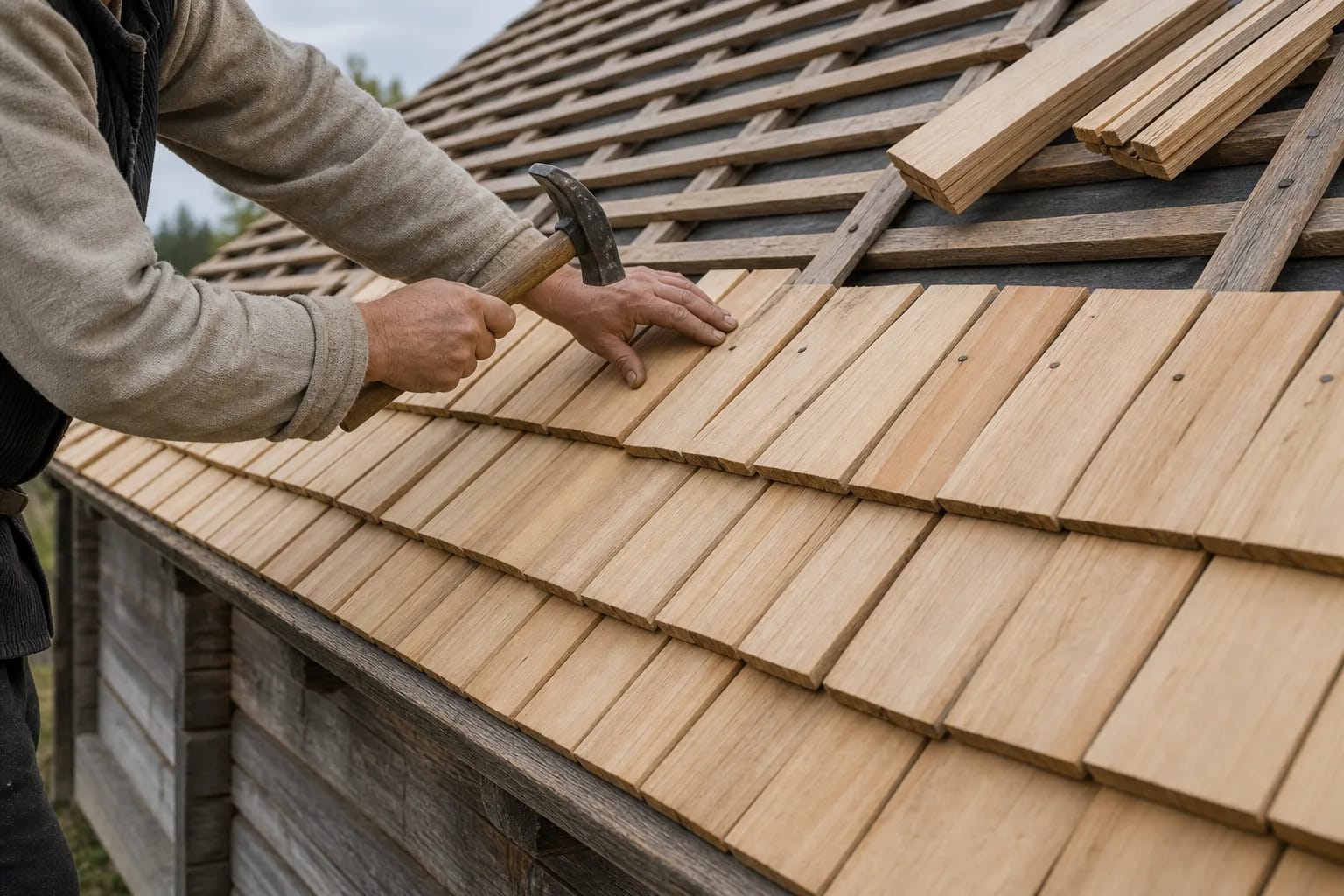
The craftsperson has to see the whole plane at once: rows must not wave, overlaps must repeat evenly, and edges, eaves, and roof corners must be solved so water cannot collect anywhere.
Ridge, eaves, and ventilation
The weakest places in a wooden roof are often not the broad plane but the ridge, eaves, roof breaks, joints, and places near chimneys. Water, snow, and wind try to find a way inside there.
The ridge has to cover the tops of both slopes while allowing the construction to dry. The eaves must lead water away from the wall. If there is no air movement under the covering, the wood stays damp longer and decays faster.
A traditional covering is therefore not only a historical surface. It has to be coordinated with the whole roof structure, chimney, drainage, and use of the building.
Roofer and tools
A roofer, in some places called a stiegėjas, had to know both how to make the covering and how to lay it. VLE connects roofers with many roof-covering materials, but a wooden roof requires special knowledge of wood, overlaps, and fastening.
The tool set depended on period: axes, knives, chisels, hammers, wooden mallets, drabnyčios, saws, and later mechanized means of making shakes. The tool was meant not to hurry at any cost, but to preserve the proper form of the piece.
The value of this craft is precision. A poorly laid wooden roof may at first look like a good one, but mistakes appear in rain, frost, and after several seasons.
Lekėčiai and the Čekauskai museum
The Inventory description connects the tradition of shake roofing with Lekėčiai and the Čekauskai family environment. Preserved equipment, knowledge, and examples there helped show that a shake roof is not only a remnant of old buildings.
The Čekauskai Ethnographic Museum is important as a place where wooden construction, tools, and village-life heritage can be seen together. Roof covering there is understood not as a separate product but as part of the house, homestead, and work culture.
Such places move the tradition from theory into learning: a person sees wood, tool, strip, rows, and building in one system.
Maintenance and mistakes
A wooden roof is not a maintenance-free covering. It has to be watched: whether strips have lifted, leaves and moss are collecting, the ridge is tight, water is running by the walls, and the chimney is in order.
A common mistake is to use a wooden covering as decoration while ignoring pitch, ventilation, fire safety, and moisture. In that case heritage appearance does not help; the roof simply will not last long.
A properly installed malksna or shake roof can be durable, but its longevity depends not only on wood. The decisive factors are the craftsperson's work and care of the building.
How is it different from a straw or reed roof?
A malksna, shake, or gontas roof is a wooden covering. A straw or reed roof is a plant thatch or reed covering laid by a completely different logic.
The material, thickness, fastening, ridge solutions, fire risk, maintenance, and regional architectural expression differ. These topics should therefore be kept separate.
Wooden-strip roofing and straw or reed roofing should be read as separate branches of roofing craft.