- Place
- Pasvalys District Municipality
- Region
- Aukštaitija
- Type
- nationally significant KVR-registered Baltic Way event site with a Freedom Altar and evolving ensemble of crosses
- Address
- Maliupiai village, Pasvalys rural eldership, beside the A10 Via Baltica
- Coordinates
- 56.06883, 24.43227
- Visit duration
- 20-40 minutes for the altar, crosses, and surviving inscriptions; longer during a commemorative event
- Best time
- in daylight and dry weather; Baltic Way commemorations may occupy the grounds on 23 August
Pasvalys Valley of Crosses, Valley of Crosses, Baltic Way sign site
One exact site near Pasvalys, not the whole Baltic Way
The Baltic Way Valley of Crosses lies on the eastern edge of Pasvalys beside the A10 Panevėžys-Pasvalys-Riga road, also known as the Via Baltica and the Baltic Way. The coordinate 56.068830, 24.432270 marks the ensemble of crosses and the altar in the territory of Maliupiai village. It does not mark a confirmed vehicle entrance, car park, or safe place to stop on the main-road shoulder.
The Cultural Heritage Register names it the Baltic Way sign site and assigns unique code 2064. The record gives it registered status, a national level of significance, and historical valuable properties. It identifies this particular demonstration point as 158 km from Vilnius, rather than using the name for every roadside memorial on the Lithuanian route.
Administrative labels vary between sources. A newer municipal plan and the military-heritage guide place it in Maliupiai, an older territorial study uses Papyvesiai, and a 2022 municipal survey associates the valley with Diliauskai. The KVR code, coordinate, and site name therefore identify the memorial more reliably than a village name alone.
The altar and first crosses appeared in August 1989
According to KVR, Pasvalys members of Sąjūdis used fieldstones to build the central monument, now called the Freedom Altar or Baltic Way Altar, on the eve of the demonstration. Heritage historian Gražvydas Balčiūnaitis told LRT that people affected by Soviet occupation and repression had been asked to contribute a stone and that some brought many rather than one.
On 23 August 1989, Baltic Way participants from Pasvalys, Akmenė, Pakruojis, Mosėdis, Joniškėlis, and Kretinga raised crosses beside the altar. The founding act was collective: the valley cannot be credited to one architect or cross-carver, even though the authors of some later crosses are known.
KVR also records that a Biržai participants' cross was moved here from Saločiai in 2009. That relocation and the later dedications show that the ensemble did not freeze after one day, while its historical core remains the 1989 event place, fieldstone altar, and signs left by the first participating groups.
The number of crosses depends on the inventory date
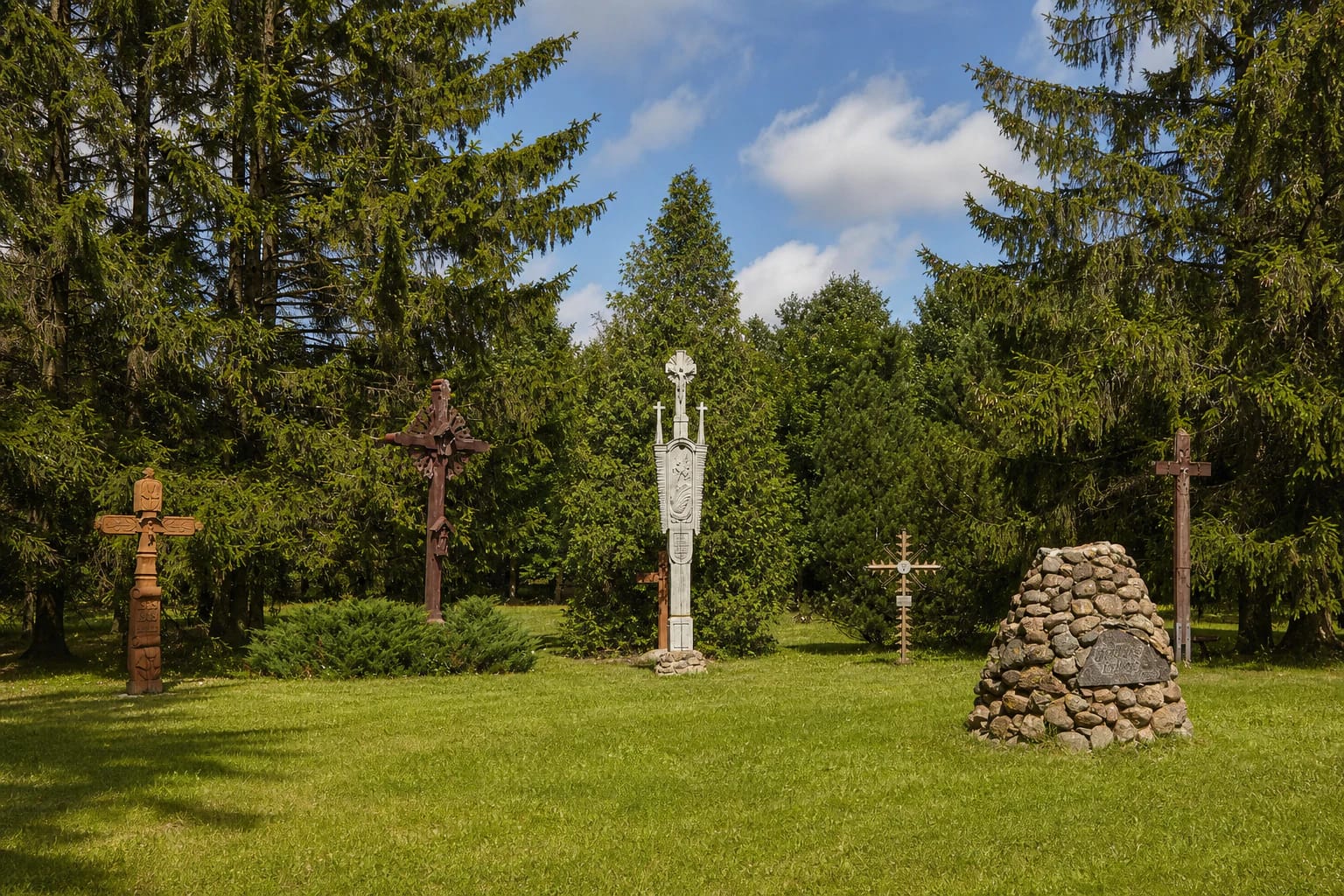
This is not a dense field of crosses. Individual memorials of different heights and designs, including a chapel-post form, stand across a broad maintained lawn among mature trees, with a low fieldstone altar near the centre. An older Pasvalys district study described 9 crosses and 1 chapel-post around the altar, while a 2024 military-heritage guide counted 14 crosses. Fourteen is therefore a dated 2024 inventory, not a promise that the total will never change.
Not every surviving cross was raised during the Baltic Way or dedicated solely to that event. Lithuania's cross-crafting catalogue identifies Arūnas Grušas as the maker of the 1996 cross for Stasys Lozoraitis and of gratitude crosses erected in 1993 and 1996 for Norwegian and Swedish support to people in Pasvalys. LRT also mentions a cross commemorating an anniversary of 11 March, the date of Lithuania's restored independence.
Several hundred oaks were planted beside the valley after the Baltic Way. Together with mature conifers and other greenery, they now give the site the character of a quiet memorial park. Interpret individual dedications from surviving plaques and documented catalogues rather than guessing from ornament or wood colour alone.
Creation and present-day groundskeeping are different roles
The memorial began with Pasvalys Sąjūdis members and Baltic Way participants from six places and districts. Arūnas Grušas is the documented author of several later crosses, not the designer of the whole ensemble. Pasvalys cross-carver Vytautas Jackūnas discussed the importance of crosses during the national revival in an LRT report, but the sources checked do not identify him as creator of the valley or of a particular cross here.
The Pasvalys rural eldership's 2022 activity report lists the Maliupiai green areas, including the Valley of Crosses and Atgimimas Park, among non-privatised recreation land maintained by the eldership. It also records the collection of ownerless waste at the valley. This establishes routine public-space and greenery upkeep; it does not say that the eldership owns or conserves every cross.
KVR treats the historical event place and its terrain as valuable properties. Straightening a cross, moving altar stones, cleaning plaques, or adding a new marker without authorisation is not visitor maintenance. Report damage to Pasvalys District Municipality or the Department of Cultural Heritage and leave physical intervention to the responsible bodies.
One memorial within a wider 600-650 km story
The Baltic Way took place on 23 August 1989, the fiftieth anniversary of the Molotov-Ribbentrop Pact and its secret protocols. Lithuania's Sąjūdis and the Latvian and Estonian popular fronts joined Vilnius, Riga, and Tallinn in a living chain roughly 600-650 km long. Official sources round the distance differently, while the participation figure is commonly given as about two million people.
The Pasvalys valley is one physical point in that chain and one of many signs that later remained along the Lithuanian road. It reveals the initiative of specific communities and the material language of their crosses, but it cannot by itself represent the Latvian and Estonian sections or every participant's experience.
In 2009 UNESCO inscribed documentary heritage recording the Baltic Way in its international Memory of the World Register. The Valley of Crosses is not a separate UNESCO World Heritage property: its Lithuanian immovable-heritage identifier is KVR code 2064. That distinction matters in descriptions, map labels, and image captions.
A respectful visit begins with a safe stop off the A10
This is an outdoor memorial, but no dependable official list of permanent opening hours, tickets, toilets, drinking water, lighting, or dedicated parking could be found. The map point marks the ensemble, not a place to leave a car. Follow road signs, use only a lawful access point, and never stop in an A10 traffic lane or on an unsafe shoulder for a photograph.
Grass and trees dominate the grounds, and no detailed public audit of present path gradients, surfaces, thresholds, or wheelchair access was found. Wet grass, roots, and uneven ground can be slippery. Visitors with specific access requirements should ask the municipality about current conditions before travelling.
Baltic Way commemorations are held here on 23 August, when ceremonies and temporary traffic arrangements may change the usual approach and atmosphere. At any time, do not climb the altar, move its stones, touch fragile carvings, or leave rubbish, and allow other visitors space for quiet remembrance.