- Place
- Pasvalys District Municipality
- Region
- Aukštaitija
- Type
- karst sinkhole park inside the town
- Address
- Panevėžio g., Pasvalys
- Coordinates
- 56.05570, 24.39744
Avižonis Pits
Gypsum karst on the edge of town
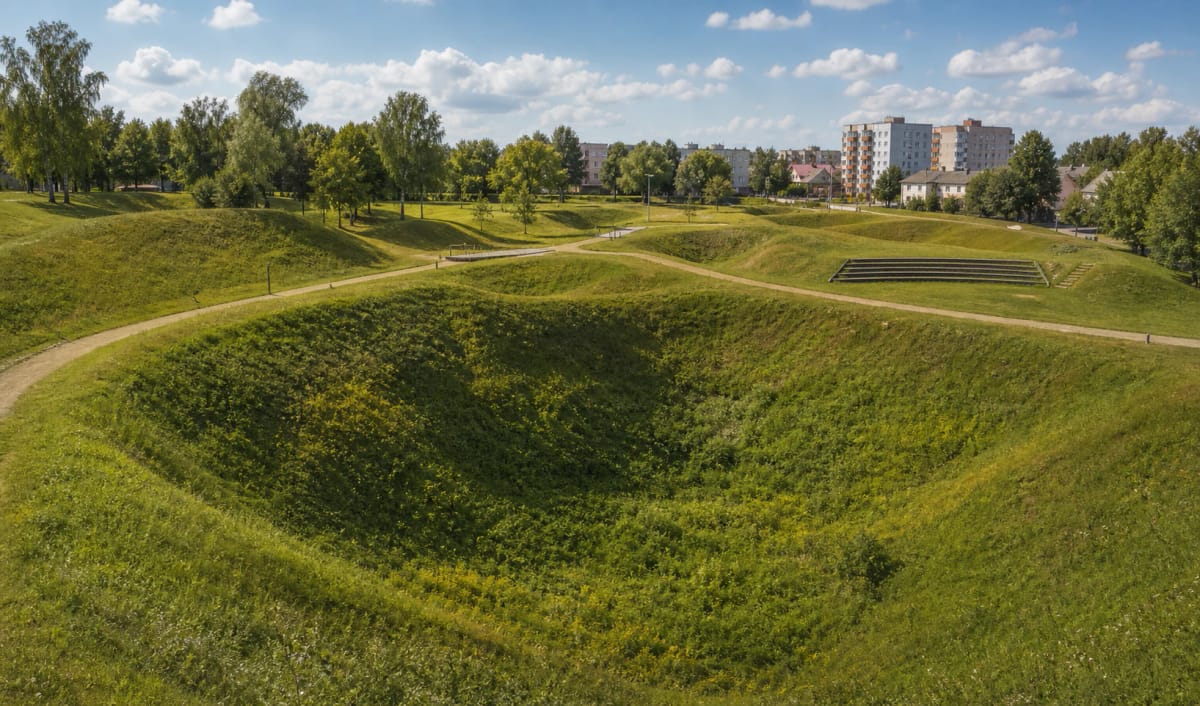
Pasvalys Sinkhole Park lies around Panevėžio Street, between the town and the Via Baltica highway. The Pasvalys encyclopedic source presents it as an 8 ha park with dozens of sinkholes of different sizes, making it one of the most convenient places to see karst relief that is usually scattered across a wide area.
The sinkholes form through gypsum karst: in northern Lithuania soluble gypsum lies close to the surface, water dissolves it below ground, cavities open, and when the overlying soil collapses a funnel-shaped hollow appears. VLE places Pasvalys in northern Lithuania's karst region and lists the sinkhole park among town cultural and recreation spaces. Karst is often explained through Biržai, but Pasvalys shows that it is a wider regional geological reality.
Avižonis Pits: a local name and a story of adaptation
Historically the place was called Avižonis Pits because the land belonged to the Avižonis farmers. Houses were not built here and ordinary farming was not possible: the sinkhole field dictated where land could be worked and where it might collapse at any time.
This history helps explain the practical relationship with karst. People did not merely admire unusual relief; they adapted to it, avoiding construction where the ground could change. That kind of adaptation is part of daily life across the northern Lithuania karst belt, about seven kilometres wide, running through Biržai and Pasvalys districts.
How the sinkholes change
Karst terrain is alive: the number of sinkholes changes, some hollows fill in or become overgrown, and new ones appear. The State Service for Protected Areas organises annual counts of new sinkholes in northern Lithuania, so Pasvalys Park should be seen not as a frozen monument but as a changing geological system.
For that reason, the park is not only a walking place but also a teaching space. In one area visitors can compare old, overgrown depressions with newer, sharper hollows and understand how gypsum dissolution shapes the surface.
Amphitheatre, Brazdžionis monument, and active recreation
Work on the park began in 2004, and it opened to visitors in May 2009. One of the larger dry sinkholes was adapted as an amphitheatre for town cultural events, turning the geological hollow into a natural stage and audience space.
In 2007 a monument to poet Bernardas Brazdžionis, born in the Pasvalys area, was unveiled in the park by sculptor Arūnas Grušas. Six religious roofed poles were added in 2011. Later additions include active recreation areas: an extreme sports park for skateboards, BMX, and rollerblades in 2021, and an 18-throwing-station disc golf course in 2024.
How to visit Pasvalys Sinkhole Park
This is a freely accessible outdoor town space, and checked sources did not list a separate opening schedule or ticket. Visit it as karst terrain: keep to paths, do not damage slopes, avoid risky spots after rain, and protect park infrastructure.
The park usually takes 30-60 minutes, but it is worth combining with other Pasvalys sites, such as the Pasvalys Regional Museum and the Green Mineral Water Spring, or with the wider northern Lithuania karst route through Likėnai, Cow Cave, and Kirkilai.