- Place
- Pasvalys, Pasvalys District Municipality
- Region
- Aukštaitija
- Type
- historic watermill site with an altered industrial building and the Lėvuo weir
- Address
- 14 Nepriklausomybės Street, Pasvalys
- Coordinates
- 56.05837, 24.38783
- Visit duration
- 15-30 minutes to view the building and weir only from publicly accessible parts of the Lėvuo riverbank
- Best time
- in daylight; early spring or late autumn gives a clearer view through the trees
Pasvalys Watermill, Pasvalys Mill, Ustukių Mill in Pasvalys
An altered industrial site, not a picturesque mill with a wheel
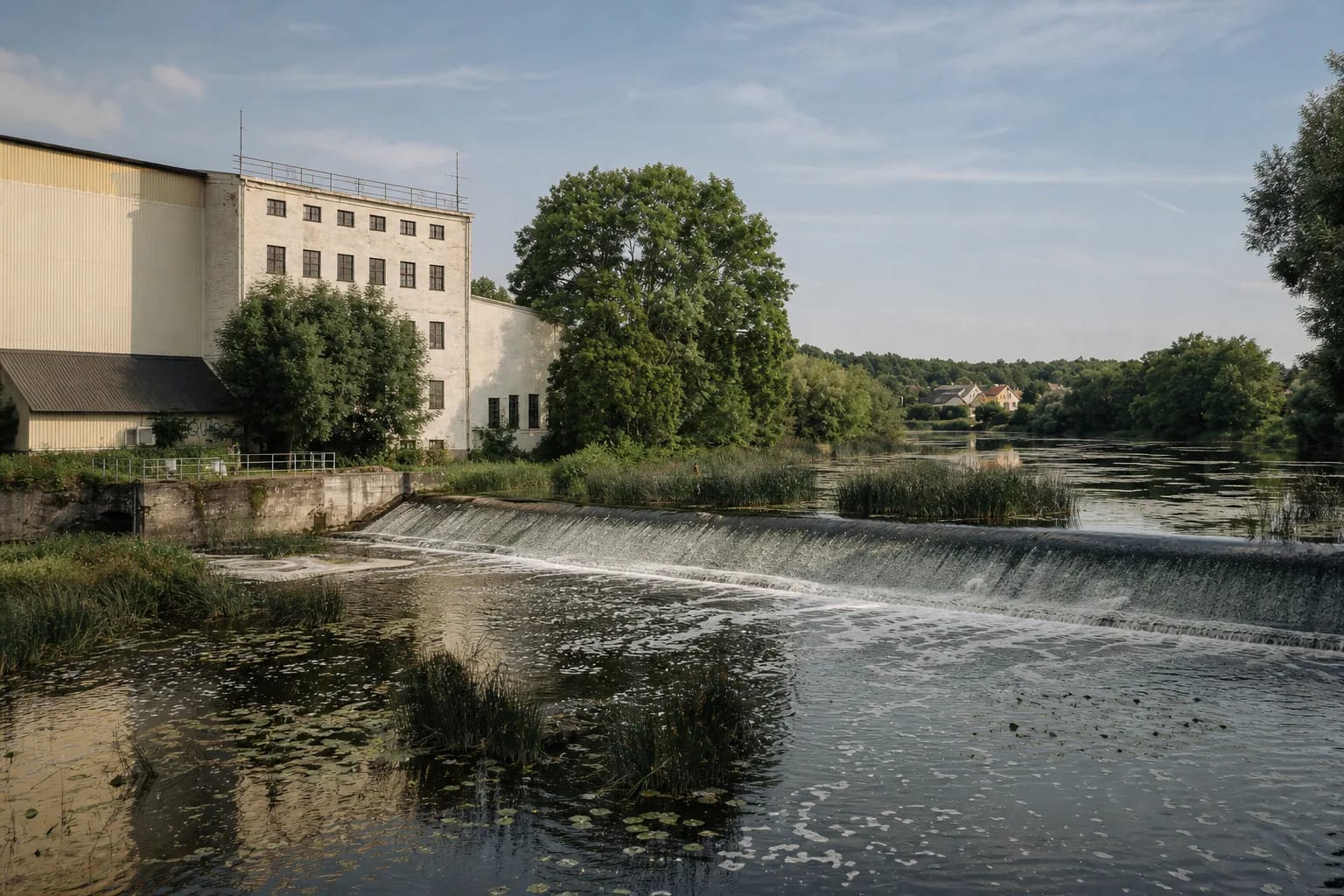
Pasvalys City Watermill stands on the left bank of the Lėvuo at 14 Nepriklausomybės Street. The coordinate 56.058365, 24.387834 marks the building beside the weir, not a public entrance, car park, or viewing platform. Look for a tall rectangular pale-rendered block with several rows of small windows, large cream-coloured sheet-metal extensions, and the broad low sill spanning the river.
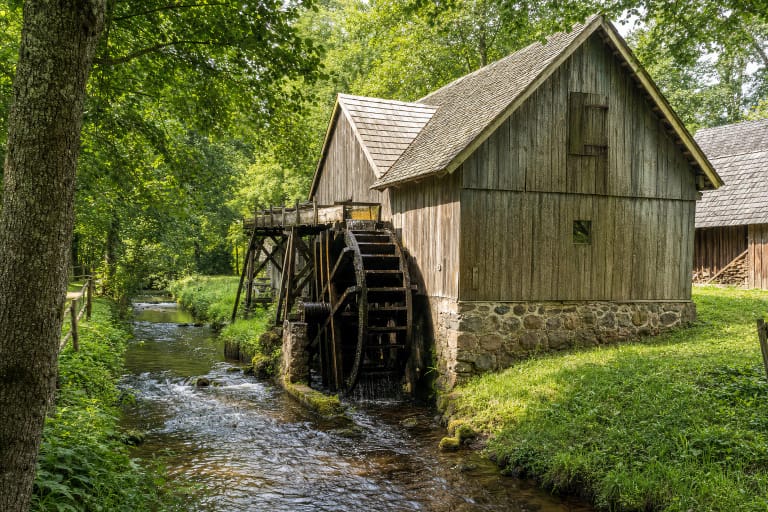
There is no timber waterwheel, rustic stone mill, or restored miller's homestead to find. Pasvalys's own visitor description stresses that the present appearance no longer resembles a traditional watermill. Successive alterations changed the building, while turbines, a diesel engine, and electric motors eventually drove its milling equipment. The rewarding subject is therefore the relationship between industrial building, river channel, and weir rather than an eighteenth- or nineteenth-century facade.
The municipal tourism system labels the place as cultural heritage, but this research found no separate Cultural Heritage Register code for the present building. A visitor category does not establish legal KVR protection, so this page does not assign the site an unverified status as a registered or state-protected monument.
From the 1755 record to a masonry mill around 1830
A local historical compilation places the first record of a mill on the Lėvuo at this site in 1755, when this part of town was associated with Pumpėnai Street. A 1771 document described it as being in poor condition, while a 1777 survey called it one of the town's most powerful mills. It belonged to the Vilnius Cathedral Chapter and paid an annual levy of 30 zloty. These claims derive from archival records, but they do not mean that any wall of the present building survives from the eighteenth century.
A late-eighteenth-century inventory described an old timber mill with a thatched roof. It underwent a major repair in 1799 under Andris Miuleris. Around 1830, a new masonry mill replaced the earlier structure. The local account attributes its design to Vilnius University surveyor Jonas Zantura, the mechanical work to Štrausas, and its masonry to craftsmen from Vilnius.
Continuity of place must be separated from authenticity of the current volume. Milling beside the same stretch of the Lėvuo is documented across centuries, but its materials, height, machinery, and facades changed. It is more accurate to describe this as a historic mill site with a surviving hydraulic node than as an unchanged building from 1755.
The 1895 weir, three wheels, and a twentieth-century technological shift
A stone weir was built across the Lėvuo in 1895, with a bridge above it carried past five ice-breaking supports. The mill then had three waterwheels, and outbuildings and a brewery operated nearby. The surviving sill has been altered by concrete and later repairs and should not be treated as unchanged in every 1895 detail, but its position remains the main marker of the old water-power landscape.
By the first half of the twentieth century, photographs show a large four-storey industrial mill. A 1926 photograph in the Pasvalys Regional Museum collection records an earlier appearance, while the Lithuanian Central State Archives catalogue lists a 1929 site plan for Pasvalys Watermill. The local history compilation leaves open whether 1929 denotes reconstruction or another building phase, so it should not be presented as a proven construction date for the present block.
The Ziva brothers, identified in the local source as Jewish owners, installed a second turbine and a diesel engine in 1940. Accounts mention four roller mills, wheat and semolina equipment, elevators, a fulling machine, and a dyeing boiler. This was more than a pair of millstones: it was a mixed industrial operation. The building survived the Soviet period, but its watermill function faded.
A link with Ustukių malūnas does not make this a visitor factory
Pasvalys visitor descriptions connect the site's later story with UAB Ustukių malūnas, a company active since 1992. A 2015 municipal order records the company's request to begin a land-formation project at 14 Nepriklausomybės Street. That establishes a relationship with the address at the time; it is not a current land-register extract and does not create public access rights.
The company's own 2023 announcement says production would continue in a new factory in Ustukiai village, bringing all crispbread production under one roof. Its current contact page gives 1 Vytartų Street in Ustukiai. Older directory hours or company contacts at 14 Nepriklausomybės Street must therefore not be mistaken for tourist admission to the old Pasvalys building.
The official attraction record publishes no visiting hours, admission price, or tour telephone number. Reliable sources reveal neither a public machinery exhibition nor regular interior tours. You can read the site from a public street or riverbank, but enter the industrial yard, annexes, or building only with explicit permission from the lawful controller.
Malūno lanka and the unresolved future of the weir
Above the weir, the Lėvuo broadens into the Pasvalys town pond known locally as Malūno lanka, or Mill Meadow. Below the sill, it narrows again. The contrast makes the mill's original logic visible: impoundment created a difference in water level that could be converted into mechanical power. The same structure is now an ecological barrier to river continuity.
The Environmental Protection Agency's Lielupė basin measures table listed the Pasvalys barrier on the Lėvuo for removal or reconstruction in 2023-2027 to restore continuity. Yet at the municipality's August 2024 meeting, officials discussed only hypothetical projects, not an approved demolition. The municipality raised questions about karst ground, possible sinkholes, Malūno lanka, bathing areas, and an already reduced Lėvuo water level.
The weir is clearly visible in official 2023 local imagery, and the 2024 municipal notice did not announce its removal. This review found no later official completion notice by 19 July 2026. Hydraulic structures can change, however, so check the municipality's latest information before travelling and obey any barriers or warnings on site.
A safe exterior visit and a useful Pasvalys route
Allow 15-30 minutes for a short stop. View the building and sill only from a legally public street or stretch of riverbank; the pin is not an invitation to cross the yard. Sources identify no confirmed visitor car park, toilet, step-free route to the best viewpoint, or formal viewing platform. If an approach or bank is signed as closed, choose another public perspective.
The weir is not a footbridge. Do not step onto the wet sill, rails, or technical concrete, wade near falling water, or let children approach the current unattended. Water level, silt, ice, vegetation, and flow can hide an edge or hollow. The safest photographs are taken from a dry bank in daylight.
Pasvalys Regional Museum supplies the broader town history, while Sinkhole Park explains the karst setting that makes the barrier debate more than a simple engineering question. The Church of St John the Baptist adds a central architectural stop. To see a watermill with surviving machinery and arranged visitor access, compare Pasvalys with Šlyninka Watermill near Zarasai after checking its current opening information.