- Place
- Pasvalys, Pasvalys District Municipality
- Region
- Aukštaitija
- Type
- Regional museum in a former 1964 cinema with geology, archaeology, history, ethnography, and cultural-history displays
- Address
- 6 P. Avižonio Street, Pasvalys
- Coordinates
- 56.06019, 24.39893
Pasvalio krašto muziejus, Museum of the Pasvalys Region, Pasvalys Museum
The Svalia cinema of 1964 became a museum, but the collection story began earlier
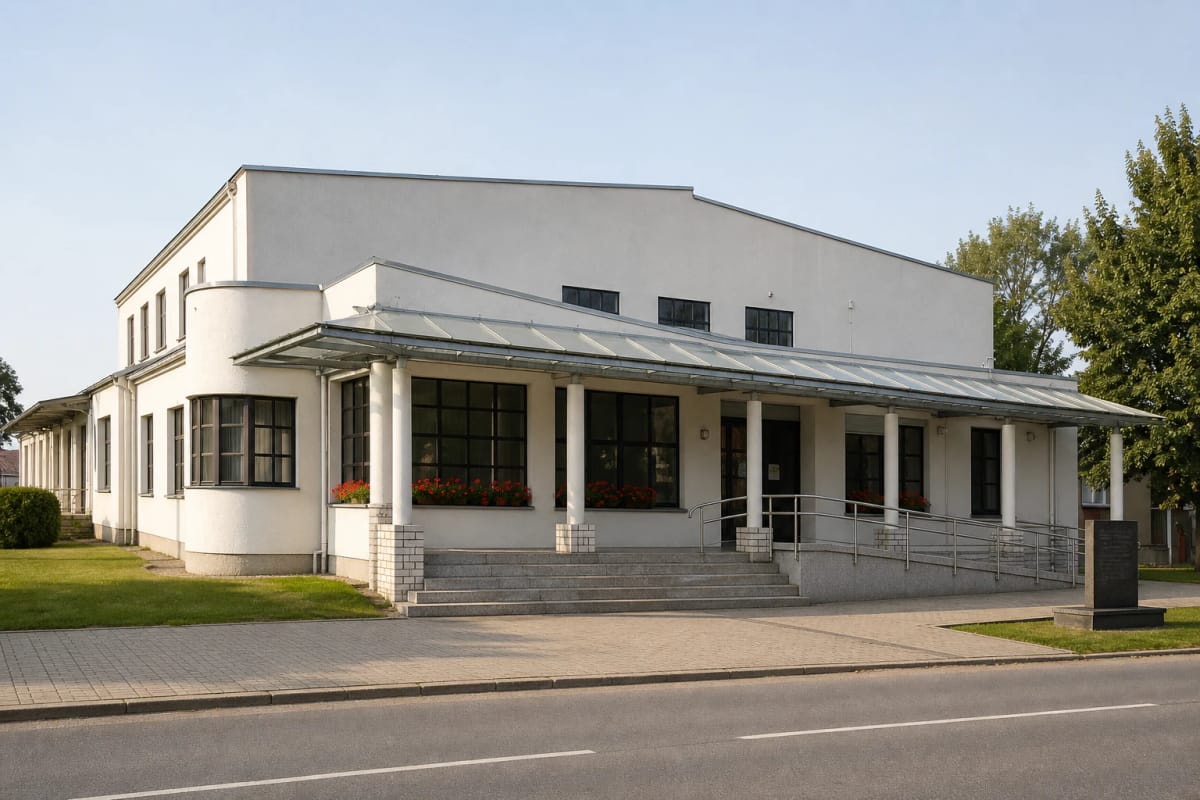
Pasvalys Regional Museum stands at 6 P. Avižonio Street, coordinates 56.0601907, 24.3989292. The low, light-rendered building, with its former auditorium volume, long translucent entrance canopy, and row of round columns, began not as a collections store but as the standard Soviet-era Svalia cinema, opened around 1964. Films were shown here until 1990.
Museum work reaches back to 1965, when teacher and local historian Juozas Velžys began a community museum in a former primary school that had operated in 1918-1940. Pasvalys Regional Museum was established as an institution on 29 November 1991, remained a branch of Biržai's Sėla Museum until 1998, and opened to visitors in the converted cinema in September 1998. The years 1965, 1991, and 1998 therefore mark three different stages rather than conflicting foundation dates.
A modernisation project completed in 2017-2020 had a budget of EUR 653,705.27 and planned an extension of approximately 300 sq m, spaces for education, exhibitions, and workshops, and an animation laboratory. This explains how the old cinema volume now serves as a multifunctional museum. The holdings numbered approximately 61,400 objects in 2024, when annual attendance reached 44,285.
The geology display explains why the Pasvalys landscape sinks into hollows
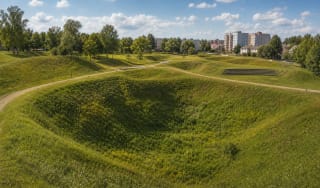
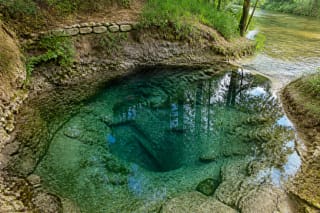
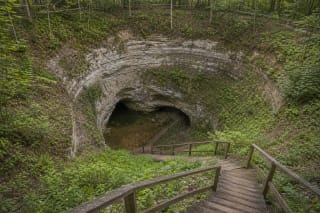
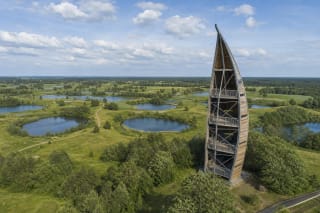
Pasvalys District is defined by shallow gypsum-bearing rocks: groundwater dissolves them and creates cavities, caves, and sinkholes. A terminal in the museum's sinkhole display explains these karst processes, while minerals, crystal forms, rocks, and plant and animal fossils surround it. The gallery provides a strong introduction before visiting Sinkhole Park or Žalsvasis Spring.
Geologist Eduardas Vodzinskas's mineral and rock collection forms the core of the display. The museum identifies Lithuanian crude oil, quartz sand from Anykščiai, Baltic amber, and a trilobite fossil among its specific objects. Together they separate the broad geological story of Lithuania from the active karst processes distinctive to the north.
An interactive experience offers a virtual descent into the approximately 20 m depth of Žalsvasis Spring. This is neither an actual caving excursion nor permission to enter the protected spring, but a museum interpretation that reveals a cavity otherwise concealed beneath the water.
Semigallian weapons lead from early archaeology to a reconstructed old Pasvalys market
The archaeology section begins with Stone Age flint and stone axes, boat-shaped Baltic battle axes, and stone farming hoes. Finds from Ąžuolpamūšė Hillfort, Noreliai burial ground, and Pamiškiai old cemetery represent the Iron Age. Iron axes, spearheads, a knife, and a sword introduce Semigallian life and conflict through objects rather than an abstract timeline.
The displays then trace changes in Pasvalys streets, buildings, and residents. In a reconstructed interwar market square, visitors can sit on a wooden crate or sack to watch an animated story about the town. Music associated with Antanėlis, the old violinist of the Lėvuo bridge, links the gallery with his interactive sculpture in Pasvalys.
The historical story extends beyond the main building. The museum maintains the site of a bunker used in Žadeikiai Forest in 1945 by partisans led by Jonas Alenčikas-Dragūnas; destroyed in battle, it was first reconstructed in 1997 and renewed in 2019. A virtual-reality bunker experience in the museum complements that separate outdoor site.
Ethnography recreates a smoke-filled farmhouse, while objects speak in the Cultural Panorama
Objects collected by Juozas Velžys and Antanas Stapulionis form the basis of the ethnography section. Nineteenth- and twentieth-century farming implements, household goods, craft tools, instruments, and folk art explain grain and flax cultivation, animal husbandry, beekeeping, milling, and weaving. A farmhouse interior evokes lingering smoke, while unusual transport objects include a traditional sledge and a bicycle with wooden wheels.
The Cultural Panorama cannot represent every one of more than a thousand notable people from Pasvalys District, so it selects eloquent authentic objects. These include a wooden pelican rescued from the burned church in Saločiai, memorial material for priest Alfonsas Lipniūnas, Bernardas Brazdžionis's walking stick and briefcase, and the diploma recording boxer Jonas Čepulis's silver medal at the 1968 Mexico City Olympics.
Other pieces deliberately join very different biographies: the original monument to pilot Vytautas Lapėnas and wreckage from his aircraft, Signatory of 11 March Romualdas Ozolas's pen collection, writer Kazys Saja's wooden clogs, and physician and politician Rasa Juknevičienė's gas mask. The room is most rewarding when visitors read whom each object belonged to and under what circumstances.
Antanas Poška's motorcycle, the Rudnosiukas playroom, and the Millstone Museum offer three separate experiences
The exhibition World Citizen - Antanas Poška focuses on the traveller, scholar, and Esperantist. Five interactive books assemble his biography, personal objects bring his daily life closer, and a still-operational Iž Jupiter 2 motorcycle evokes his 1972 journey to the North Caucasus. This is a self-contained exhibition rather than a brief panel about a famous local figure.
The Meškiuko Rudnosiuko trobelė playroom is intended for children aged 2-7 and draws on the poem by Bernardas Brazdžionis, who wrote for children as Vytė Nemunėlis. It includes a sound-recognition table, creative games, a small woodland cottage, and sensory activities. A separate escape room called Už kadro accepts teams of two to four with advance booking; it is an entertainment service rather than part of the permanent displays.
The Millstone Museum is not inside the P. Avižonio Street building. At Antanas Stapulionis's homestead, 2 Lėvens Street, an open-air collection contains approximately 321 museum objects: 214 millstone halves, 64 cup-marked stones, seven footprint stones, two boundary stones, and mill gearing. Collection began in 1979 and the ensemble was later donated for the museum's tenth anniversary, so confirm its visiting arrangements separately.
The museum opens on Sundays in summer, and an adult ticket cost EUR 3 in 2026
The published 2026 schedule was 08:00-17:00 Monday to Friday and 09:00-17:00 on Saturday and Sunday from June through August. From September through May, weekday hours remained 08:00-17:00, Saturday was 09:00-17:00, and the museum closed on Sunday. It works one hour less before public holidays; exhibition changes and events may affect access, so recheck official information.
On the research date, adult admission was EUR 3, while pupils, students, pensioners, visitors with disabilities, and the listed service personnel paid EUR 1.50; a family ticket was EUR 5. Preschool children entered the museum free, while the Rudnosiukas room cost EUR 3 per child. The two-to-four-person escape room cost EUR 30 and required booking on +370 618 85272. Reconfirm every price before travelling.
Official exterior photographs clearly show a handrailed ramp at the main entrance, but the published accessibility page describes only the website and does not map a complete physical route through all floors and special spaces. Call the administrator about specific mobility, vision, or hearing requirements. On 13 July 2026, the Google Maps entry named Pasvalys Regional Museum had 322 reviews averaging 4.7 out of 5.