- Place
- Šiauliai District Municipality
- Region
- Šiauliai Region
- Type
- pilgrimage, memory, and cross-crafting site
- Address
- Jurgaičiai village, Meškuičiai eldership, Šiauliai District
- Coordinates
- 56.01936, 23.43206
Jurgaičiai Hillfort, Domantai Hillfort
Why the Hill of Crosses is special
The Hill of Crosses is not just a sight near Šiauliai. It is a space of pilgrimage, gratitude, petition, mourning, and national resolve, where every cross can become the story of a person or community.
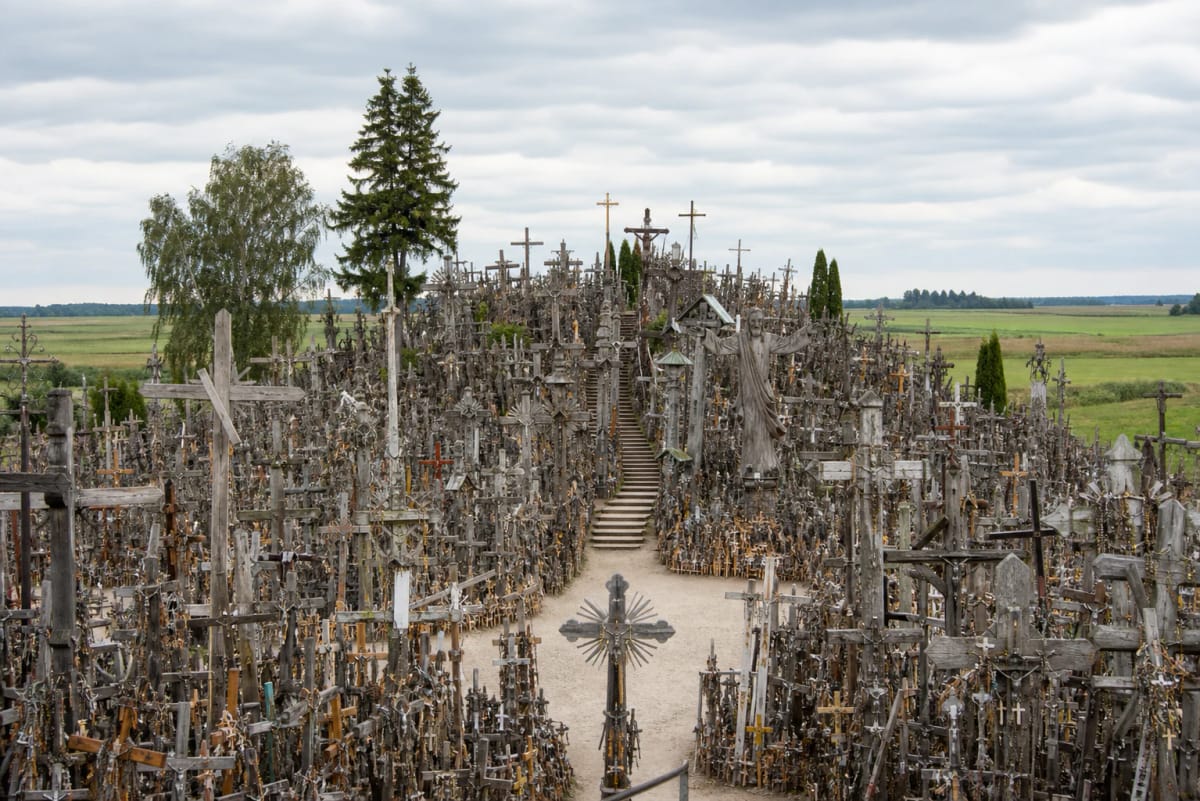
The official Hill of Crosses website states that there are more than 200,000 crosses and other sacred signs here, and more than 50 crosses are included in the Cultural Heritage Register. The number constantly changes because people keep bringing new crosses, rosaries, and small memorial signs.
The Hill of Crosses on Jurgaičiai Hillfort
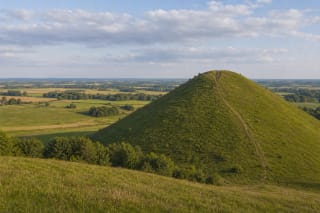
The Hill of Crosses stands on Jurgaičiai Hillfort, also called Domantai Hillfort. This matters because the place has not only a sacred layer but an older landscape layer: the hill rises from an open Šiauliai District field and from a distance looks like a small but sharply marked island.
The hillfort's origin and the earliest history of crosses are not fully documented. It is best not to rely only on romantic legends; more reliable sources speak about the strengthening of the tradition in the nineteenth century and early written mentions.
The nineteenth century and the cross tradition
VLE notes the tradition that the first crosses were erected after the 1831 uprising in memory of killed insurgents, because Russian authorities forbade visits to their graves and memory moved to the hillfort. At the end of the nineteenth century, ethnographer Liudvikas Krzywickis counted about 130 crosses and a masonry chapel on the hill.
In the early twentieth century the Hill of Crosses became a sacred place with services and feasts, and people from across Lithuania placed vow and thanksgiving crosses here. Later the number grew, and the hill became inseparable from Lithuanian cross-crafting, a tradition proclaimed by UNESCO in 2001 and inscribed in 2008 on the Representative List of the Intangible Cultural Heritage of Humanity.
Soviet-era destruction and return
One of the strongest parts of the Hill of Crosses story is the Soviet attempt to destroy it. According to VLE, Soviet authorities destroyed the hill between 1958 and 1988: gravel was dug in 1958, crosses began to be demolished in 1961, wooden ones were burned, metal ones taken for scrap, and stone or concrete ones smashed and dumped into the Kulpė stream. In 1961 alone about 5,000 crosses and the chapel were destroyed; by 1975 another about 1,200 were destroyed.
In 1978-1979 there were even plans to flood the hill, but despite soldiers and the KGB guarding it, people put up crosses at night. Crosses were no longer forbidden from 1988. The Hill of Crosses therefore became a place of quiet resistance, where not only the number of crosses matters but also the fact of their return.
John Paul II and the Franciscan monastery
On September 7, 1993, Pope John Paul II celebrated Mass in the Hill of Crosses chapel, built the same year. The visit strengthened the site's international significance. In 1994 a crucifix gifted by the Pope and made by sculptor Enrico Manfrini was erected on the hill, and in 1997 Bishop Eugenijus Bartulis revived the Hill of Crosses feast, held on the last weekend of July.
In 2000 a Franciscan monastery was built near the hill. Today the Hill of Crosses is both an open tourist site and a living prayer space where very different visitors meet every day.
How to visit
The Hill of Crosses is about 12 km from Šiauliai. The official route description follows the A12 road from Šiauliai toward Joniškis and Riga, then turns at the sign for Kryžių kalnas. Public transport routes can change, so check the current schedule before travelling.
Before going up the hill, consider stopping at the information centre in Domantai for context, souvenirs, or practical details. On the hill itself, paths are narrow between crosses, so wear comfortable shoes and behave respectfully.
What to notice on site
The large wooden and metal crosses are visible first, but the true scale appears up close: smaller crosses hang on larger ones, rosaries are woven between them, and plaques, memorial signs, prayers, and travellers' symbols appear in many languages.
Do not rush. Walk around the hill, look at the open field horizon, notice different forms of cross-crafting and the different languages on memorial signs. This helps explain why the place is more than a photogenic object.