- Place
- Pasvalys, Pasvalys District Municipality
- Region
- Aukštaitija
- Type
- karst spring with an underwater cave, hydrogeological natural monument
- Address
- Left bank of the Lėvuo River, near Kalno Street, Pasvalys
- Coordinates
- 56.06450, 24.40090
A Karst Wonder in Pasvalys
Žalsvasis Spring lies inside Pasvalys itself, on the left bank of the Lėvuo River near Kalno Street, about 400 m below the mouth of the Svalia. It is one of the most interesting objects in northern Lithuania's karst region, where gypsum and dolomite layers create sinkholes and springs.
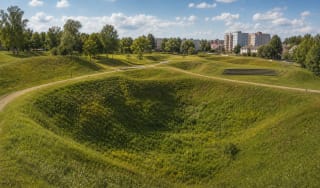
The spring is a hydrogeological natural monument. It has been protected since 1985 and was declared a natural monument in 2000. It should be distinguished from nearby Pasvalys Sinkhole Park and the Kirkilai karst lakes, which are separate sites in the same karst region.
How the Spring Formed
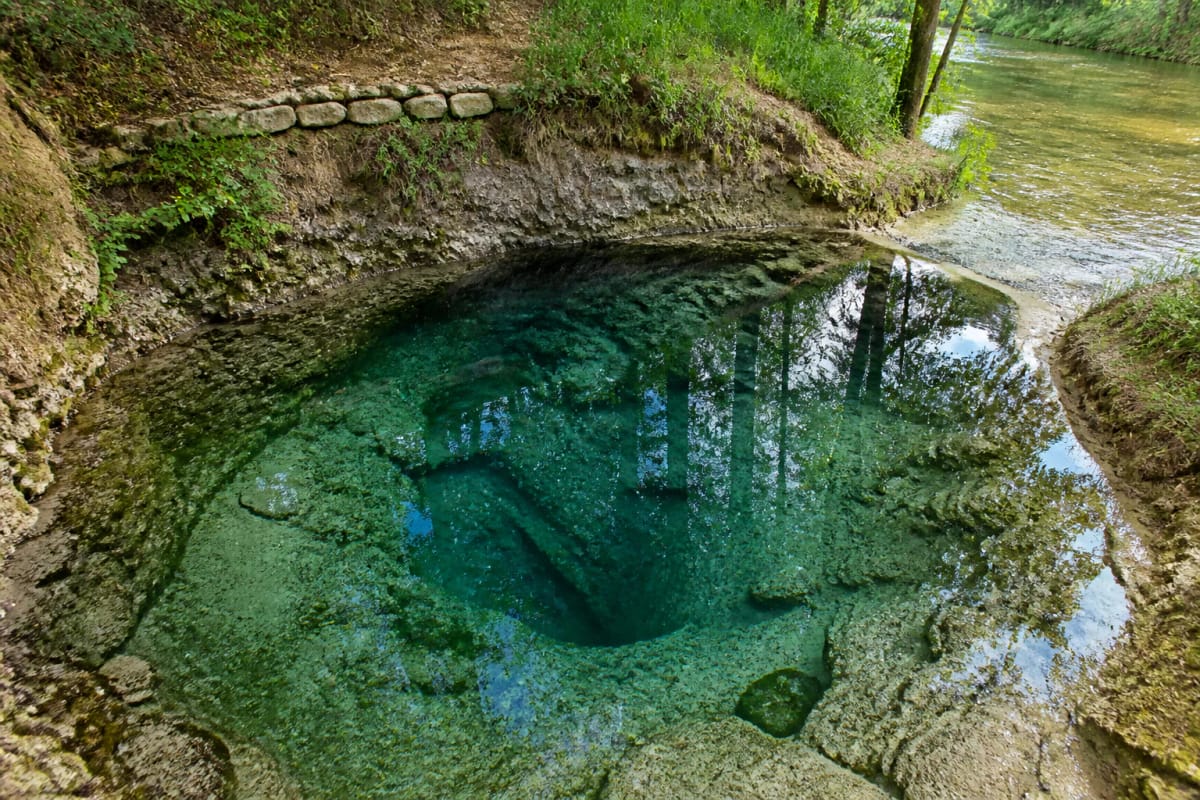
The spring formed when a karst sinkhole collapsed. Underground water dissolved shallow gypsum layers; when the upper cover could no longer support the void, it caved in and the spring emerged through the opening. It is a living example of how karst changes the landscape.
Sources differ on exactly when it formed. VLE says the spring appeared at the end of the 1940s, while popular accounts mention around 1960. The exact timing should therefore be treated as uncertain.
Greenish Water and Sulphur Smell
The spring's name comes from its colour. Grey-green deposits collect on the bottom of the channel formed by the spring, and these deposits give the water its greenish shade. The water itself is clear, cold, about 7.5 degrees C, and smells of sulphur, or hydrogen sulphide.
It is calcium sulphate, weakly mineralised water, and one of the most water-rich springs in Lithuania. In winter the spring and a short stretch of the Lėvuo beside it do not freeze, so ducks overwinter here.
Lithuania's Deepest Cave
Beneath the spring is an underwater cave which, according to the encyclopedia, is the deepest in Lithuania, about 20 m. The first shaft branches into chambers at 8 m depth, while a narrow fissure leads to the lowest chamber at 20 m. The cave formed in gypsum and dolomite layers.
The inside of the cave is not accessible to ordinary visitors. The vaults are unstable and visibility is poor, so it has been explored only by experienced speleological divers. Visitors can observe only the spring outlet and the collapsed walls with gypsum and dolomite exposures.
How to Visit Žalsvasis Spring
Žalsvasis Spring is an open, freely accessible natural monument in Pasvalys town. For a short stop, 15-30 minutes is usually enough. It combines well with Pasvalys Sinkhole Park and other karst-region places.
Visit respectfully and safely: do not climb into the collapse and do not drink the water, because it is mineralised and sulphurous. The municipality has announced plans to adapt the site better for visitors, so check current information on the official Pasvalys page before travelling.