- When / context
- Late nineteenth and twentieth centuries, with forms still practiced today
- Tradition area
- Community life
- Themes
- Neighborhood, neighborly help, borrowing, sharing, hospitality, food, reciprocal labor, fire relief, bandžiulystė, public opinion, mediation, coexistence
Neighborhood customs connected nearby farms through borrowing, sharing food, reciprocal labor, help during illness, death, or fire, and the common table. These relationships were vital but not invariably harmonious: obligations to repay, reputation, wealth, exclusion, and the changing shape of settlements all affected them.
What Did It Mean to Be a Neighbor?
Distance between houses alone did not define a neighbor. Ethnological research treats neighborhood as both a territorial and social relationship maintained through repeated contact, mutual recognition, and a measure of trust. The person beyond the fence might also be a relative, godparent, work partner, or old adversary. In every case, overlapping daily interests made that person more visible than many others.
Neighborhood was not merely a feeling. It meant knowing whose animal had escaped, who owned a drill, ladder, or horse, which household had lost its principal worker to illness, and where to run first after seeing smoke. A moral expectation formed alongside this practical knowledge: a good neighbor notices trouble, does not refuse a reasonable request, and does not exploit another household's goodwill. Yet a particular community defined the 'good neighbor,' and its judgment could be biased.
The Nearest Neighbor and the Wider Circle
People interviewed in field studies often distinguish those living immediately beside them from a wider circle in the village or surrounding area. The closest farmstead mattered in ordinary life and sudden need: borrowing embers or salt, asking someone to watch a child, animal, or sick person, and obtaining help before anyone farther away could arrive. A larger talka, funeral, or response to fire drew people from across the village together with relatives and friends.
Social and geographical closeness did not always coincide. Two adjoining households might argue over a boundary for decades, while a godparent or trusted work partner several farms away remained the safer person to ask. Local terms and the limits of neighbor circles vary in researchers' records, so no universal distance can define the relationship. People sustained neighborhood through action—visiting, service, shared work, and acknowledged reciprocity.
Why Did a Street and Strip-Field Village Require Agreement?
In a street village, farmsteads stood close together while each household's cultivated land could be scattered among narrow strips. Roads, boundaries, pasture, water, and livestock paths intersected, so one neighbor's carelessness quickly affected others. Households had to agree when a herd could be released, where a fence belonged, how to prevent crop damage, and who would compensate for it.
The division of villages into isolated farmsteads from the late nineteenth century through the interwar period increased distance and turned some common land into individual holdings. It gave a farm greater autonomy but made spontaneous exchanges of small services more difficult. A neighbor remained indispensable after fire, illness, or on a demanding workday, yet reaching that person took longer. Settlement pattern changed the frequency and form of the custom rather than automatically ending neighborhood.
A Borrowed Object, a Pledged Word, and Trust
A pot, sieve, scythe, rake, cart, horse, seed, or food item could fill a short-term gap in a working household. Borrowing meant that every family did not need to own an object used only occasionally, and it rescued a time-sensitive task when a tool broke. The size of a request reflected the relationship. A small item could come from the nearest house, while a valuable animal or implement needed for several days was entrusted to somebody well known.
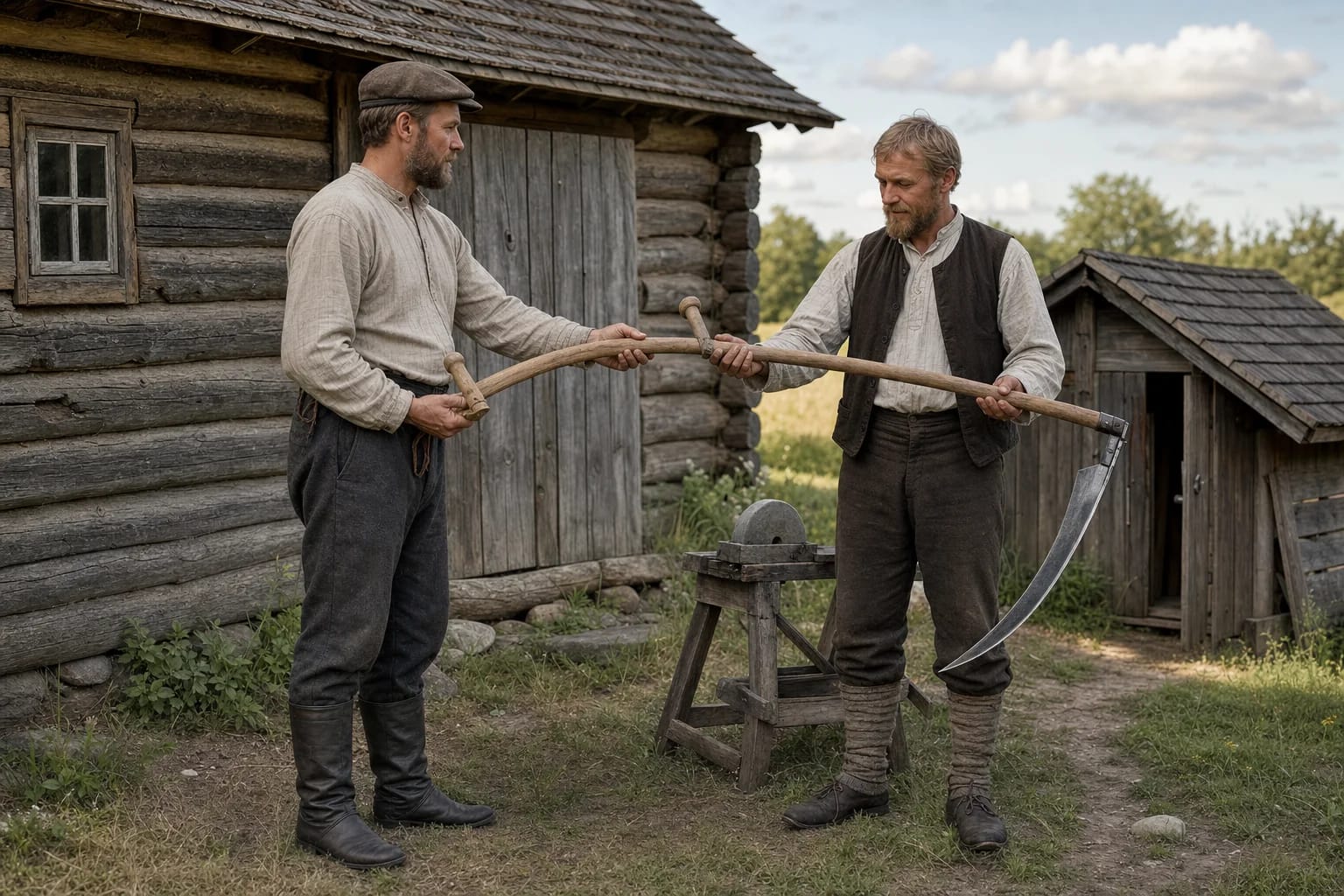
The central duty was to return an object promptly, clean, and undamaged. If it broke, an honorable borrower was expected to say so, repair it, or compensate the owner. Concealing damage destroyed trust. Food or seed might be returned in kind, through labor, or at another agreed value. No single national accounting system governed this exchange. Some neighbors relied on remembered reciprocity; a valuable bargain elsewhere called for witnesses or a clearer agreement.
Food Sharing: From New Bread to Slaughter
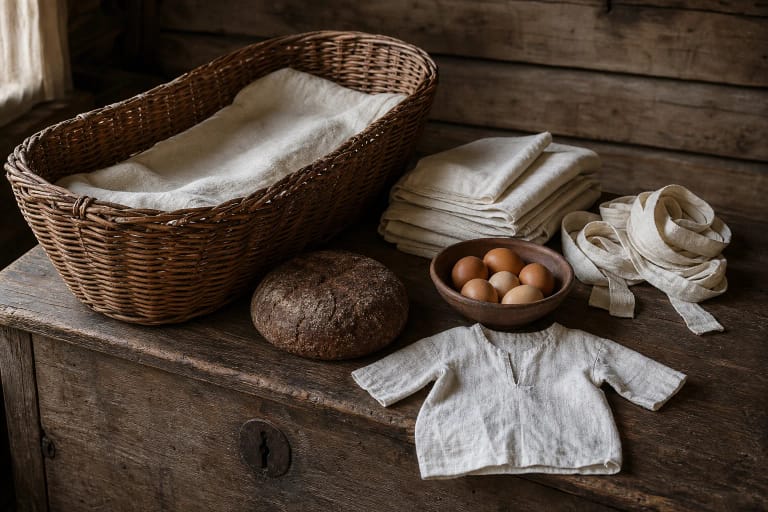
Sharing food was one of the most visible languages of neighborhood. Ethnographic descriptions mention carrying newly baked bread or ragaišis, giving a portion of meat after slaughter, sharing a dish made from colostrum, the first milk after calving, and taking neighbors a jug of newly strained beer during koštuvės. Such a gift announced a new resource in the household, let others taste it, and confirmed who belonged to the close circle of exchange.
The foods, terminology, and occasion differed by region and household resources. Not every loaf was shared, not every slaughter supplied the whole village, and a poor family could not reproduce a prosperous table. A gift also created memory. The recipient did not necessarily repay it immediately or with an identical product but was expected to remember the giver when another opportunity arose. Sharing joined sincere care with the maintenance of long-term reciprocity.
Hospitality, a Brief Visit, and the Common Table
A neighbor entering the house was greeted and invited to sit; during conversation a host might offer bread, cheese, milk, coffee, beer, or whatever was available. A feast brought a more abundant table, whereas a brief work-related call required only a modest offering. A winter evening gathering, baptism, wedding, slaughter day, or funeral vigil each produced a different form of hospitality.
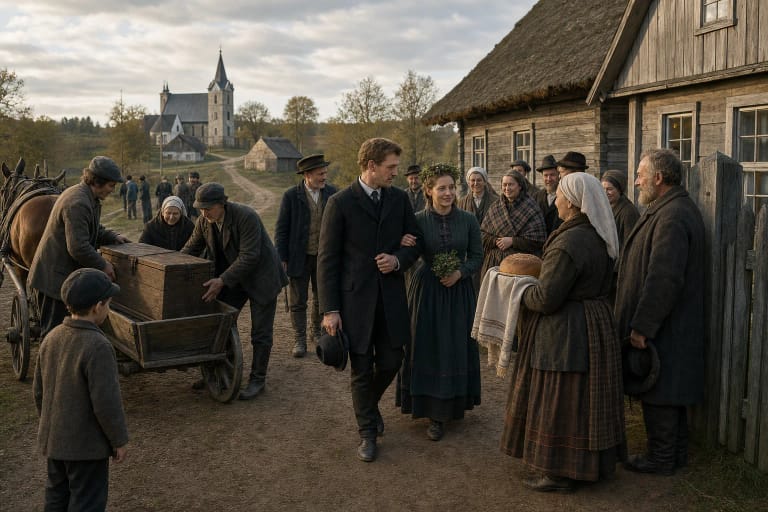
Folklore and memoirs often treat generosity to a guest as a virtue and mock a stingy host. That does not prove an innate Lithuanian 'hospitality gene' or identical treatment of every guest. Status, wealth, fasting rules, region, confession, and historical period shaped the table. Bread and salt carry powerful ceremonial symbolism, but they are not evidence that every household used one universal ancient formula for greeting an ordinary visitor.
Illness, Death, Fire, and Communal Care
When a household head became seriously ill, neighbors could feed animals, bring water or firewood, prepare food, provide transport to a doctor, and take over urgent fieldwork. After a death, help included carrying the news, preparing the home, keeping vigil, cooking, digging a grave, and maintaining the farm. This was more than etiquette: a bereaved family could not physically complete every domestic and funeral task alone.
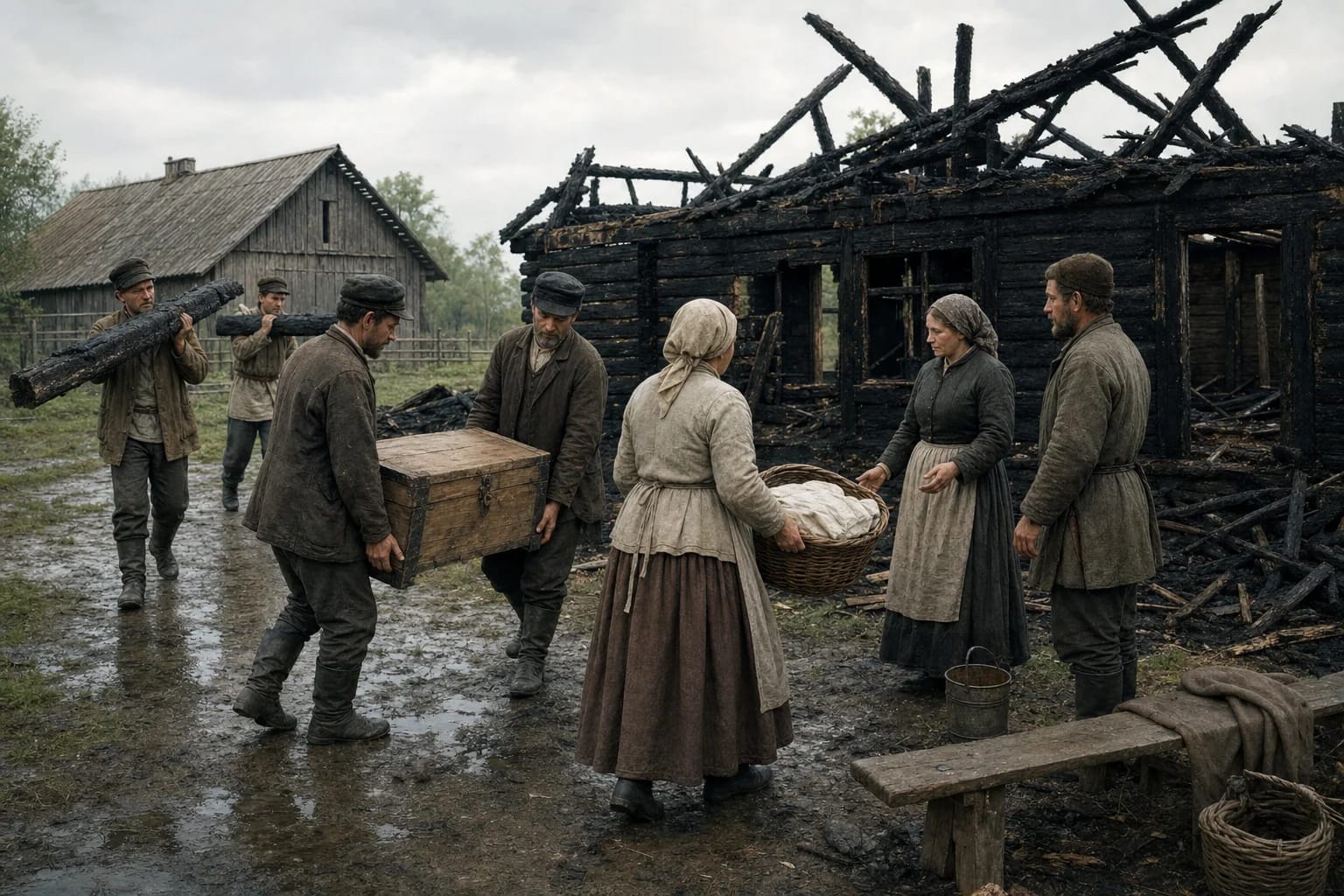
A fire could destroy shelter, seed, tools, and fodder within hours. The first responsibility was to save people and animals and fight the flames; afterward came needs for lodging, clothing, bread, timber, and rebuilding labor. Through the custom of bandžiulystė, an animal could be lent to a neighbor struck by disaster for an agreed period, with its produce and offspring divided by agreement. This helped restore a household while also binding the recipient to the lender's conditions.
Help, Reciprocal Labor, Gift, or Payment?
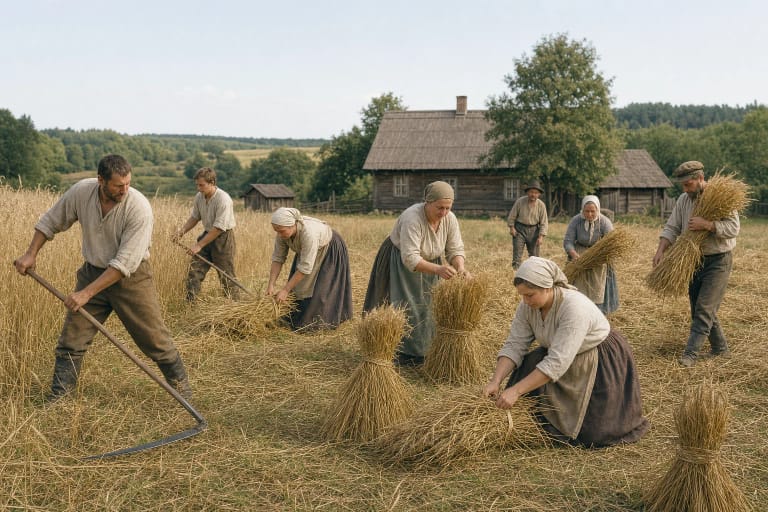
Not all neighborly help had the same economic meaning. Carrying water to a sick person might be a gift with no expected return, whereas a full day at the rye harvest commonly created an obligation to provide comparable work. Use of a horse and cart carried a different value from one person's labor; a skilled craftsperson might receive cash, food, or goods. The host's meal did not cancel an agreement for reciprocal labor or payment.
The language of 'help' must not hide the value of work. Research on talkos documents reciprocal exchange, hiring, duties written into farm servants' agreements, and even labor imposed by an authority. Neighborly assistance remained sustainable when both sides regarded the response as fair and the weaker person was not exploited. In a modern setting, a clear understanding—gift, exchange, or paid service—shows more respect than a vague demand to help 'because it is tradition.'
Public Opinion, Gossip, and Shame
In a small settlement, reputation operated as everyday credit. Neighbors more readily entrusted a tool or child to someone who repaid loans, appeared at communal work, and responded after misfortune. A person who continually took without reciprocating, lied, or damaged others' property became a subject of talk and ridicule and might be left without aid. Public opinion could reinforce unwritten rules without a formal court.
Gossip is not a reliable way to establish truth. Rumor could pursue a poor family, newcomer, unmarried mother, or a person of another confession or ethnicity, while an influential farmer's conduct received gentler treatment. Shame sometimes restrained abuse, but it could also control clothing, relationships, and harmless individual choices. Any account of neighborhood heritage should therefore include reputational coercion as well as solidarity.
When Neighbors Quarreled
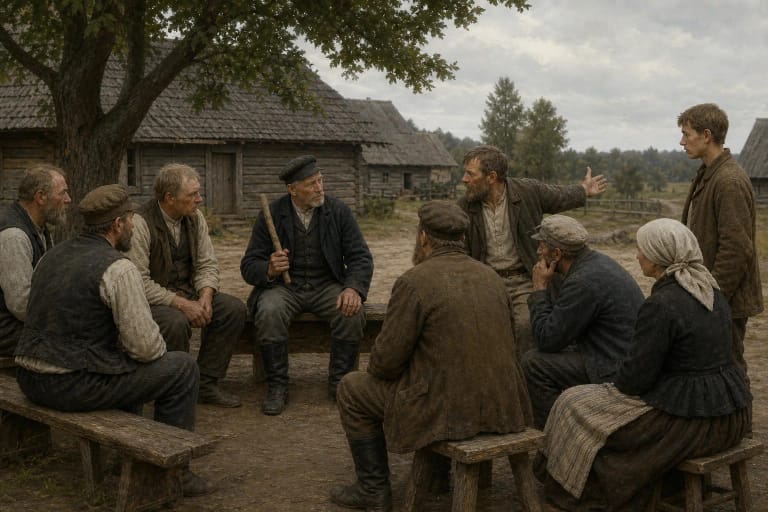
Field boundaries, livestock damage, drainage, fences, roads, unpaid debts, noise, and insults repeatedly created tension. A direct conversation could be the first step. If it failed, a mutual neighbor, relative, godparent, elder, village assembly, or clergyman might intervene. A mediator needed the trust of both parties and knowledge of local circumstances.
A handshake, compensation, a shared drink, or food might mark reconciliation, but no sign guaranteed that resentment had disappeared. Some conflicts lasted across generations, reached courts, or became physically violent. An eternally harmonious Lithuanian village is as misleading as a community in constant conflict. Custom offered instruments for negotiation, while the result depended on power, interests, and each side's willingness to accept a settlement.
Exclusion, Newcomers, and Women's Often Invisible Work
A neighbor circle had boundaries. A newcomer first had to demonstrate reliability, while a landless person or hired servant could not reciprocate with land, a horse, and a large farm in the way a prosperous household could. People of different languages, confessions, or ethnicities might form close practical relationships, but political tensions and stereotypes also created distance. Modern findings from the multiethnic Vilnius area illuminate contemporary life and cannot simply be projected backward into the nineteenth century.
Much neighborhood infrastructure depended on women's labor. Women carried food to a new mother or sick person, watched children, prepared a funeral table, exchanged dairy products, and maintained information between homes. Their voice was often weaker in public land and assembly decisions, so an official picture centered on male household heads hides this daily network. The same female network could offer essential support and also police other women's behavior particularly harshly.
Regions, Confessions, and Neighborhood Today
Research on etiquette in Dzūkija villages emphasizes visiting, greeting, service, and food, yet customs varied even within one ethnographic region between street villages, isolated farms, and towns. Žemaitija, Aukštaitija, Suvalkija, Lithuania Minor, and the Vilnius Region combined agricultural conditions, fasting, festive visits, brewing, cemetery practices, and parish ties in different ways. Region helps formulate better questions but does not make all residents identical.
Wars, occupations, collectivization, apartment buildings, cars, and migration changed distance and dependence during the twentieth century. Recent research around Vilnius still finds small-scale daily assistance: caring for an animal or greenhouse, bringing an item from town, sharing garden produce, or helping an older person. Good neighborhood today does not require reenacting a frozen ritual. It continues the central principle—notice the person nearby, agree clearly, and do not turn reciprocity into coercion.