- When / context
- A changing sequence lasting several days after engagement, not a single calendar date
- Tradition area
- Life cycle
- Themes
- Engagement, wedding eve, church marriage, two wedding parties, bridal farewell, daughter-in-law, new household, return visit
A traditional Lithuanian wedding was not merely a marriage service. It was an extended sequence that brought two families and communities into a new relationship, from engagement through the bride's reception and the later return visit.
Not One “Ancient Wedding,” but a Changing Ritual System
Brief written notices of Lithuanian wedding customs first appear in the early sixteenth century. Seventeenth-century authors in Lithuania Minor provide fuller descriptions, while most comparable material was collected in the nineteenth and twentieth centuries. Details from different centuries and districts therefore cannot be assembled into one supposedly exact pre-Christian script. Ethnologists compare recurring functions—agreement, separation, public confirmation, reception, and a post-wedding return—while also recording how their form changed.
This account chiefly concerns ethnic Lithuanian rural communities. Nobles, townspeople, hired laborers, and poor peasants did not have equal means to host a long feast or a large wedding party. Nor does this system represent every person who lived in Lithuania: Karaite, Jewish, Polish, Belarusian, Orthodox, and other communities had their own religious and family structures.
The most common model was patrilocal: the bride usually moved into the groom's parents' farm. That is a historical social arrangement, not a modern requirement or a romantic national ideal. The rituals reveal the value of a woman's labor and property, but also the limits placed on her choices and the two kin groups' effort to regulate a new relationship publicly.
From Matchmaking to Engagement: The Bridge into the Wedding
Several distinct meetings preceded the wedding. During atklausai, an intermediary cautiously learned whether the girl's parents would receive a proposal. At a meeting later described as pazintuves, the prospective groom, matchmaker, and family met; subsequent matchmaking visits addressed marriage and property; engagement confirmed the agreement through drink, gifts, wreaths, or rings. In nineteenth-century descriptions, engagement had a public legal and sacred force as well as an emotional meaning.
This stage should not be reduced to cheerful romantic courtship. The condition of both farms, the bride's share and pasoga, kin connections, and reputation were practical concerns. The young people's voices are not always audible in sources because elders and the matchmaker conducted public negotiations. The separate page on pirslybos follows these inquiries and engagements in detail; this overview begins once an agreement had been reached.
Preparation, Invitations, and the Wedding Season
Engagement began a period of material preparation. The bride and village girls might sew the groom's wedding shirt; her family brewed, cooked, and baked; relatives prepared a karvojus; and the svocia brought her own ceremonial food. This work mobilized a community, but its scale depended on wealth. A substantial farm could feed a large party for several days, while poorer families shortened the feast and combined roles.
The couple and their parents might invite guests, but a mounted kvieslys was especially prominent in Dzukija, Uznemune, and Lithuania Minor. He carried a ribboned staff with a bell and delivered a formal oration. Until the mid-twentieth century, weddings often followed the main fieldwork, either before Advent or during mesiedas before Lent. Accounts of a fortunate new moon or waxing moon belong to the history of belief rather than verifiable rules of cause and effect.
The Wedding Eve and the Meeting of Two Parties
On the eve of church marriage, the bride's household held a bridal evening known by such names as mergvakaris, pintuves, or panu vakaras. Bridesmaids made the wreath, decorated the home, sang, and helped separate the bride from her unmarried age group. In some localities the groom also had his own gathering. In late nineteenth- and early twentieth-century Lithuania Minor, a baldijimo evening or Polterabend with noise and broken pottery reflects the region's Prussian and German cultural setting.
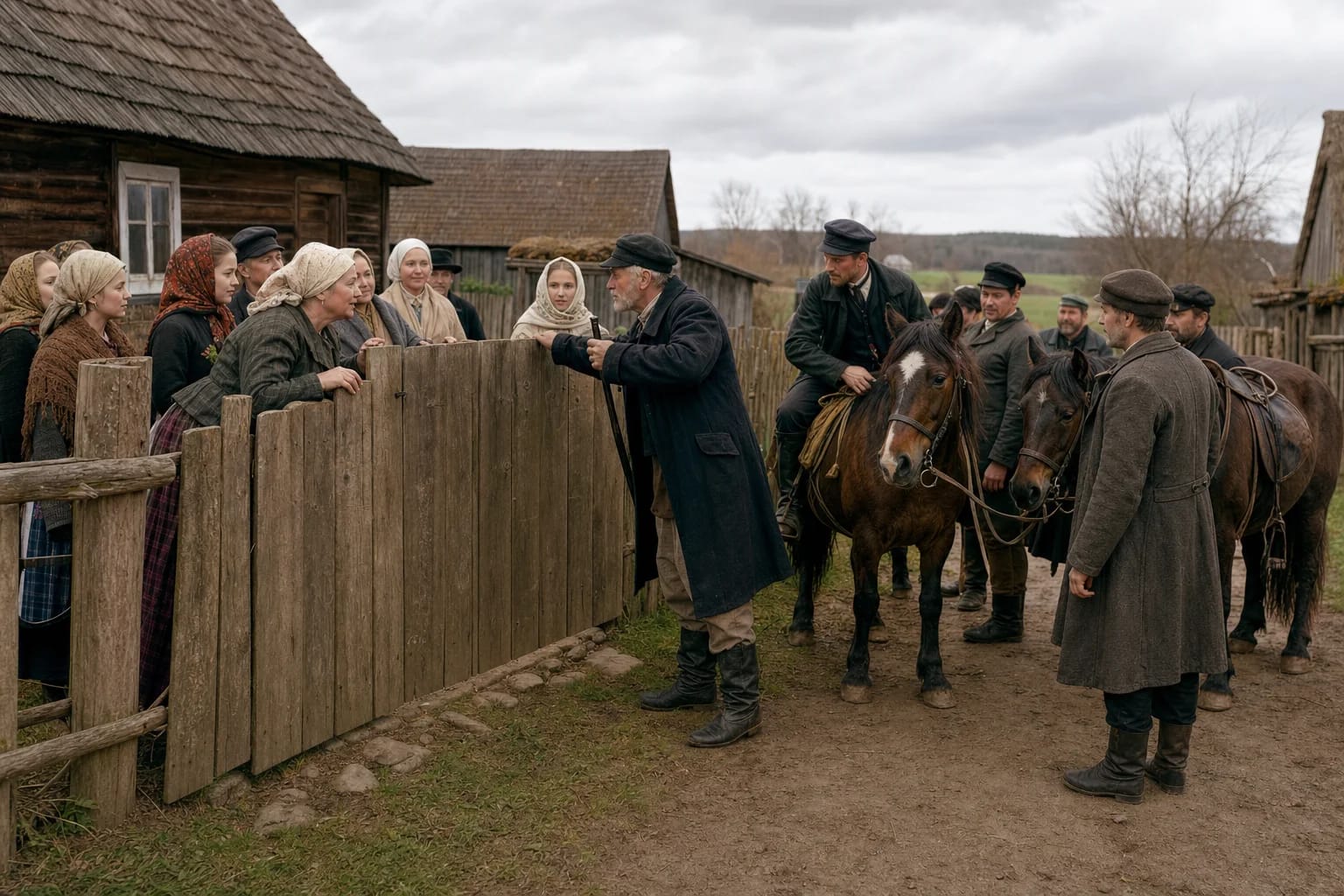
The groom arrived with a separate party. Until the end of the nineteenth century, this group was often male and sometimes mounted. The bride's side might close the gate, deny the arrivals a bench or table, hide the bride among veiled bridesmaids, and demand payment. Such acts staged the boundary between two groups and its negotiated crossing. They do not, without further evidence, prove that every ransom was a direct survival of actual bride purchase or abduction.
Church Marriage and Different Regional Routes
Banns, a public announcement to the parish of an intended marriage, appear in Lithuanian sources in the sixteenth century. After the Council of Trent, church marriage acquired compulsory legal force in Catholic lands, but household rites did not disappear. A church service may initially have confirmed an agreement already enacted at home; by the nineteenth and twentieth centuries, village customs increasingly framed the church marriage as its eve and continuation.
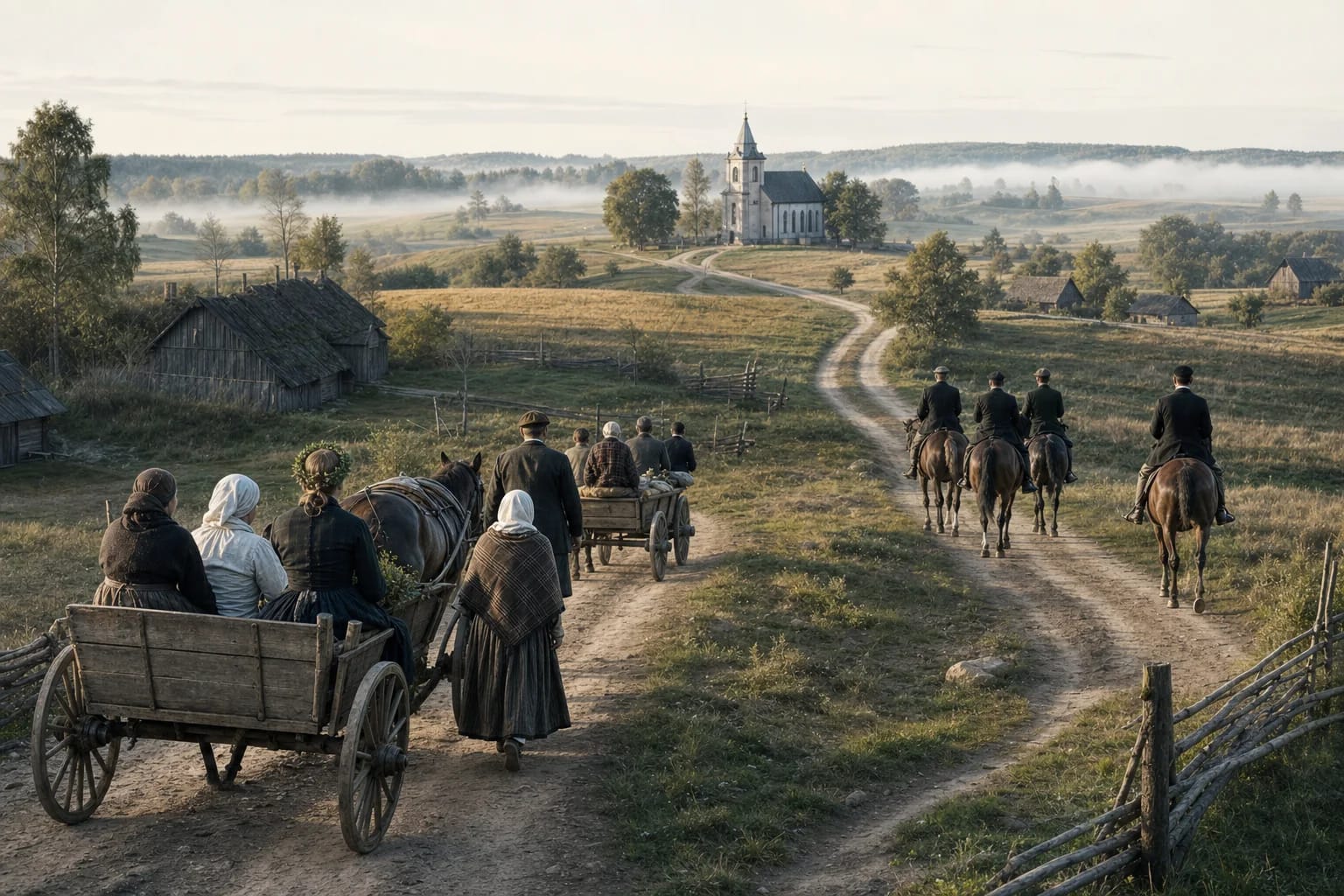
Into the first half of the twentieth century, bride and groom often traveled to church separately, each with an escort. In Suvalkija, bridesmaids might lead the bride and groomsmen the groom. In northern Zemaitija, the matchmaker went first, the groom's brothers led the bride, and her bridesmaids led the groom; in southern Zemaitija, sources more often name the vainiksegis for the bride and the svocia or vainiksege for the groom. These contrasts show why a single national diagram would mislead.
The Lietuvininkai of Lithuania Minor lived largely in an Evangelical Lutheran environment within Prussia and later Germany. The Catholic consequences of Trent cannot be applied mechanically to that region. Yet not every contrast between Zemaitija and Lithuania Minor was purely confessional: law, local custom, language, urban fashion, and movement across the border all interacted.
The Return, Ceremonial Gates, and the Shared Table
There was no single required route after church. In older Aukstaitian practice, bride and groom could return with their own parties to their respective homes, while the groom sent mituliai to watch over the bride until departure. Elsewhere everyone traveled to the groom's home or returned to the bride's; during the twentieth century the latter became common. Joint weddings funded by both families and receptions in halls or restaurants later spread.
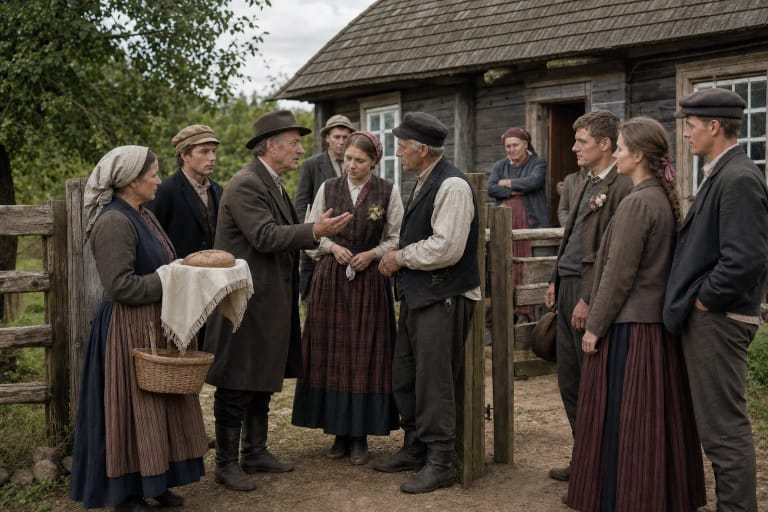
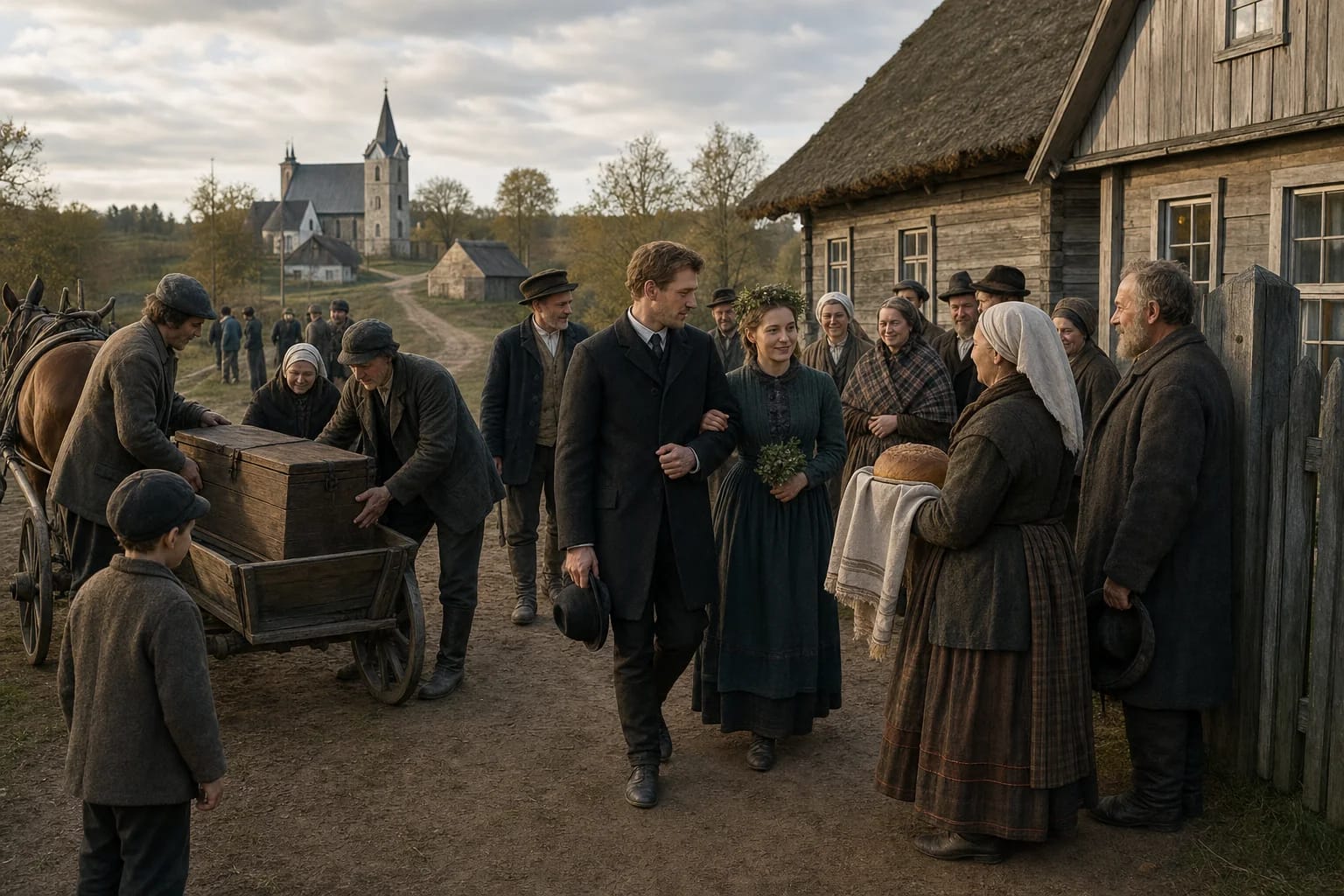
At the house, parents or hosts met the newlyweds as honored guests with bread, salt, and drink. In parts of Dzukija they were showered with rye, wheat, or oats. Village youth erected greeting gates. Long strings of roadblocks became popular as playful ransom in the late twentieth century, so a present-day barrier should not automatically be presented as an unchanged ancient custom.
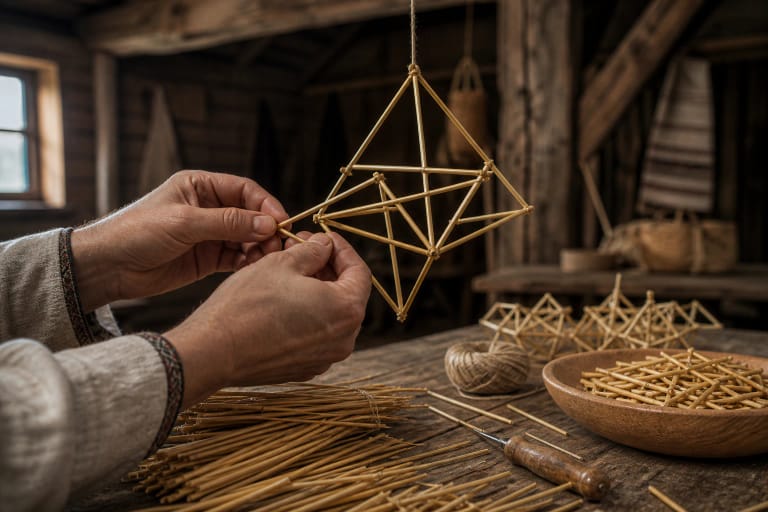
Sources from northern and eastern Lithuania and parts of the southeast mention redeeming a sodas or freeing the table. In wedding evidence, sodas can name different objects as well as the ceremonial space above or around the table. It should not always be equated with today's UNESCO-recognized craft of making straw mobiles; the origins and meanings of wedding sodai remain subjects of scholarly interpretation.
Sending the Bride Out and Changing Her Social Status
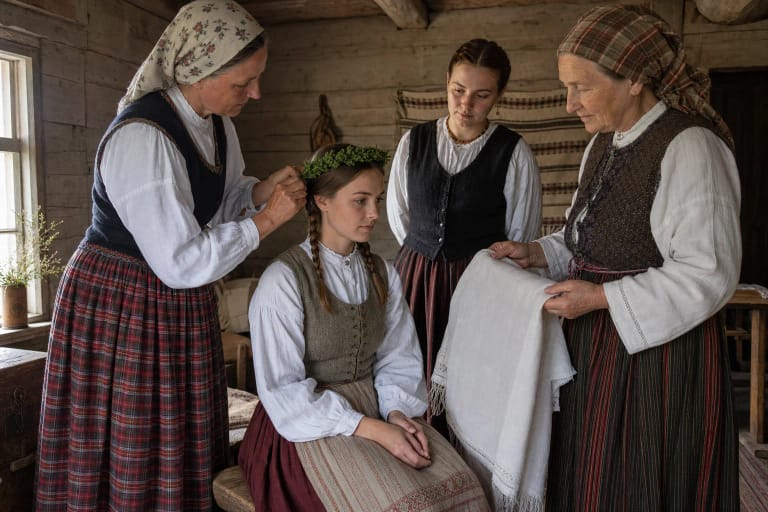
In farewell, the bride might kneel to kiss her parents, lament, circle the table, and name the home and people she was leaving. Removing the wreath, unbraiding the hair, and covering the head during gaubtuves marked more than a change of ornament: it publicly transferred a woman from the group of unmarried girls into that of married women. The performers and head covering varied. Cutting the hair was local and historically limited, not a universal Lithuanian practice.
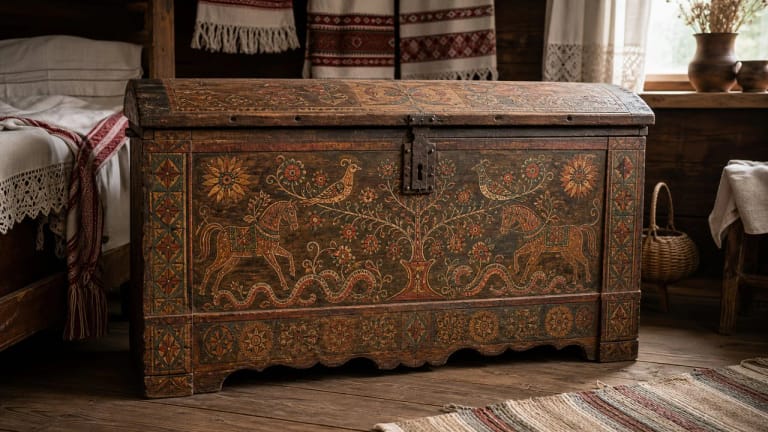
The dowry was removed at the same time: cloth, clothing, bedding, and other possessions accumulated by the bride and her mother. Men from the groom's side carried it, accompanied by representatives of the bride. This textile dowry was not identical to the whole property share or pasoga agreed by the families. In customary-law accounts, unused dowry remained the wife's property, although moving into the husband's farm placed her within an unequal patriarchal household.
This overview deliberately does not catalogue every farewell and gaubtuves detail. The dedicated page treats songs, wreath, braid, nuometas, dowry, and reception as one passage rather than a collection of attractive customs.
Receiving the Young Wife in the Groom's Household
The groom's mother received the young wife, in some places with water and salt. She might be led into the main room or granary, hang a patterned towel in the place of honor, receive a bowl of embers and a ladle, greet her father-in-law, and give him a sash. With the svocia and members of the groom's kin she visited parts of the farm and scattered grain and salt for livestock. These actions introduced her not to an abstract nation but to a specific household, its work, and its network of dependence.
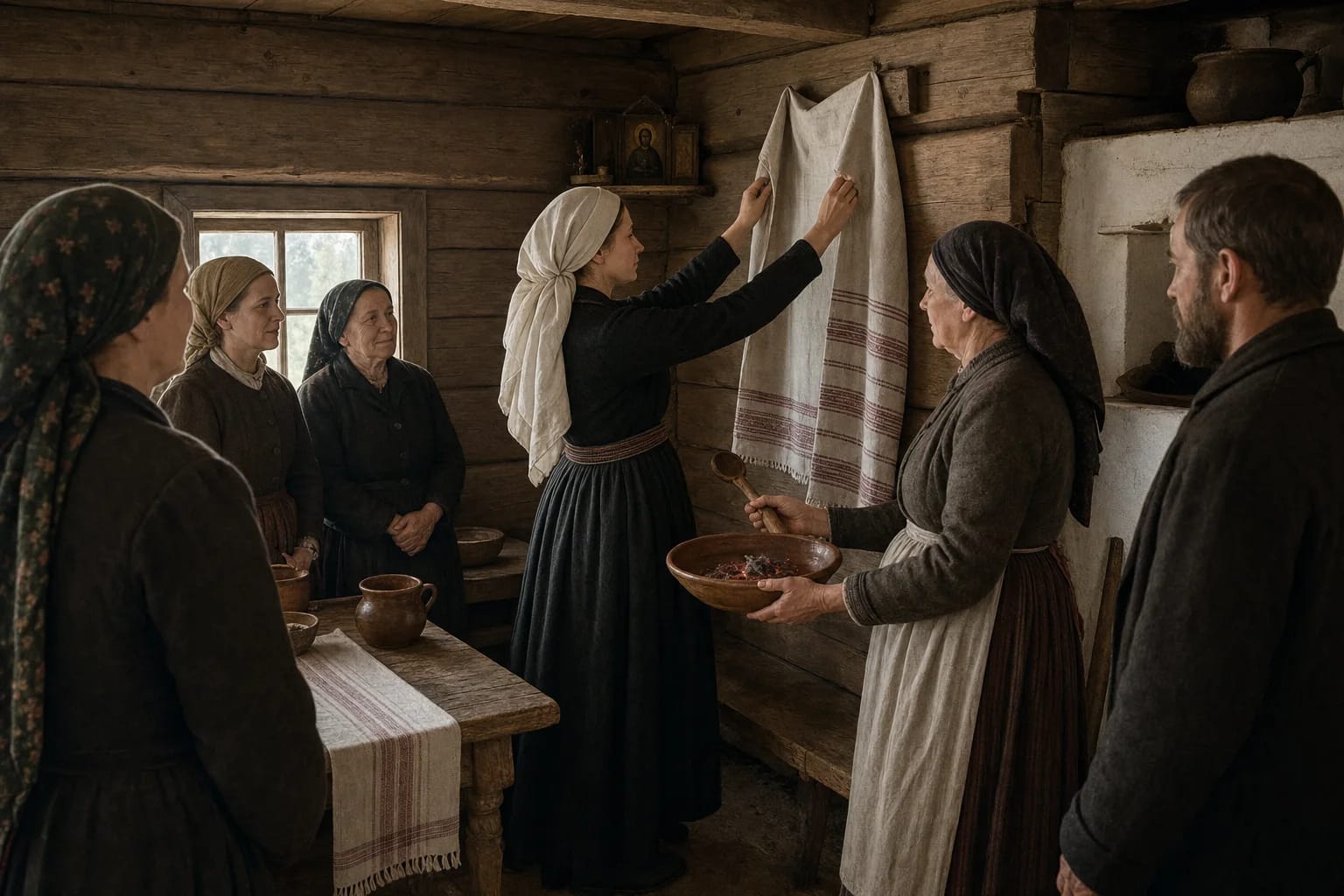
At the marcpietis, the bride served food brought from home and gave textiles to the groom's parents, siblings, and wedding officials. A first dance with a brother-in-law, senior groomsman, or father-in-law could be understood as admission to a new community. Towels, sashes, lengths of cloth, and clothing represented her labor and resources, but also worked as a language through which she bought a place in an unfamiliar household order.
Some ethnological writing interprets these actions as propitiation of household deities or guardian spirits. That remains an interpretation. A nineteenth-century participant might have understood the same act as custom, a wish for good fortune, a sign of household duty, or a Christian-compatible blessing rather than a conscious pre-Christian cult.
Atgrazstai: The Birth Family Bond Was Not Erased
On the first Sunday after the wedding—although timing and names varied—the newlyweds and the groom's parents could visit the bride's parents. The visit was called atgrąžtai, atgrįžtuvės, atlankai, or sugrąžtai. The closest relatives, matchmaker, svocia, and principal escorts attended a smaller feast. In some areas, the bride's parents later made a reciprocal visit to their son-in-law's family.
The custom shows that sending a daughter out did not erase her from her birth kin. The visit reopened ordinary contact, and the family might collect a remaining property share or agreed livestock. Atgrąžtai declined rapidly around the middle of the twentieth century as the farm and inheritance system that gave the visit practical force broke down.
Twentieth-Century Change and What Counts as Tradition Today
Nationalization and collectivization under Soviet occupation destroyed much of the private-farm basis of the wedding system. Inspecting the groom's farm, negotiating a property share, assembling a large textile dowry, transporting chests, and collecting the remainder during atgrąžtai lost their earlier practical meaning. Civil registration became the legally required act, while some church marriages took place separately or in secret. Culture-house performances and family receptions reworked the matchmaker, svocia, wreath, gate, and hearth motifs.
White wedding dresses began appearing in Lithuania in the late nineteenth and early twentieth centuries, then became a mass norm later, especially during the Soviet period. Passing a wreath or veil to a bridesmaid, lighting a symbolic family hearth, presenting household tools to both spouses, and long sequences of humorous ransoms may be meaningful modern customs, but they should not be labeled unchanged ancient rites. Kupiskenai Weddings are especially important as an ethnographic performance tradition begun in 1933, interrupted in 1941, and revived in 1966 from local memory, songs, and research.
Responsible use of tradition does not require a modern couple to repeat historical gender, property, or obedience relations. It is valuable to understand the ritual structure, hear the songs, identify the region, and choose consciously what to continue. Heritage stays alive when its change is visible—when an old, local, reconstructed, or newly created layer is named honestly.