- When / context
- For urgent seasonal and one-off work, especially from haymaking through late autumn
- Tradition area
- Community life
- Themes
- Talka, reciprocal labor, neighbors, harvest, haymaking, manure hauling, flax, threshing, building, work songs, feast, patalkys
Talkos were forms of collective work in which neighbors, relatives, household members, and sometimes hired workers gathered for an urgent task or one requiring many hands. Reciprocal labor was central, but talkos also included paid work, estate obligations, compulsory Soviet campaigns, and modern civic volunteering.
What Was a Lithuanian Talka?
The Universal Lithuanian Encyclopedia defines talka as collective work and unpaid help, usually for a difficult or urgent task. That captures its central form: one farm gathered enough people to complete something that exceeded the household's labor. Yet the history is broader than a single definition. Workers might be neighbors, relatives, hired hands, or people repaying earlier assistance.
A talka was both a labor technology and a relationship system. It could save ripe grain from shedding, move manure in one coordinated day, keep a threshing machine supplied, break dried flax, or shift heavy logs. At the same time it revealed who trusted whom with time, animals, tools, and future obligations. It is therefore better understood as organized shared work with a social dimension than as a spontaneous village festival.
Atodirbis: Help That Had to Be Returned
From the late nineteenth century through the first half of the twentieth, many talkos operated through atodirbis, reciprocal labor. A neighbor helped with the expectation of receiving similar assistance at their own busy time, or came to repay help already received. The unit was not simply money: a working day, use of a horse and cart, and the labor of an accomplished mower or other specialist all carried different weight. This was not exact bookkeeping in every household, but it protected a rough balance.
National descriptions sometimes emphasize family ties, especially in Žemaitija, while local studies show a mixed group of neighbors and nearby relatives. Invitations might be issued several days in advance; for a short job such as slaughtering, assistance could be requested that morning. Trust was practical. The host needed enough people to arrive at the agreed time, and workers needed confidence that their own future need would not be ignored.
Not Every Talka Was Unpaid or Voluntary
A romantic picture of freely assembled neighbors can hide significant distinctions. Jonas Mardosa's study of the Vaiguva area records payment in cash or goods alongside reciprocal labor. Women pulling flax might receive flax, grain, or an agreed fee, and service contracts could require farmhands to join the employer's talkos. Food was then not merely a gift but part of what a host owed the people whose labor sustained the farm.
The word also changed meaning under unequal power. Eugenijus Saviščevas shows how an older custom of communal work in the Grand Duchy of Lithuania could be transformed into an estate obligation during peak agricultural periods. Soviet 'communist subbotniks' were officially called voluntary, although they were compulsory for employees of state enterprises and institutions; students and schoolchildren were also mobilized. Reciprocal help, paid labor, manorial or state compulsion, and genuine volunteering must therefore be kept separate.
From Haymaking to House Building: The Range of Talkos
National accounts list talkos for haymaking, rye harvest, potato lifting, flax pulling, flax breaking and scutching, manure hauling, threshing, feather stripping, moving logs, house building, and slaughtering livestock. The range extended beyond field agriculture into textile materials, food stores, forestry, and construction. A building talka could begin in the forest or with hauling timber, not only when a wall was being raised.
This list is not a rule for every village. In Vaiguva, plowing, sowing, and even haymaking normally belonged to the household; a group was called only after illness, misfortune, lack of a second horse, or another exceptional need. Manure hauling, rye harvest, threshing, flax breaking, and pig slaughter were more typical there. It is accurate to say that a task could be done as a talka, but not that everyone in Lithuania always did it through a single village crew.
Manure Hauling as a Coordinated Work Chain
Manure hauling shows why a talka needed organization. Material had to be forked from the cowshed, loaded, carried by cart, unloaded and spread in the field, and soon plowed under before it dried or was washed by rain. In parts of Žemaitija this was such a characteristic communal job that people called it simply talka. Farms could be served in sequence, so a delay at one disrupted the plans of several neighbors.
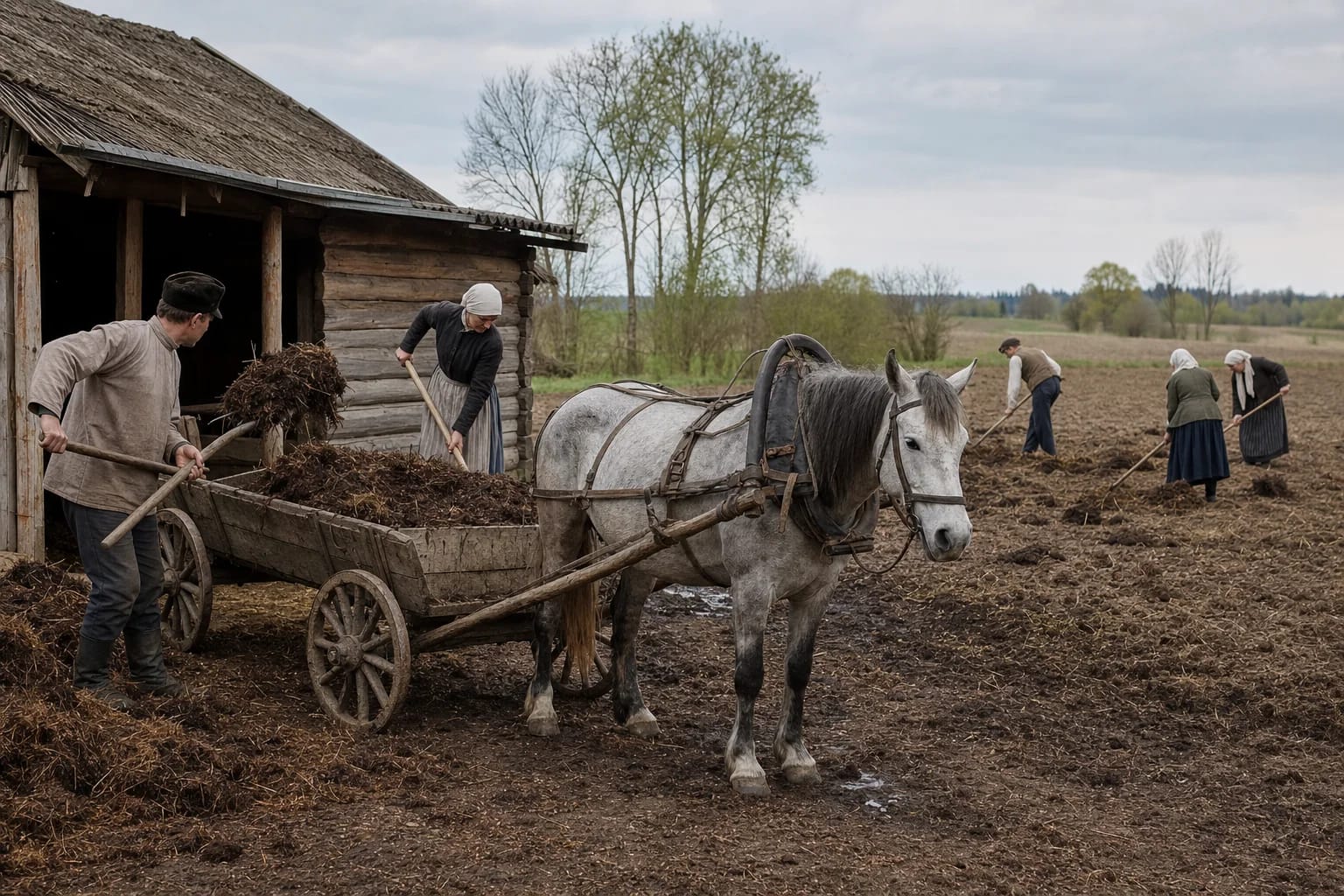
Accounts from Vaiguva distinguish workers pulling material from the shed, people driving horses and carts, spreaders in the field, and older children helping to lead horses. Roles differed from farm to farm, but the principle is clear: a talka was a coordinated chain, not a crowd performing the same action. A truthful historical image includes muddy sheds, wooden carts, horses, and several work stations rather than festive clothing.
Harvest, Threshing, and the Pace Set by Machinery
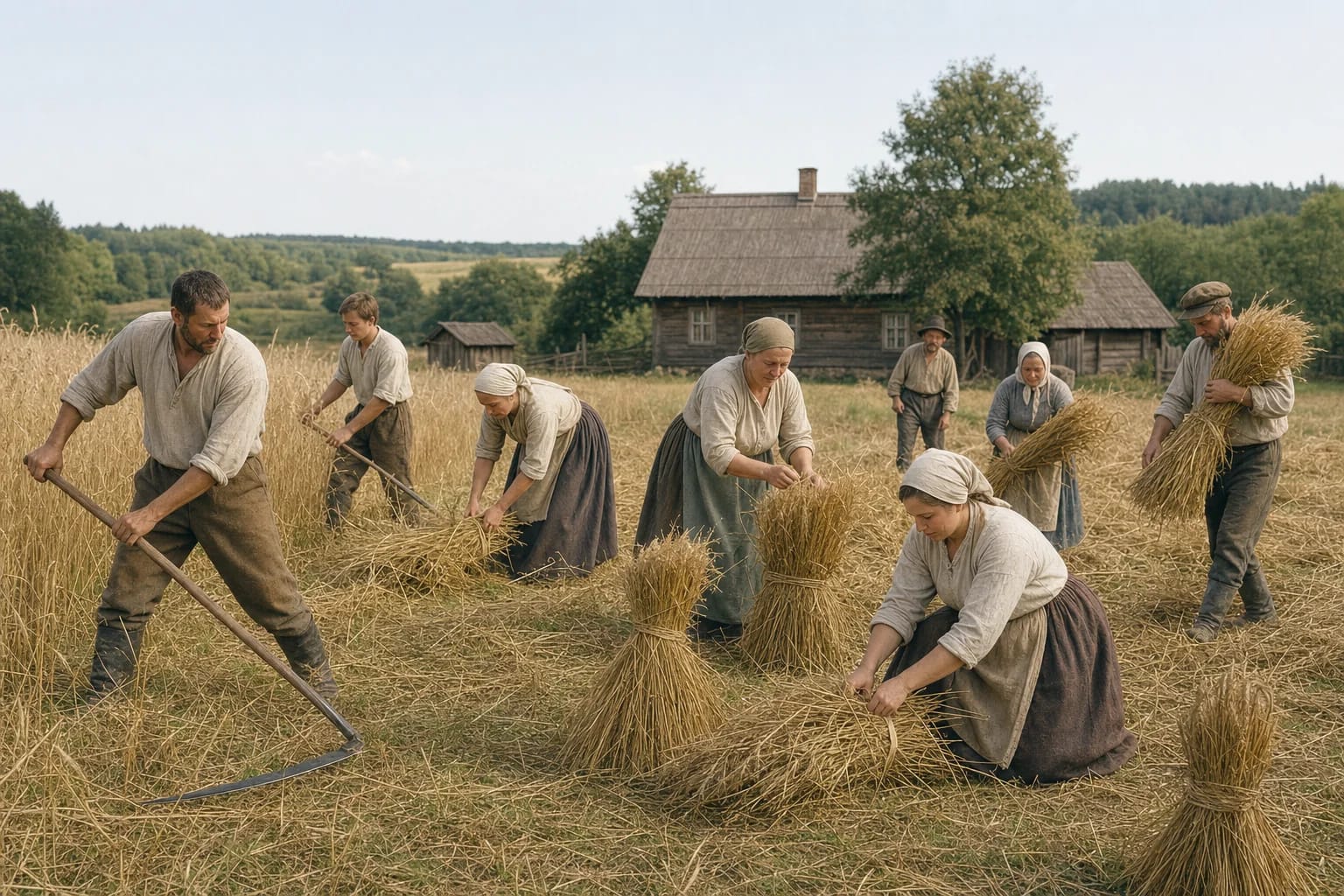
At rye harvest, men might cut with scythes, women bind sheaves, and children carry them, although roles varied by locality and household. People worked in pairs or strips, competed, and took short breaks. The final sheaf and wreath customs belonged specifically to harvest completion and must not be transferred to every talka. They are treated in greater detail on the Oninės page.
Machinery changed threshing in a more complex way than simple disappearance. Hand flailing required a shared rhythm. In the interwar period a horse- or engine-driven threshing machine might demand a large crew with sharply divided jobs. The machine set a relentless pace, leaving little room for games while it ran. Early mechanization could increase the number of hands needed at once; only later did more efficient equipment reduce it.
The Workers' Table as a Host's Responsibility
Feeding workers properly was not a decorative extra. The Universal Lithuanian Encyclopedia mentions ham, skilandis, meat-filled potato pudding, vėdarai, and mutton; local studies add porridges, kastinys, cheese, butter, bread, kvass, and other dishes. This was not one mandatory Lithuanian menu. Summer fieldwork favored portable food and drink, autumn brought more meat, and Friday or other fasting rules could alter the meal.
The Vaiguva material also records a day unlike ordinary household routine: workers might arrive after breakfast, while the largest meal came at supper or at completion. Good food honored labor and strengthened future reciprocity; a stingy host risked receiving less help next time. Yet for a hired hand or poorer neighbor, the meal could also be a concrete part of compensation and the day's nourishment, not merely symbolic gratitude.
Work Songs and a Rhythm Sustained by Voice
Song could coordinate people, sustain morale, and mark the pace. The Lithuanian Institute of Literature and Folklore's work-song volumes show collective organization, relationships among reapers, and the feel of tempo in morning and midday harvest songs. Evening songs express exhaustion or unfairness; completion songs turn to the wreath, the return through the yard, and wishes offered to the host.
The evidence does not mean every talka throughout Lithuania sounded the same. Rye-harvest songs are especially well documented in northeastern, eastern, southeastern, and southern Lithuania. A noisy threshing machine or a different region produced another soundscape. Songs therefore belong with a particular task and place. The site's work-song collection presents individual pieces, while this page explains the labor relations around them.
Completion and Patalkys Were Not an Automatic Party
After an important task hosts might provide a closing meal, and young people could arrange a patalkys with music, dancing, games, and beer. Žilvytis Šaknys's study of 331 informants found major variation: parties were mentioned most often after threshing and flax breaking, while they were much rarer after manure hauling, flax pulling, potato lifting, rye harvest, or feather stripping. Even within one region, people danced in one village and ate briefly before going home in another.
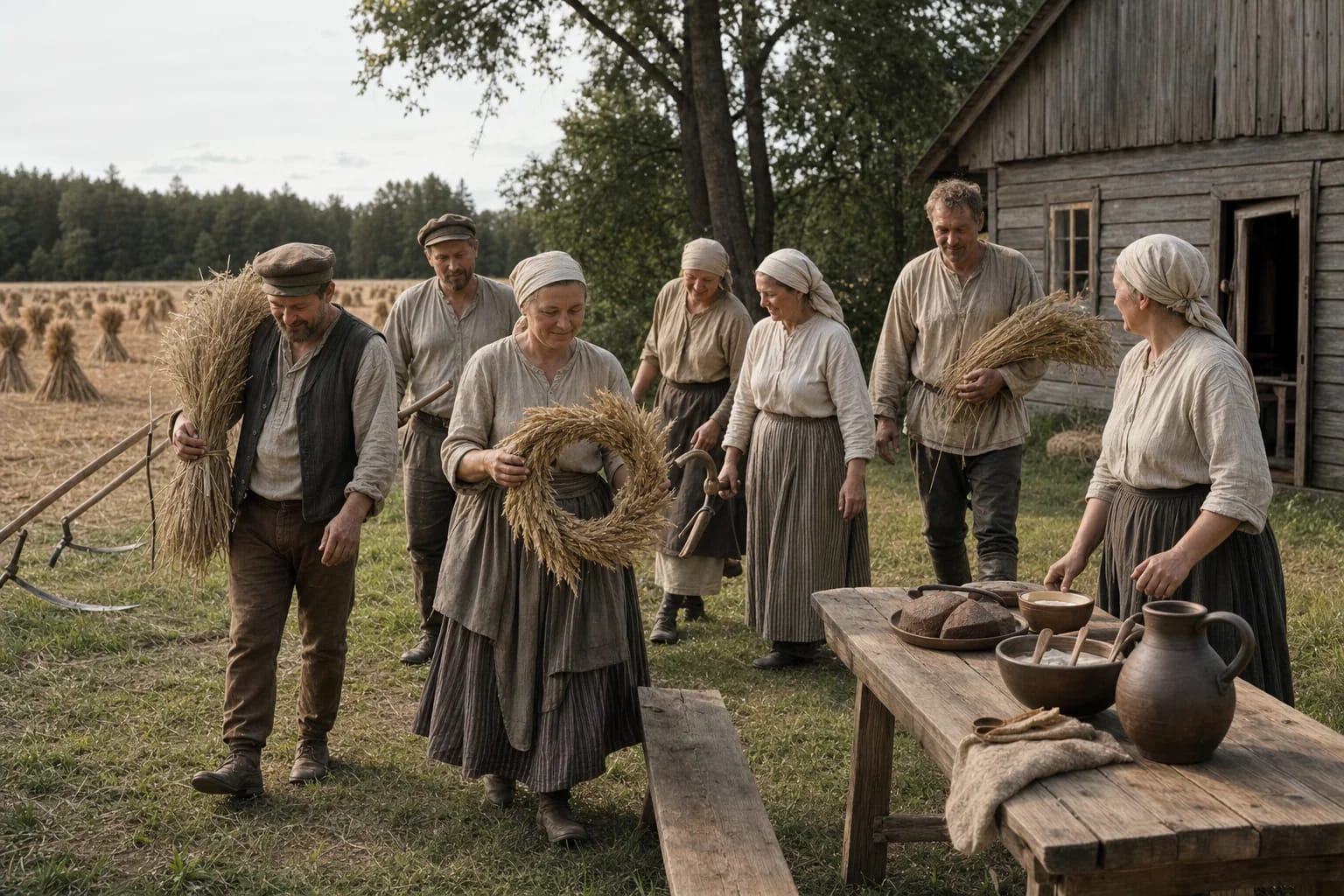
Patalkys is therefore best presented as one possible form of completion. Harvest could end with a wreath and formal return; a flax-breaking night with games; threshing with supper after the machine stopped; and short slaughtering help with a meal and a portion of meat. Work, food, and entertainment formed a chain of exchange, but each link had a different weight in each setting.
From a Neighbor's Farm to a Civic Work Day
The division of villages into separate farmsteads, wage labor, mechanization, and later collectivization reduced the need for large agricultural talkos. Potato planting and lifting, bringing in hay, manure hauling, slaughtering, and construction help still survived in the later twentieth century, but a large neighborly crew became less common. Rasa Paukštytė-Šaknienė's recent research near Vilnius found more small reciprocal acts—watching animals or a greenhouse, bringing firewood, or lifting something heavy—than old mass work gatherings.
Since the restoration of independence, talka has also become a word for public volunteering: people gather to clear an area, plant trees, or care for a shared site. Civic talkos retain collective action but do not necessarily operate through household atodirbis. Family and friends also help one another move, renovate, or harvest. What survives is not one frozen rite but the principle that a large job becomes manageable when responsibility is shared.