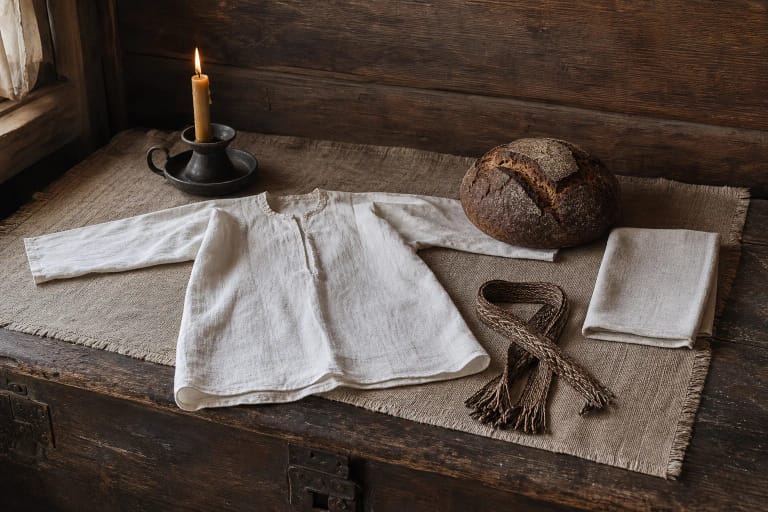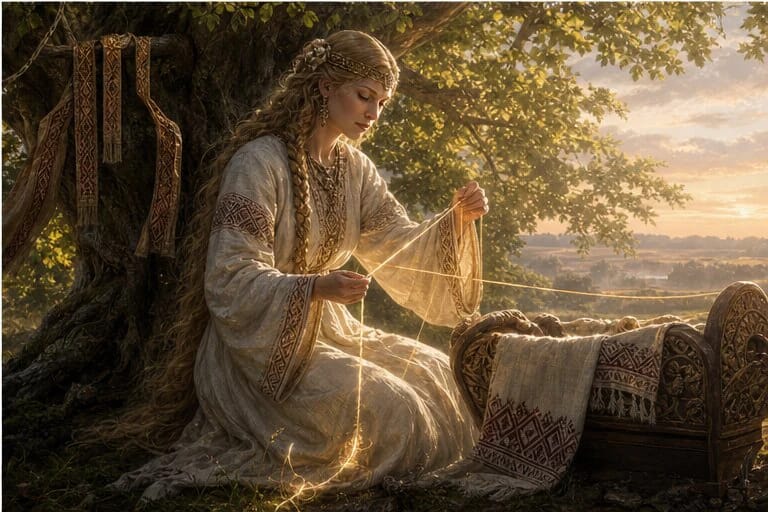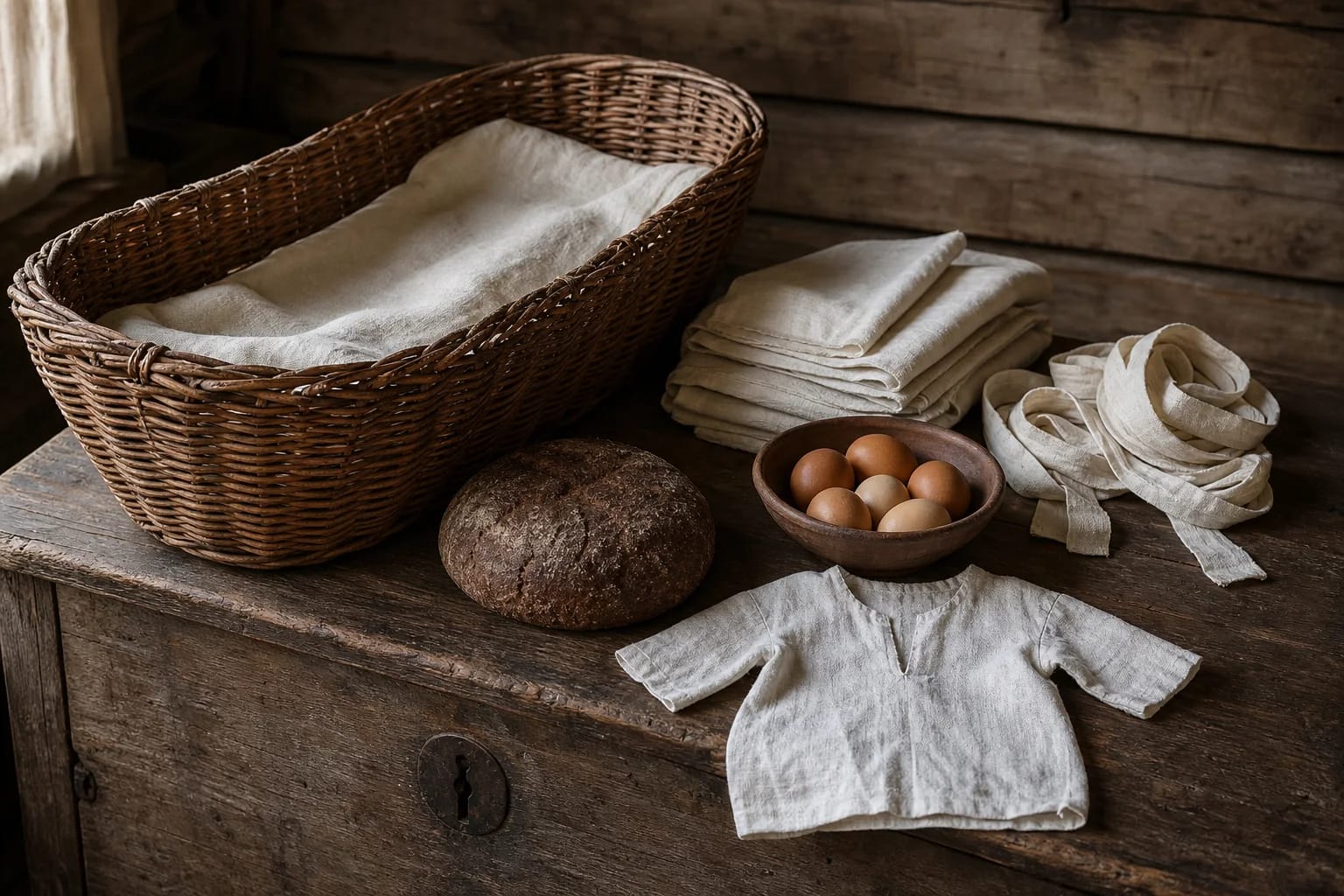
- When / context
- From pregnancy and birth through visits, baptism, and the mother's return to community life
- Tradition area
- Life cycle
- Themes
- Birth customs, pregnancy, childbirth, birth attendant, newborn, lankynos, palankynos, radynos, lullabies, play-songs, churching, regional and confessional differences
Lithuanian birth customs encompassed far more than the moment of delivery. Studies of the late nineteenth- and early twentieth-century countryside trace a cycle from pregnancy through childbirth, the village birth attendant's help, newborn care, women's visits, baptism, and the mother's return to religious and village life. Practices differed by place, confession, family status, household means, and period. They are presented here as historical ethnography—not modern medical advice or one ceremony once performed throughout Lithuania.
Gimtuvės Was More Than One Day
Ethnologist Rasa Paukštytė-Šaknienė analyzes gimtuvės as part of the human life cycle in which physical birth was not the whole event. A household had to care for mother and newborn, while the community had to recognize a new member. The sequence therefore extends from pregnancy and delivery to visits, baptism, and the mother's churching. These stages belonged together, but their duration and meaning were not identical in every locality or family.
A central source for this page is the Lithuanian Institute of History monograph published in 1999. It draws on fieldwork undertaken in 1989–1996: responses from 552 informants—mostly women born between 1890 and 1930—across 44 Lithuanian districts and the Punsk area. This is a broad but retrospective picture of the rural late nineteenth and first half of the twentieth century. It does not justify calling every recorded belief ancient, universal, or alive today.
Pregnancy and the Village's Social Rules
Pregnancy was treated as an exceptional condition in the communities studied. Sources record numerous instructions, prohibitions, and guesses that attempted to explain a future child's sex, appearance, or temperament. They reveal a historical worldview and anxiety about the unknown, not biological or medical knowledge. Such material should always be framed with 'people believed,' 'it was thought,' or 'an informant recalled,' never rewritten as advice for an expectant parent.
Custom also served as social control. Village opinion elevated motherhood within marriage while an unmarried mother could face public censure, exclusion, and humiliation. Paukštytė's work documents rather than endorses that inequality. Any account of the family ideal must therefore acknowledge its cost: a woman's reputation was judged more harshly than a man's, and boundaries imposed by adults could harm a blameless child.
The Pribuvėja: Village Birth Attendant and Helper
The pribuvėja, commonly called bobutė and locally baba or babūnė, was an experienced woman summoned to attend a birth. Most had no formal medical education; knowledge came from observation, assisting other women, and practice. In some early twentieth-century cases, a doctor or trained midwife provided limited instruction. This distinction matters: respect for the attendant's communal role must not become romantic endorsement of unsafe procedures.
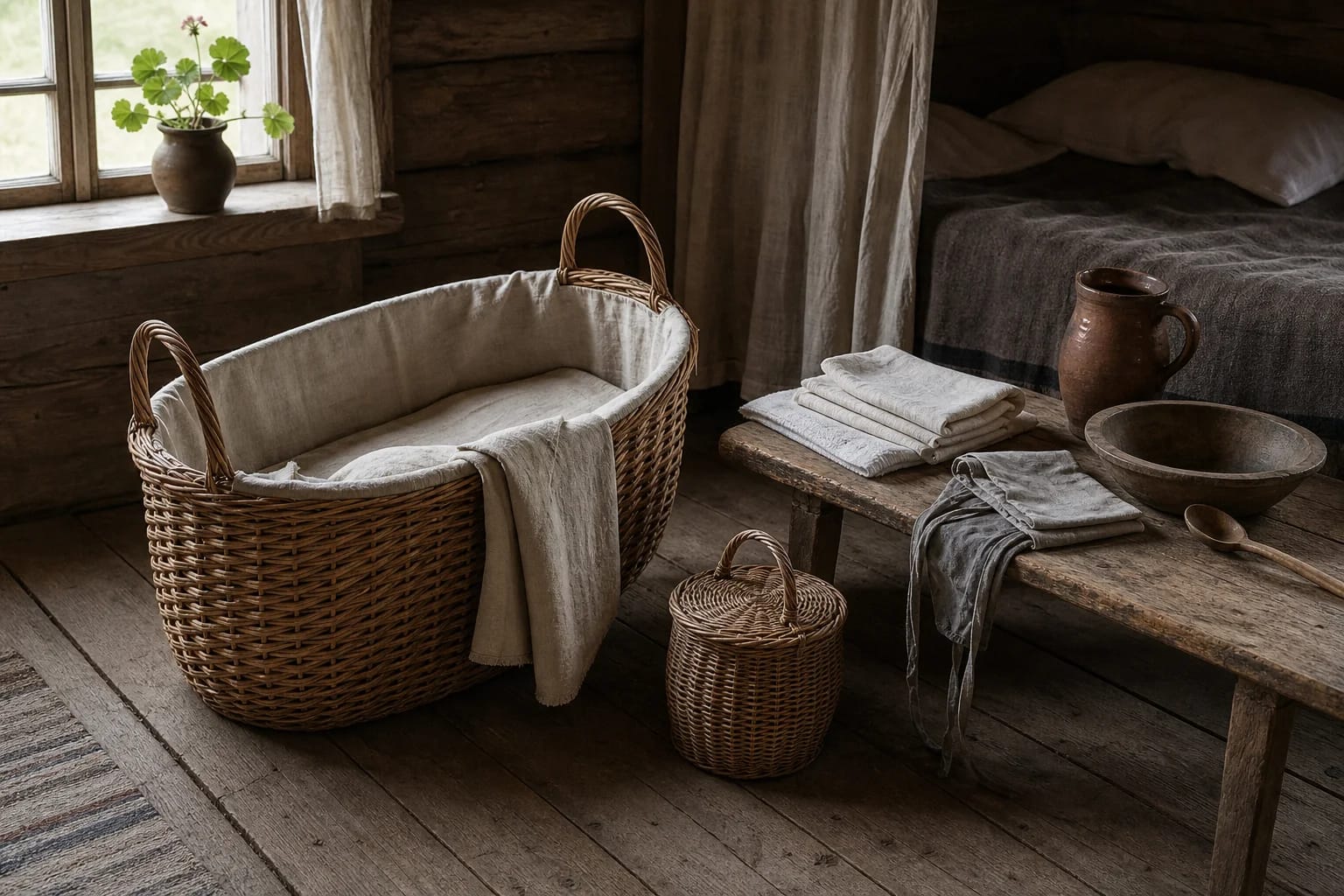
After delivery, she washed and swaddled the baby, arranged the bed, prepared food or drink for the mother, and sometimes took on household tasks. Payment was usually food or money. Eastern Lithuanian evidence also mentions cloth, including linen in eastern Aukštaitija and Dzūkija. Aid could work in both directions: an attendant might bring nappies or other necessities to a poor household.
She also held social and ritual authority. Before baptism she protected the baby, prepared it for the journey, received gifts from the sponsors, and handed the newborn to them. Later baptism-party games involving stolen hats, ransoms, or 'grandmother's porridge' preserve traces of that earlier standing. When trained midwifery reduced the practical role, some actions became playful ceremony performed by a grandmother or older relative.
The Newborn's Earliest Care
First washing and swaddling carried two kinds of meaning in the sources. The practical task was to warm, clothe, and care for the baby. The symbolic layer included objects placed in water, predictions drawn from bodily features or birth time, and wishes for health, diligence, or good fortune expressed through the attendant's actions. These practices show a community giving order to an uncertain beginning; their outcomes were not medically tested.
The monograph also records folk remedies, but they belong to medical history. Hemorrhage, infection, and obstructed labor could be fatal then as now, and few village attendants had specialized training. A cultural-history page should not reproduce dosages or procedures or promise effectiveness. The responsible approach is to understand how women tried to help with the resources they possessed while recognizing the importance of professional obstetric care.
Why Was the Time Before Baptism Considered Dangerous?
In late nineteenth- and early twentieth-century testimony, an unbaptized baby was often imagined as not yet fully admitted to the community's order. Caregivers made the sign of the cross, avoided displaying the infant to strangers, or covered the cradle with cloth. Records from Samogitia, Aukštaitija, and other places mention holy water, salt, and religious signs. In Protestant Lithuania Minor, a hymnal placed near the child provided a confessional emphasis that cannot simply be transferred to the rest of Lithuania.
Stories of the evil eye, Laumė, Apmainė the changeling, or the soul of an unbaptized baby belong to historical belief and narrative folklore. They reflect high infant mortality, family anxiety, and the period's religious imagination—not a real supernatural threat. Sensitive motifs should be explained without frightening readers and without assuming that everyone believed them alike. One informant's memory proves that the story was told; it does not by itself establish a national custom.
Lankynos, Palankynos, Radynos, and Apgėlai
Visiting mother and baby was a form of mutual aid among women. In Paukštytė's material, visitors often came before the mother was fully back on her feet; many were married women with children of their own. They arrived alone or in groups with bread, eggs, other food, linen, or baby clothing. In some places an empty-handed visitor was thought envious of the baby's happiness. That is a recorded belief, while bringing food also offered tangible support to a recovering mother.
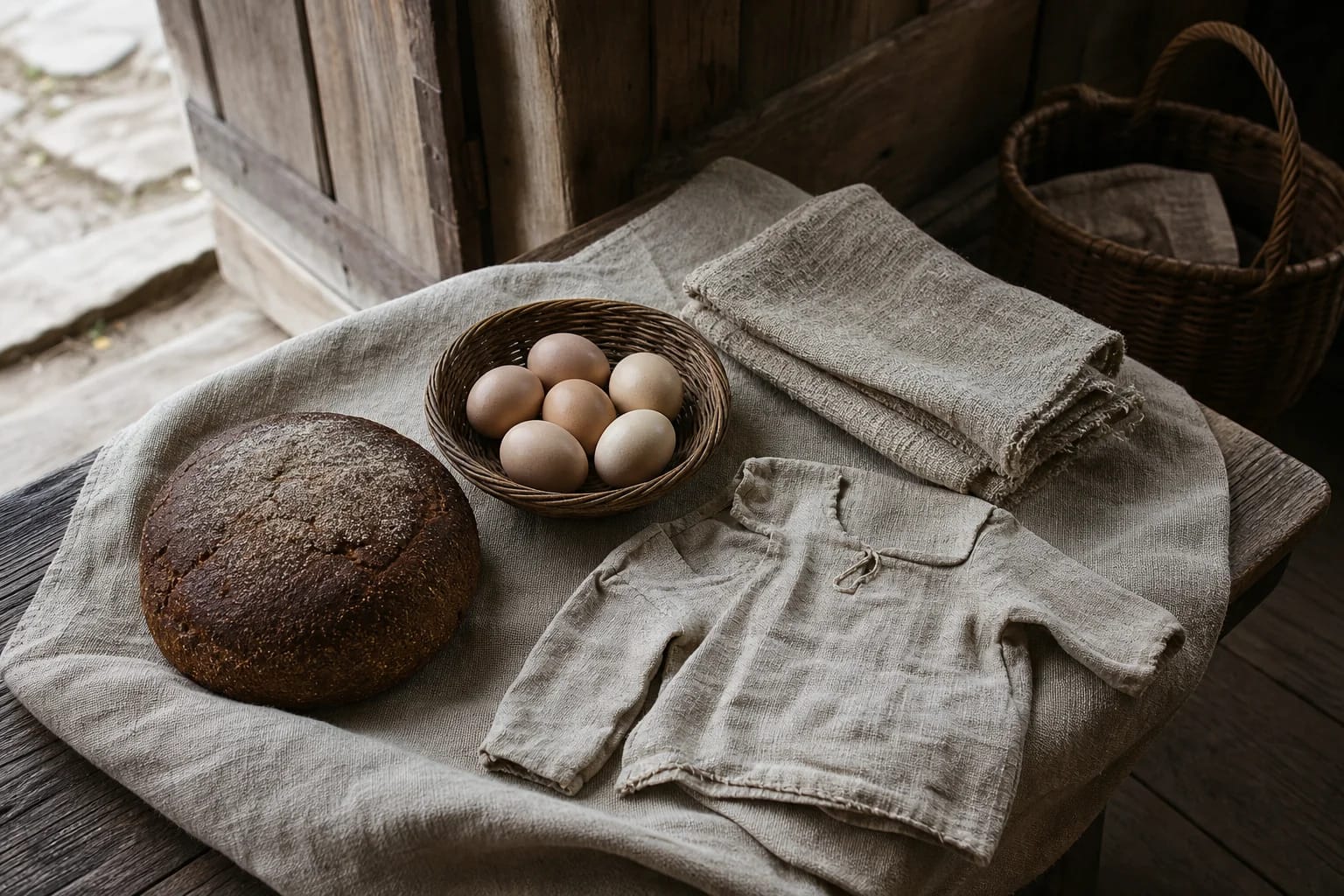
The vocabulary has a revealing geography. Sources contain lankynos, palankynos, atlankai, apgėlai, radynos, patakai, patekylai, and additional forms. Palankynos is often associated with Dzūkija, radynos with the Biržai and Pasvalys area, and patekylai with the vicinity of Švenčionys, but boundaries were not fixed. The same word could change meaning: an early occurrence of apgėlai has also been connected with a child's first haircut, whereas later evidence uses it for a postpartum visit and meal.
The visit created a female support network but also exposed its limits. Childbirth knowledge was treated as a subject protected from men, and women themselves were not always admitted on equal terms. It is best understood in both ways: as practical exchange of food, experience, and attention, and as a space constrained by historical social rules. Bringing a warm meal to new parents today can continue the ethic of care without reproducing the old exclusions.
Lullabies and Play-Songs: Folklore Closest to the Baby
A lullaby is a short song used to soothe a baby to sleep. Lithuanian lullabies favor a slow tempo, repeated refrains such as a-a-a, čiūčia liūlia, and lylia lylia, and improvisation. A mouse, hare, or cat may bring sleep, while the singer wishes for the child to grow, remain healthy, or become a household helper. The words are not a fixed canonical text: Lithuanian National Culture Centre publications invite caregivers to adapt them to the child, as traditional singers did.
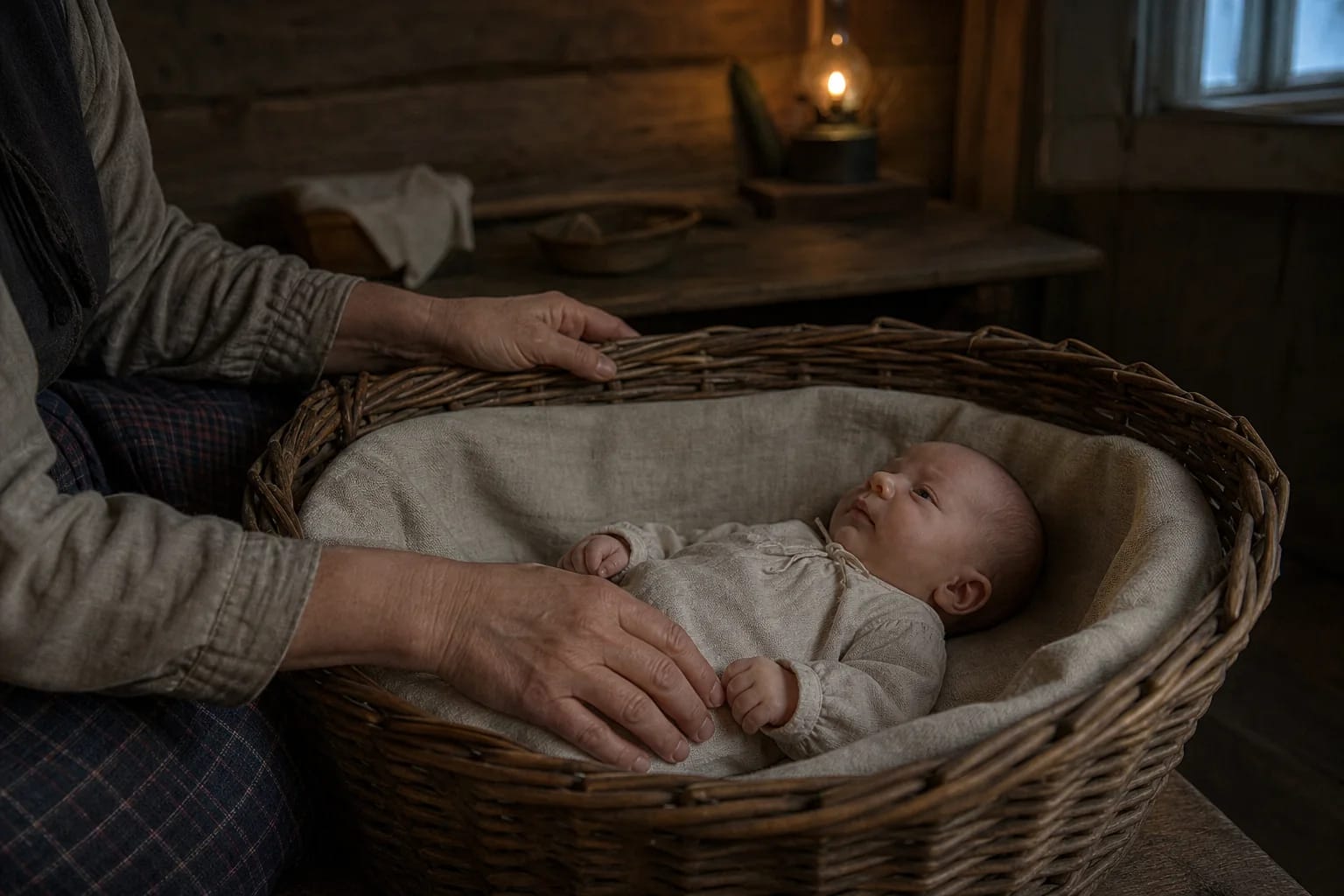
Play-songs are short pieces accompanied by movement. An adult bounces, cuddles, tickles, or moves the baby's fingers and palms while imitating riding, cooking porridge, or baking bread. Voice, rhythm, touch, and focused attention work together. Historical accounts most often show mothers, grandmothers, and nursemaids, but a living tradition need not be restricted by gender: fathers, grandparents, older siblings, and other close caregivers can carry it forward.
Jurga Sadauskienė examines the value of lullabies and play-songs through a contemporary psychotherapeutic perspective, emphasizing felt safety, emotional bonding, and empathetic interaction. This is analysis of culture and performance, not a promise that folklore cures illness. Nor is the repertoire uniformly gentle: wolves, bogeys, punishment, and death appear in some texts. Intonation, play, age, and family setting shape their meaning, so a line isolated from performance can mislead.
Churching and the Mother's Social Return
In the historical Catholic countryside, the birth cycle concluded with the mother's churching—a blessing after childbirth. Timing varied, often falling several weeks after delivery. Paukštytė interprets it socially as well as religiously: it marked the woman's return to village life and a wider sphere of activity. Small family meals were still held for the occasion in some places but were already fading in evidence from the first half of the twentieth century.
This should not be described only as a warm celebration of motherhood. Access and community judgment depended on marital status, and unmarried mothers could be rejected. Catholic churching is also not an adequate model for the experiences of Lutheran, Reformed, Orthodox, Jewish, or nonreligious families. A single page can define the boundaries of its principal evidence; life-cycle traditions in other communities require separate research.
From Home Birth to Living Family Memory
During the twentieth century, the place of birth and the authority of the helper both changed. Trained midwives, health posts, and hospitals became more accessible, gradually removing childbirth itself from the village attendant's responsibility. Her presence in the household shortened or changed, while baptism celebrations retained only selected signs of her former role. This was not simply a loss of tradition: professional care reduced danger to mother and child.
Some ideas proved more durable than particular actions. Relatives still visit a new family, bring food or practical gifts, and help with childcare, while lullabies pass through homes, early-years groups, and cultural publications. Lithuania's inventory of intangible heritage presents lullaby singing and infant-soothing as a living practice that changes within families. Continuity here means care, voice, and mutual aid, not the exact reproduction of an old tableau.
Birth heritage can be renewed responsibly by recording family memories, learning a lullaby, visiting new parents at a time they welcome, or giving something genuinely useful. There is no need to reenact unsafe remedies, turn historical fears about babies into entertainment, or proclaim one local belief the truth of every ancestor. The most valuable legacy is not supposed magic but a community's effort to receive a new person safely.