- Field
- Linen towels, abrūsai, towel racks, and ritual home textiles
- Type
- textiles
- Heritage status
- well attested
- Context
- Towels, abrūsai, towel racks, linen cloth, žičkai, pinikai, lace, initials, wedding gifts, guest towels, home textiles
Abrūsai, Abrūsėliai, Linen towels, Hand towels, Guest towels
Towels forms and objects
Everyday towels: Simpler linen or tow-cloth textiles used for hands, face, dishes, or work, often with less decoration.
Guest towels: Whiter, more finely woven abrūsai hung on a towel rack to show household order and honor a guest.
Ritual and gift towels: Towels used in weddings, christenings, funerals, dowries, and gift exchange, carrying social and symbolic meaning.
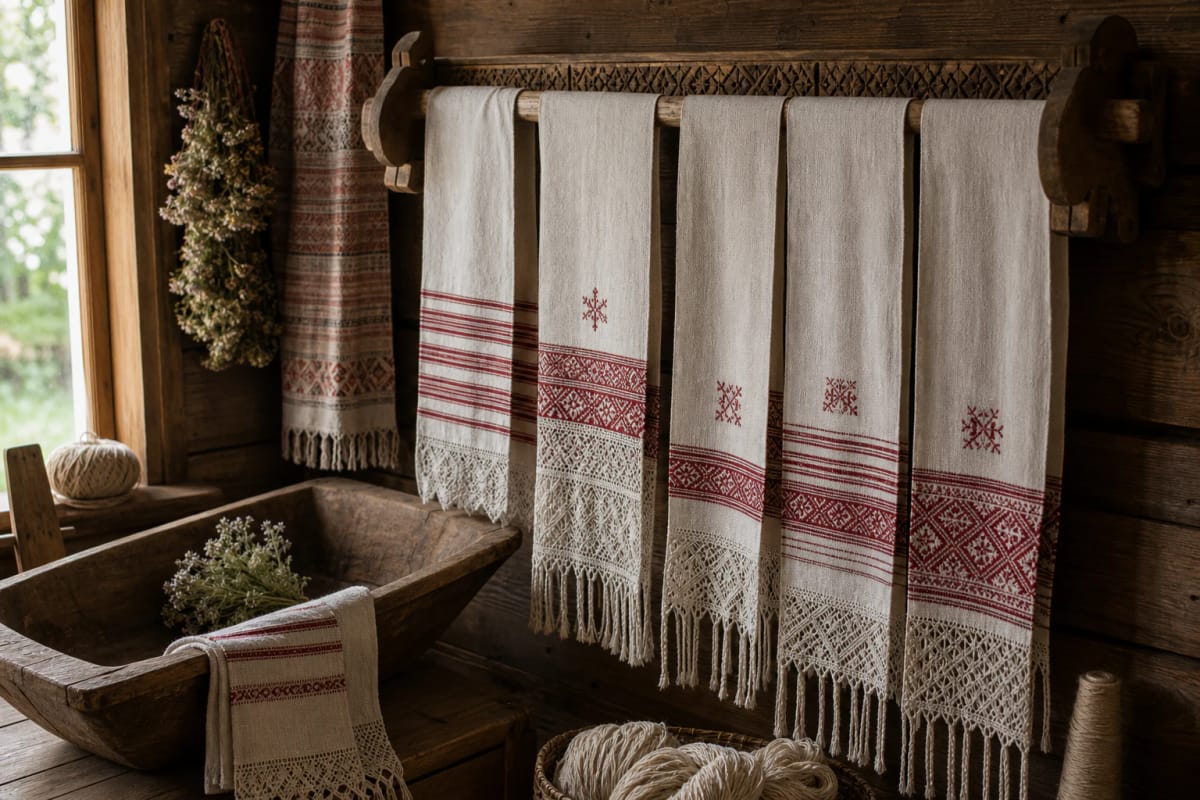
Towel-rack textiles: Long towels specially hung on a wooden rankšluostinė so that ornamented ends, pinikai, and the whiteness of the fabric were visible.
What Is a Traditional Towel?
A traditional Lithuanian towel, often called an abrūsas or abrūsėlis, is a linen or mixed-fiber textile used for drying but also carrying strong representative and ritual meaning. It was an everyday object, a gift, part of the dowry, and visible home textile.
The Universal Lithuanian Encyclopedia notes that old towels were narrow and long, often about 2.5 meters long and 28-35 centimeters wide. This format suited hanging on a rankšluostinė: the textile fell downward and the decorated ends were clearly visible. Some of the earliest written information about Lithuanian towels appears in Jan Łasicki's “On the Gods of the Samogitians” (1615). In the twentieth century, shorter and wider towels, 35-40 cm wide, began to be woven, while more complex four-shaft diminis and damask weaves emphasized pattern through the contrast of bleached and unbleached threads.
The towel therefore needs to be understood on two levels. One is practical: drying hands, face, dishes, or doing household work. The other is social: showing cleanliness, preparedness, respect for a guest, dowry wealth, and the skill of the weaver.
Abrūsas and the Towel Rack
The word abrūsas in Lithuanian textile culture often means a longer traditional towel. In Dzūkija and other regions, diminutives and local names show how close this textile was to everyday speech.
A rankšluostinė is a wooden wall shelf or rack for a towel. It was often carved, profiled, and sometimes decorated with hearts, plant motifs, or geometric forms. A towel hanging on it became an accent in the home interior.
The towel rack shows an important principle: textile and wood carving worked together. A beautiful textile needed a beautiful holder, and the wooden detail was meant not to hide but to display handwork.
Materials and Weaving
The main material for towels was flax. Good linen cloth had to be strong, absorbent, sufficiently fine, and white. Bleaching, washing, and storage were no less important than the weaving itself.
Everyday towels could be rougher, made of tow yarn, or less thoroughly bleached. Good guest or ritual towels were woven more carefully, with decorated ends, woven patterns, lace, or pinikai.
The weave could be plain or patterned. In a towel the ends are especially important: pattern, color, žičkai, finishing, and added decoration are concentrated there.
Žičkai, Pinikai, Lace, and Initials
One of the most recognizable traits of traditional towels is patterned ends with red žičkai. Red cotton or other colored threads could create stripes, geometric motifs, and a festive accent on a white linen field.
Towel ends were also decorated with pinikai, lace, fringes, embroidery, drawn-thread work, and sometimes initials, dates, or short inscriptions. This decoration functioned as a sign of the owner, family, or gift. Names of geometric motifs are often tied to rural life, such as little rakes, cat's paws, or goat hooves, and the ends sometimes include woven years, sayings, or song verses.
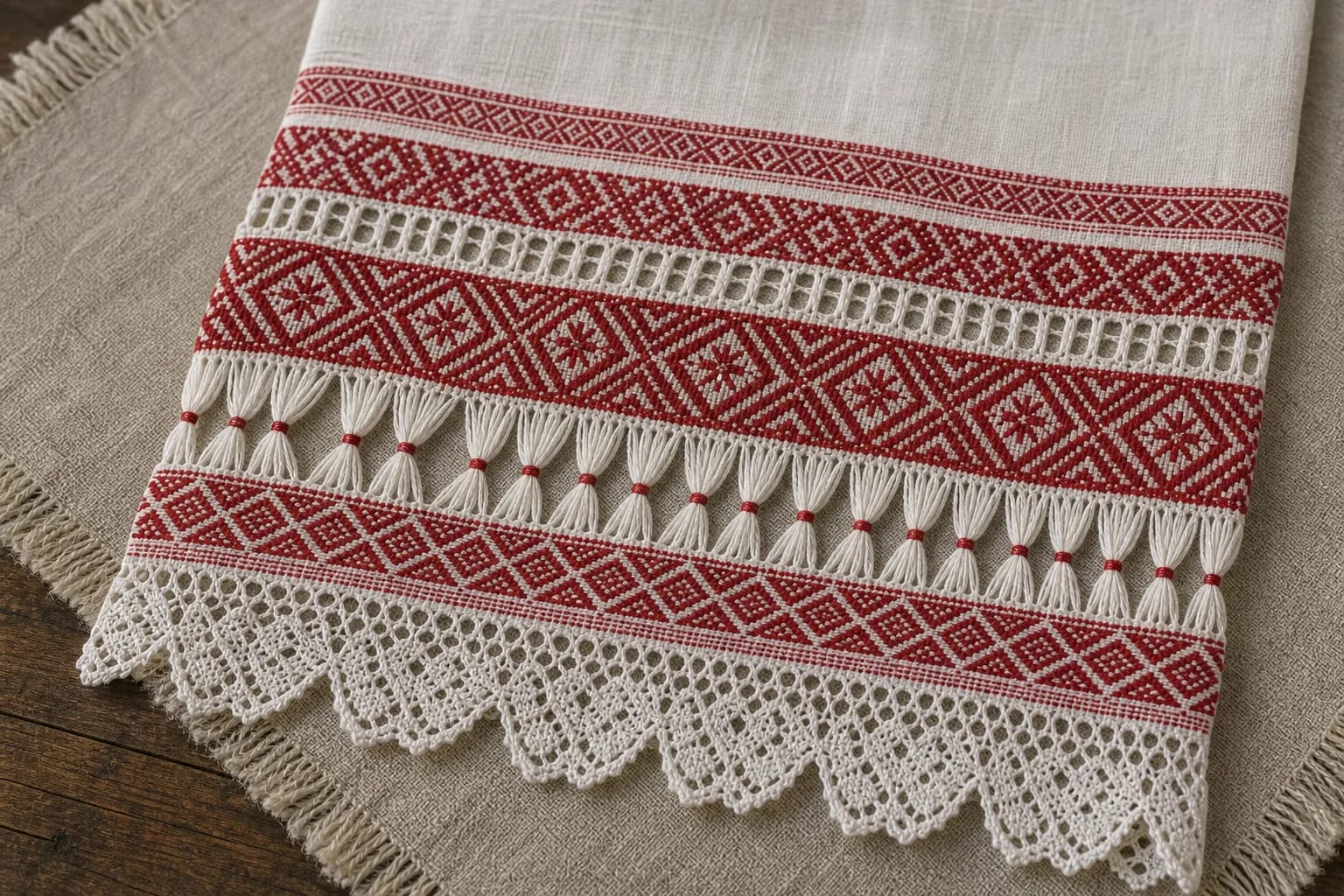
Most importantly, the ornament is usually concentrated not across the whole fabric but at the ends. When the towel hangs on a rack, the ends are what can be seen, so the towel is designed to work as a vertical composition.
Everyday, Guest, and Ritual Towels
An everyday towel could be a simple working object. It was used to wipe hands, face, dishes, milk vessels, and other household items. Such textiles wore out more quickly and were replaced.
A guest towel was more beautiful. It hung in a visible place, often near a washing area or in the better room. White cloth and decorated ends showed the cleanliness of the home and the hosts' respect for the visitor.
Ritual towels were used in weddings, christenings, funerals, holidays, gifts, and moments of transition. In such cases the towel is not only a household object: it becomes a form of bond, blessing, thanks, or memory.
Wedding and Dowry Meaning
Towels were an important part of the dowry. A young woman and her family had to prepare many textiles: lengths of cloth, sheets, towels, tablecloths, bedspreads, pillowcases, and other fabrics. Towels were among the most visible of these objects.
In wedding customs towels could be given, tied, hung, used during ritual actions, or presented as respectful gifts to important people. Specific practices differed by region and period.
A gifted towel had the value of work. It said: this textile was not bought casually, but woven, bleached, finished, decorated, and prepared for a particular relationship.
Regional Traits
In Aukštaitija and Dzūkija, one often sees white linen cloth combined with red žičkai, small geometric patterns, pinikai, and careful finishing of the ends. Dzūkian abrūsėliai are often presented in museum education as a distinctive group of linen textiles.
In Žemaitija, Suvalkija, and Lithuania Minor, towels also had local differences: decoration of the ends, restrained or brighter color, thread quality, placement on the towel rack, and connections with other room textiles could vary.
A region is best identified not by one red stripe alone but by the whole: fabric width, pattern type, end decoration, use history, museum description, and local terminology.
The Towel as a Sign of Household Order
A white towel in a visible place meant cleanliness and readiness. In a traditional home, where many tasks happened in one space, an orderly towel rack was a clear sign of household care.
The whiteness of the towel was not automatic. Flax growing, weaving, washing, bleaching in the sun, protecting the textile from dirt, and hanging it properly formed a long cycle of work. White cloth therefore had moral and aesthetic weight.
Today a traditional towel often becomes decoration or a museum object, but its meaning is clearest when it is seen together with the towel rack, dowry textiles, and customs of honoring a guest.
How to Evaluate an Old Towel
When evaluating an old towel, look at fiber, weave density, ornament at the ends, colored threads, pinikai, embroidery, initials, dates, and signs of wear. Small details often say the most.
Practical wear is not a flaw when the object has lived. Stains, repairs, or faded ends may show that the towel was truly used, given, hung, and preserved.
When reconstructing a towel, it is important to state the region, model, and technique. A white linen textile alone is not yet a traditional abrūsas if its form, proportion, and end composition have not been understood.