- When / context
- From medieval law to twentieth-century local customs
- Tradition area
- Community Life
- Themes
- Customary law, local custom, Lithuanian Statutes, field boundaries, common resources, oral agreements, obligations, public opinion, legal pluralism
Customary law consisted of unwritten rules that a local community regarded as binding. It governed land, obligations, contracts, family property, and inheritance, but it never formed one unchanging code for all Lithuania: the Lithuanian Statutes and Russian, Prussian, and interwar law repeatedly changed its place.
What Is Customary Law?
The Universal Lithuanian Encyclopedia defines customary law as unwritten law developed by a community through practical experience. The crucial quality is not antiquity but obligation. People had to do more than behave in a familiar way: they had to understand the rule as binding in a matter of property, contract, damage, inheritance, or another legally meaningful relationship. Customary law is therefore narrower than traditional culture as a whole.
A custom might regulate greetings, a feast, or the reception of a guest, while morality classified conduct as decent or blameworthy. A legal custom operated where a rule created a concrete right or duty: to repay a debt, compensate for livestock damage, respect a field boundary, or carry out an agreement. These fields overlapped. Breaking one's word could be at once a legal problem, a sin in a religious community, and a loss of personal honor.
From Unwritten Custom to the Lithuanian Law Codes
Customary law predominated in the Lithuanian state until the late fourteenth century, but more written acts appeared as government, landholding, and courts became more complex. Jogaila's privileges to the nobility in 1387 were an important early step; the 1468 Code of Casimir sought greater uniformity in criminal law and procedure; and the Lithuanian Statutes of 1529, 1566, and 1588 became the principal law codes of the Grand Duchy of Lithuania.
It would be inaccurate to say that the Statutes merely wrote down old Lithuanian peasant customs. They brought together earlier local law, rulers' privileges, judicial practice, new political decisions, and the interests of the noble estate. The Grand Duchy was a multiethnic and estate-based state, so its law cannot be equated with the daily culture of one ethnic group. Custom remained important, but it worked within an increasingly dense network of written rules.
Land, Field Boundaries, and Common Village Resources
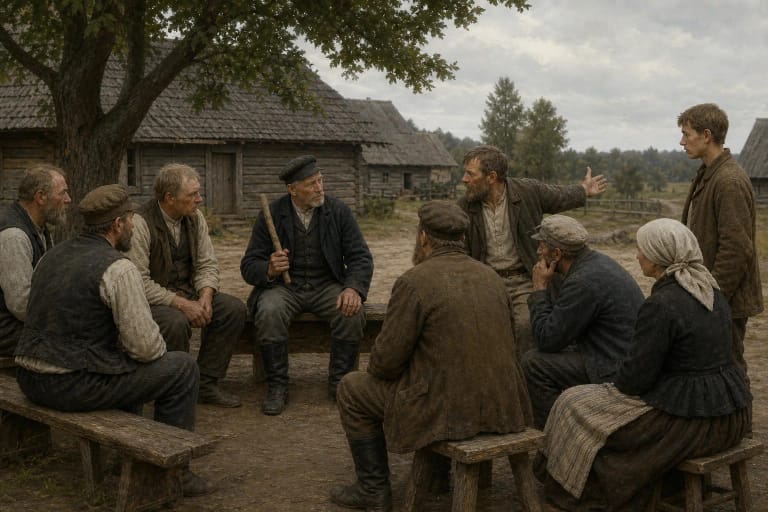
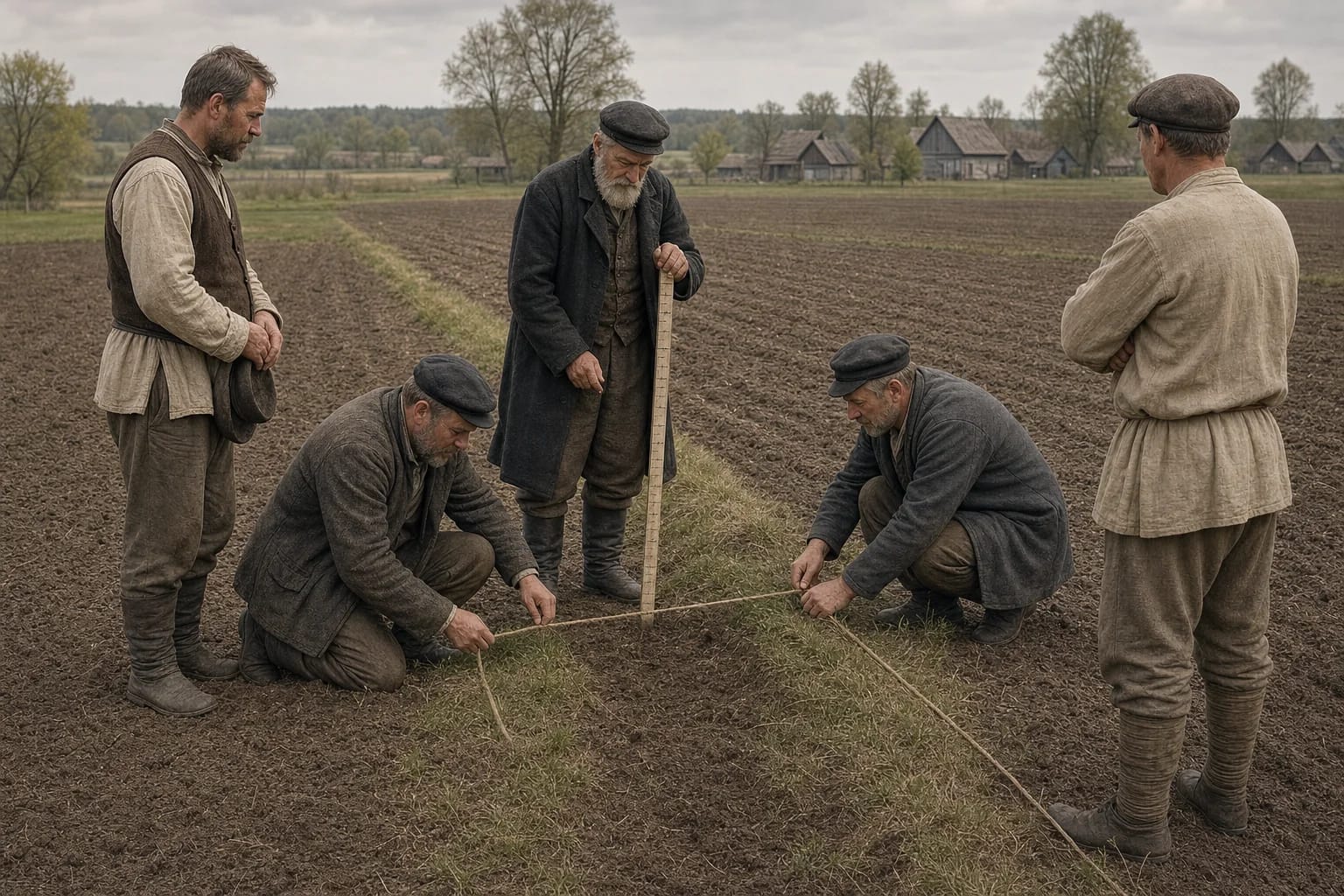
On a strip-field village's land, one farm's holdings could be divided among many narrow plots. It was easy to plough across a neighboring ežia, the line between strips, by mistake, while at other times a neighbor was suspected of deliberately taking land. In the case described by the Universal Lithuanian Encyclopedia, the elder and two respected village men measured the boundary. Their commission was not a modern court, but local knowledge and trust often made it possible to restore the line without prolonged litigation.
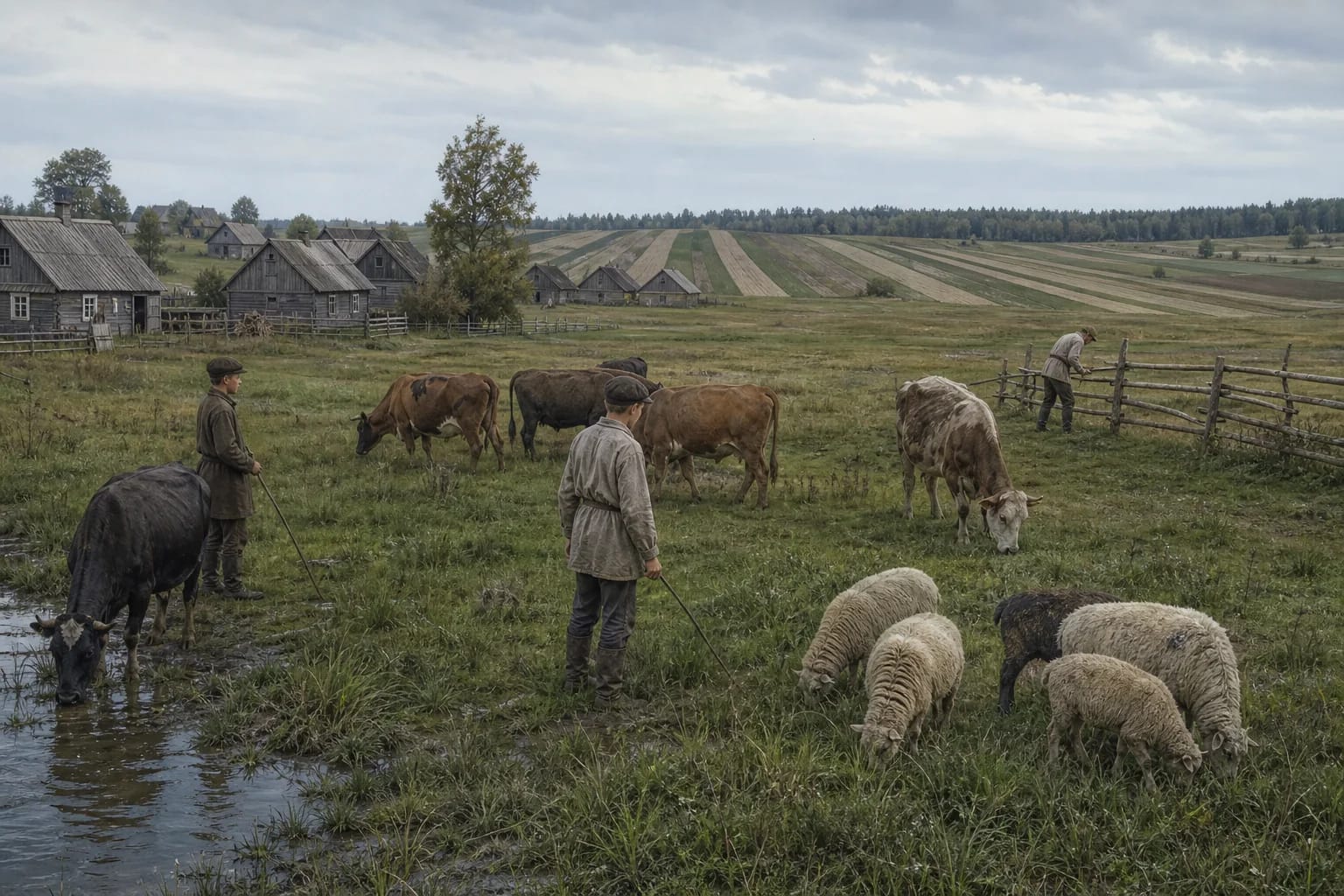
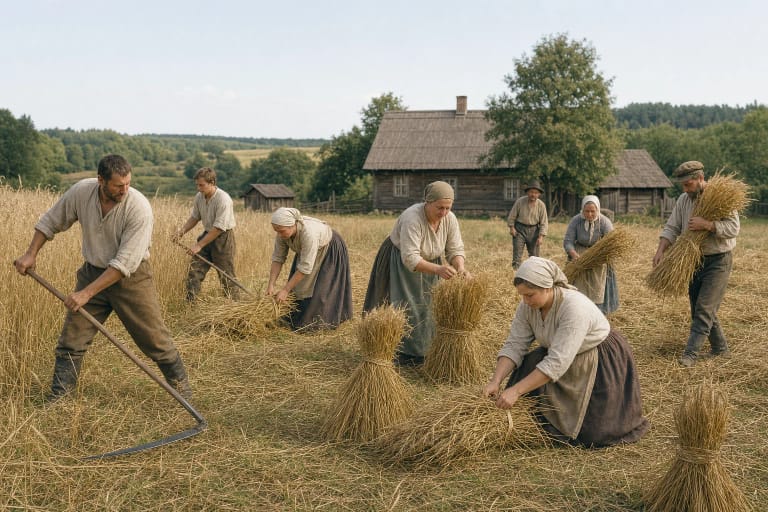
Common meadows, pastures, woods, lakes, and water required even more agreement. A village decided when grazing could begin, how many animals could be admitted, how to hire a herdsman, repair a bridge, or drain wet land. The labor owed and the produce received could be calculated according to the land held by each farm. This order was especially associated with undivided street and strip-field villages. Moving farms to isolated holdings weakened the practical need for many of these common rules.
Oral Contracts, Earnest Money, and a Pledged Word
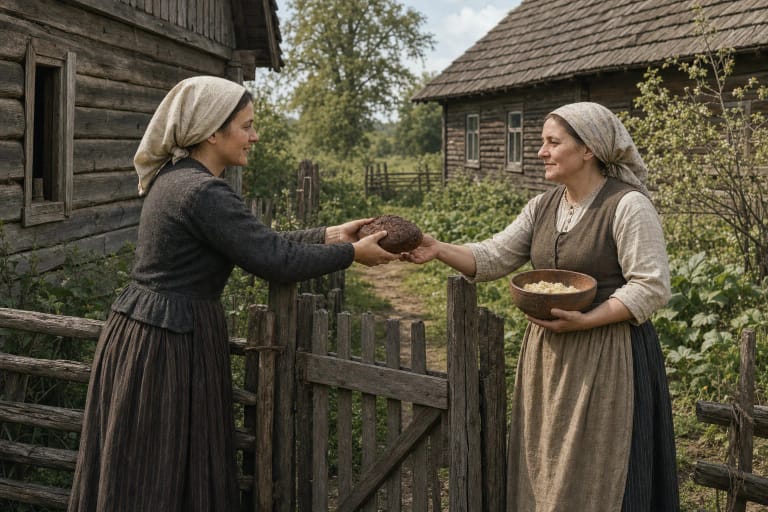
Drawing on field research, Venantas Mačiekus described oral agreements for sale, exchange, lease, hiring, and contracted work. Once parties had settled the price of an animal or another valuable object, they might clasp hands, leave earnest money, call witnesses, or share magaryčios, a drink marking the bargain. The form and meaning of these acts depended on place, period, and transaction. They did not amount to a single ancient Lithuanian contract ceremony.
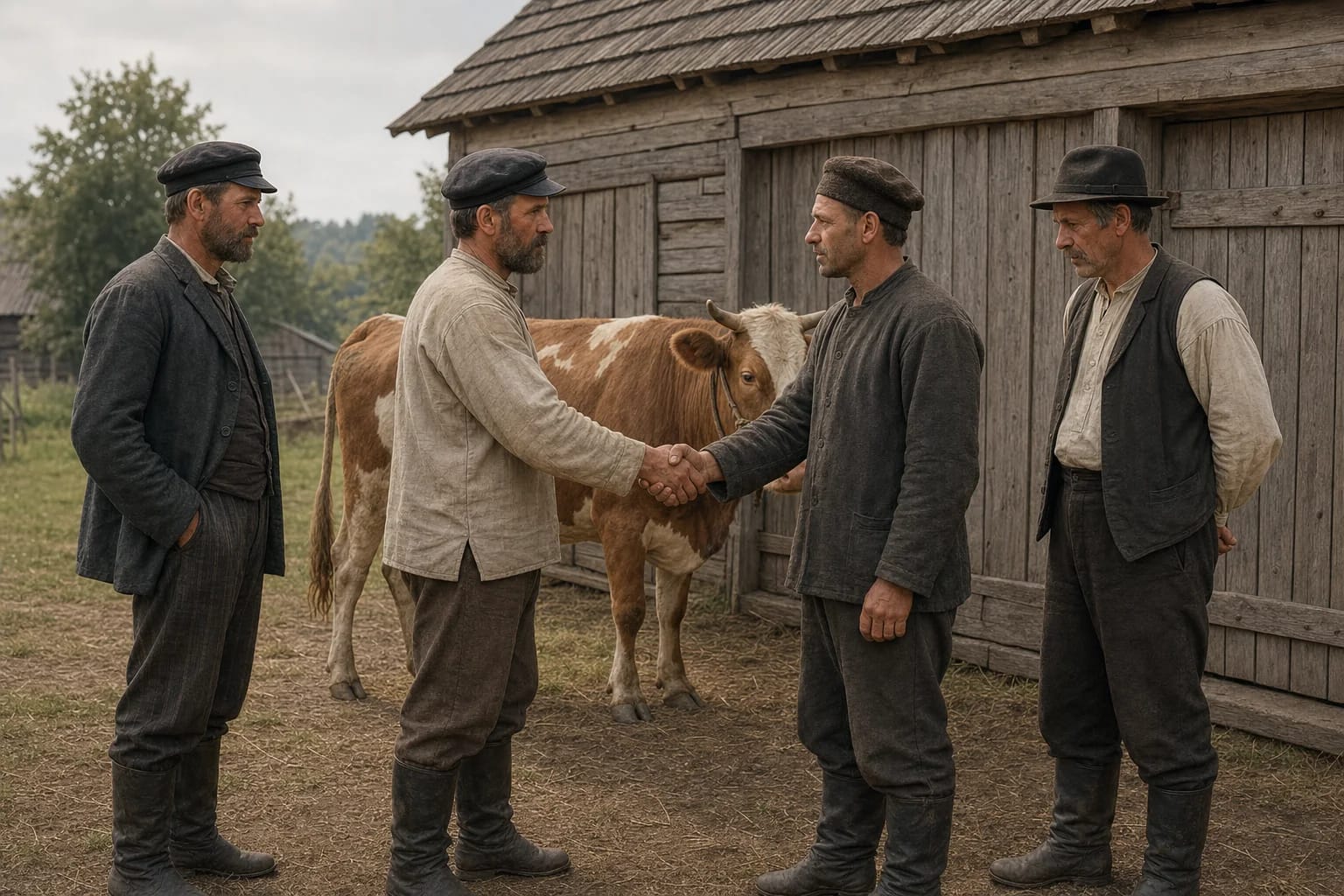
Reputation supported an oral obligation. A person who broke a bargain lost trust, and others might avoid trading or entering agreements with that person. In a religious setting, breaking one's pledged word could also be described as sinful. Social pressure did not remove inequality from negotiation, however. A large farmer, hired servant, landless tenant, and wealthy buyer possessed different resources, and the weaker party could find an oral promise difficult to prove.
Family Property, Guardianship, and Inheritance
Customary law long governed family property, guardianship, and inheritance. Who would take over the farm, what the other children would receive, who would support elderly parents, and who owned a dowry or marriage portion all depended on region, legal system, family composition, and wealth. A custom might keep a viable farm intact, but it could also give sons preference or narrow women's choices.
Cases heard by the Supreme Tribunal of Lithuania show that local customs still mattered in peasant inheritance disputes between the wars. Courts interpreted them inconsistently, however, and national legislation gradually narrowed their field of application. This subject should be read with the separate page on farm transfer and išimtinė. The central point here is not a single inheritance formula but the encounter between family practice, state law, and changing ideas of justice.
How Did a Local Custom Enter a Courtroom?
When Lithuania restored statehood in 1918, it temporarily retained laws that had operated in its different territories before the war, provided they did not contradict the new constitutional order. Russian imperial law had left room for local peasant custom, particularly in small property disputes, guardianship, and inheritance. A custom could therefore be more than an ethnographic memory in an interwar court, but only where legislation permitted its use or left a genuine gap.
Jevgenij Machovenko's research shows that parties could establish a custom through witness testimony, officials' attestations, and decisions of village assemblies. A court could not simply prefer custom when a suitable binding statute already covered the case. Legislation adopted from 1921 onward gradually removed many received rules that had allowed reliance on custom. This reveals a central limit: the state could recognize customary law, but it could also reduce its legal space.
Several Legal Regions, Not One Lithuania
Interwar Lithuania did not inherit one system of civil law. Russian imperial civil legislation operated in most of the country; Užnemunė retained the Napoleonic Code tradition; Palanga and part of Zarasai County followed Baltic provincial law; and German and Prussian codes remained in force in the Klaipėda Region. The same custom could therefore have a different relationship with a court depending on where the case arose.
In Lithuania Minor, detailed regulations issued by Prussian kings had restricted Lithuanian customary norms from the eighteenth century. Village krivūlė decisions, oral bargains, and family-property practices survived, but they had to yield to royal and later German law. The Catholic environment of Greater Lithuania, the Lutheran setting of Lithuania Minor, and the multiconfessional Vilnius Region cannot be compressed into an allegedly pure national model.
Public Opinion, Honor, and Unequal Power
Public opinion was an important guarantor of unwritten rules. Someone who failed to repay a debt, honor a bargain, or respect a neighbor's property might be judged untrustworthy, mocked, and denied future help. Such pressure was effective where people lived together for a long time and depended upon one another. It could work faster than a court, but it was neither neutral nor invariably fair.
Village authority usually rested with landholding household heads and experienced men. Landless residents, servants, newcomers, many women, and unmarried mothers often had less influence and faced harsher judgment. Customary law should therefore not be romanticized as naturally more humane than written law. It could protect a bargain or a vulnerable neighbor, but it could also preserve hierarchy, reputational coercion, and discrimination.
When Custom Collided with Statute
Mačiekus recorded the view that secretly taking timber from a manor or state forest was not equivalent to stealing from a neighbor. People explained that God had grown the forest or that there was enough for everyone. This is valuable evidence of legal consciousness, but it does not show that the cutting was lawful. The Lithuanian Statutes and later Russian imperial and Lithuanian law prohibited forest theft even where local opinion judged it differently.
A more violent conflict appears in accounts of village assemblies punishing suspected horse thieves. Sources document whipping, maiming, and other violence until around 1925, when the Republic of Lithuania's law enforcement became more established. These actions do not represent admirable ancestral justice. They expose vigilantism, distrust of police, and a collective dispersal of responsibility. Cultural history must name that evidence but cannot justify or revive it.
Change and the Meaning of Customary Law Today
In 1840 the Russian imperial government ended the Third Lithuanian Statute's force in the western provinces. Later land reform, settlement on isolated farmsteads, market growth, and formal state institutions reduced the scope of village legal decision-making. Soviet collectivization transformed property and labor. Venantas Mačiekus showed changes in attitudes toward collective-farm property, access to another person's land, and oral agreements; older norms did not continue along one straight line.
Lithuania's present Civil Code allows custom to regulate civil relations in situations defined by law or contract, but not where it contradicts mandatory rules or the principles of good faith, reasonableness, and justice. This is not permission to decide a modern dispute from a nineteenth-century ethnographic account. The heritage matters because it shows how communities built trust, allocated resources, and negotiated justice—while also making their inequalities visible.