- Place
- Kybartai village, Lazdijai District Municipality
- Region
- Dzūkija
- Type
- private open-air museum of South Lithuanian history, rural life, and stones, established in 1990
- Address
- Kybartai 5, Būdvietis Eldership, Lazdijai District
- Coordinates
- 54.26849, 23.32899
- Visit duration
- 1-1.5 hours for the stones, rural objects, border markers, and the creator's interpretation
- Best time
- in daylight and dry weather from spring to autumn, only after arranging the visit with the owner by telephone
Yotvingian Yard, Jotvingių kiemas Stone Museum, South Lithuanian Museum of History, Rural Life and Stones
This is a living personal collection, not a conventional museum building
Jotvingių kiemas occupies the Mazurkevičius family farm in Kybartai village, only a few kilometres from the Lithuanian-Polish border. Objects stand outdoors among trees, meadow, and working rural surroundings, so visitors walk through a real farmyard rather than a sequence of galleries.
Donatas Mazurkevičius began creating the museum on his ancestral property in 1990. The Lithuanian Armed Forces journal Kardas records both the founding year and the personal nature of the collection. A public organisation was registered in 2002, giving the work an institutional form while the site remained private and dependent on the owner's availability.
The value of a visit lies in more than the number of objects. Many become meaningful only when one hears where a stone was found, how a millstone or implement worked, and which family, village, or border story the creator associates with it.
Stones speak about geology, labour, and human memory
The collection includes field boulders, fossils, petrified wood, stone axes, flint objects, millstones, and whetstones. Some are natural specimens and others evidence of human work. It is worth asking which item is a find, which is a tool, and which was later assembled as part of an artwork.
Old domestic and agricultural implements show how stone, timber, and iron worked together in the rural economy. This is not a chronologically sterile display: geological time, family memory, and twentieth-century objects deliberately sit beside one another.
Do not touch, lift, or climb on the millstone compositions without the owner's permission. Even a small stone may be a fragile fossil specimen, while old iron tools can retain sharp, corroded edges.
Visata is the creator's symbolic work, not a reconstructed Yotvingian temple
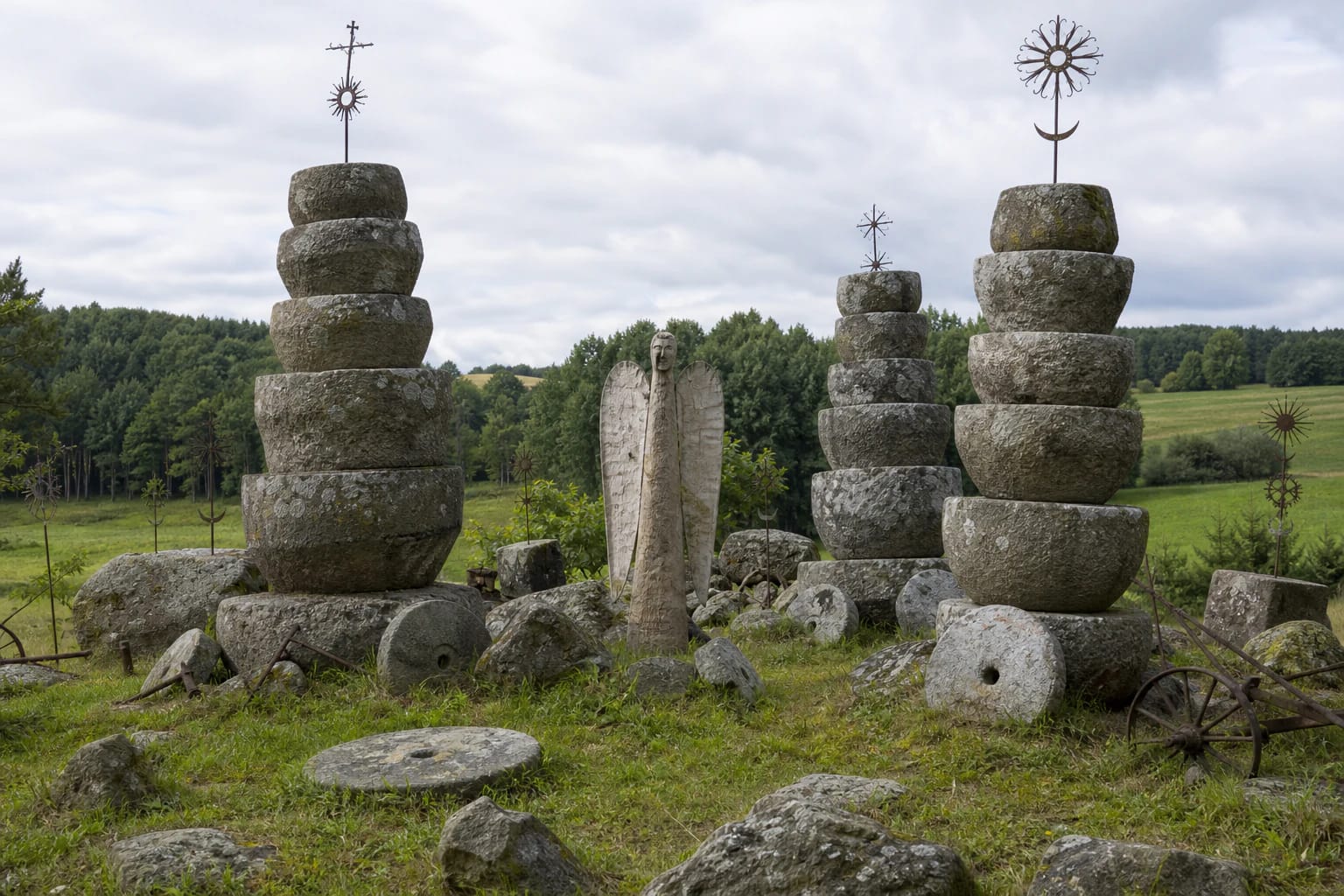
The best-known installation, Visata or Cosmos, uses pieces of millstone raised into towers around an oak Angel. In the creator's narrative, four directions and seasons connect with images of heaven, earth, purgatory, hell, and the course of a human life.
The interpretation needs careful framing. It combines Donatas Mazurkevičius's personal reading of Baltic antiquity, Christianity, and human existence. It is not an archaeologically reconstructed Yotvingian sanctuary and does not prove that historical Yotvingians represented the cosmos in precisely this form.
The name Jotvingių kiemas evokes the region's historical memory and the creator's identity, but the museum also contains material from much later periods. The site is most rewarding when legendary or symbolic readings remain distinct from the documented origins of an object.
Border posts and military remnants reveal a difficult twentieth-century layer
The Kybartai farm stands in a borderland where changing frontiers, occupations, and wars directly affected local people. Displays include old Lithuanian and Polish border markers, military spades, helmets, mess tins, and other remnants of wars that crossed the surrounding countryside.
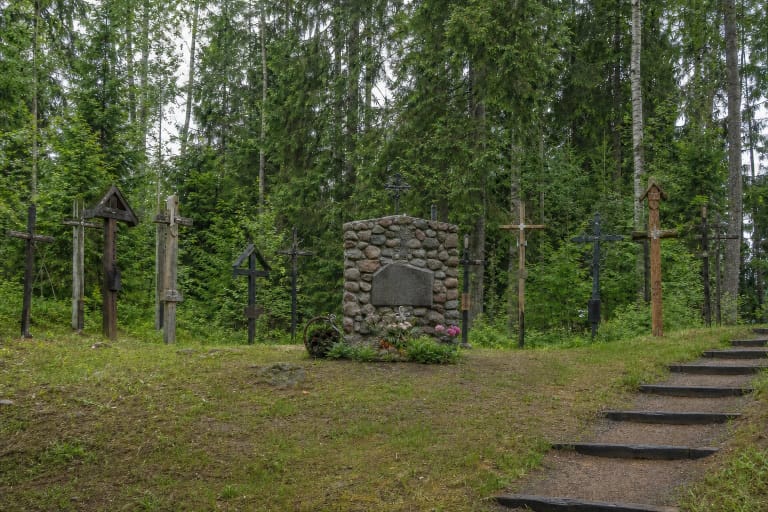
A Lithuanian Armed Forces source describes a memorial to Lithuanian warriors assembled from stones and remnants of both world wars. This helps identify specific twentieth-century material, but the museum's artistic groupings should not be mistaken for a neutral chronological military display.
Ask about the old border posts during the visit. Their emblems belong to different periods, and colours or heraldry alone cannot establish exactly where and when each marker once stood.
Arrange your arrival because the map point leads into a private farmyard
The latest public visitor information says that the museum receives guests by advance arrangement on +370 615 67131. An older daily 10:00-18:00 schedule should no longer be treated as a reliable standing timetable. Call before travelling to confirm both admission and any charge.
Coordinates 54.2684941, 23.3289929 mark the farm and outdoor display itself. They do not mark a public car park. Follow the owner's directions, do not drive into the yard without permission, and respect the limits of private land.
Surfaces include grass and uneven ground that may become slippery after rain or sleet. No comprehensive official audit of wheelchair access, toilets, or parking was found, so discuss specific needs when calling. On 27 July 2026, the exact Google Maps entry with Place ID ChIJVemxTYfd4EYRDHAaMjhl0zQ showed 4.8/5 from 118 reviews.