- Place
- Lazdijai, Lazdijai District Municipality
- Region
- Dzūkija
- Type
- a wooden 1924 memorial house operated as a branch of Lazdijai Regional Museum
- Address
- 31 Seinų Street, LT-67113 Lazdijai
- Coordinates
- 54.22969, 23.51400
- Visit duration
- 45-75 minutes; longer with a pre-booked education session and a visit to the adjacent Lazdijai Regional Museum
- Best time
- a Tuesday-Friday morning, avoiding the 12:00-12:45 lunch break and checking sanitation and holiday closures before travelling
Poeto Motiejaus Gustaičio namas, Motiejaus Gustaičio namas-muziejus, M. Gustaitis Memorial Museum, Motiejus Gustaitis House Museum
31 Seinų Street is a separate memorial house, not the regional museum next door
The operating branch's official current name is Motiejus Gustaitis Memorial House. The Cultural Heritage Register lists the same property as the House of Poet Motiejus Gustaitis under unique code 16998. House museum and memorial museum remain common alternative descriptions, but they do not identify separate attractions.
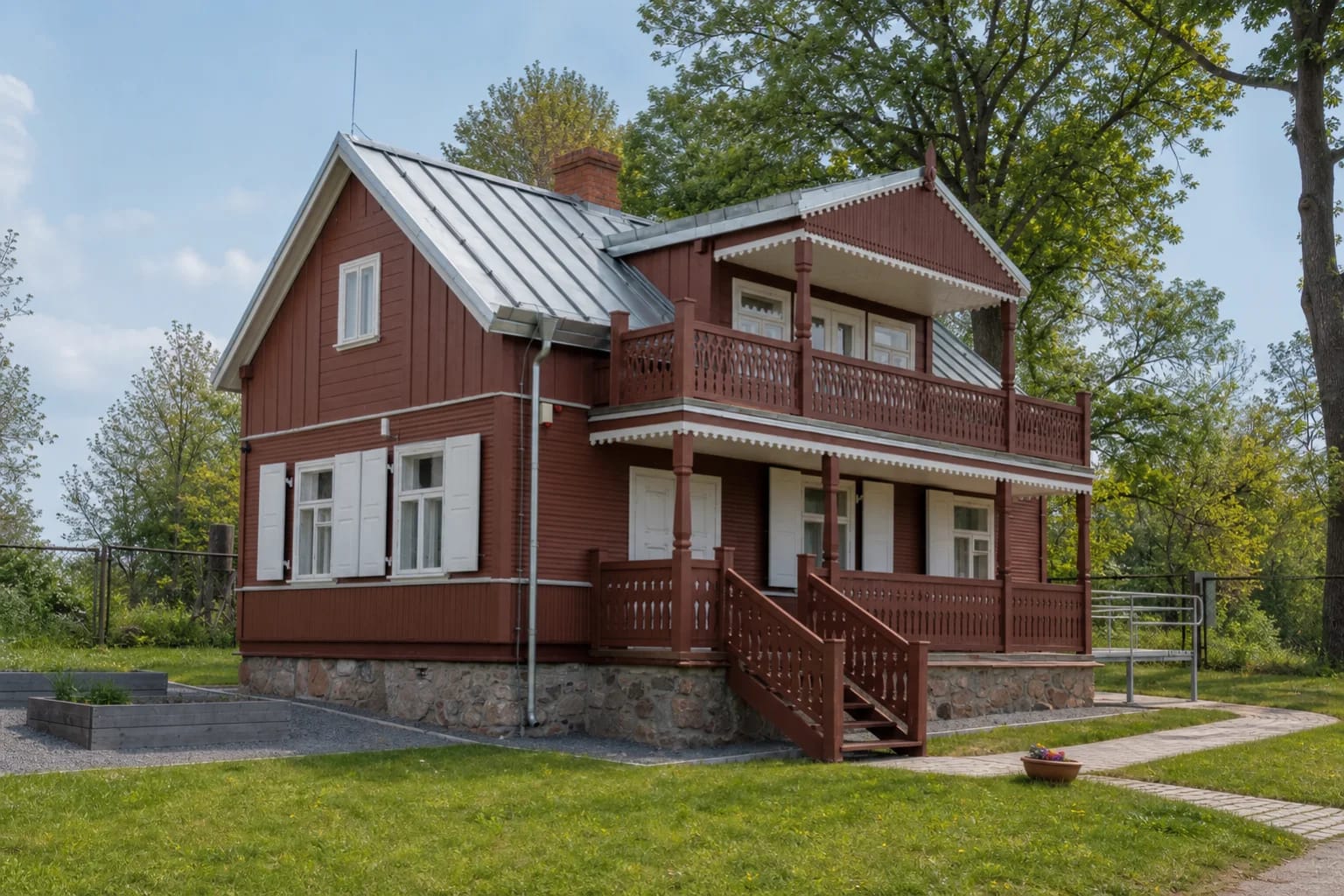
The house stands at 31 Seinų Street. Its distinguishing features are dark muted reddish-brown timber boarding, white shutters, a fieldstone plinth, a grey metal roof, and an open veranda rising through two levels with fretwork railings. Coordinates 54.229691, 23.513995 were converted from the official municipal LKS-94 point 468312, 6010389. They are a reliable site marker, not a claim that visitors always enter through the nearest door.
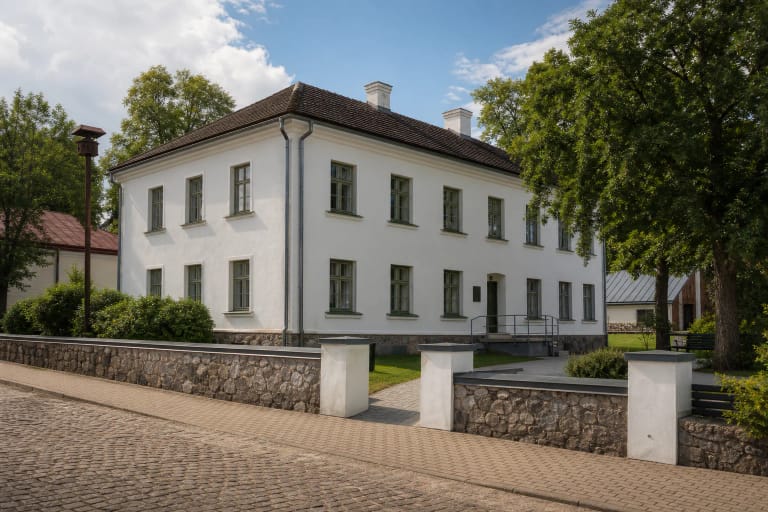
Only a few dozen metres away, the main Lazdijai Regional Museum occupies the former Žiburys gymnasium at 29 Seinų Street. Gustaitis and his pupils founded the first Lazdijai museum there in 1924. Number 31 preserves his place of residence. The two buildings make a coherent education-history route, but their exhibitions and entrances are separate.
The 1924 building combined the headmaster's home with the gymnasium office
The house was built in 1924 as the cluster of wooden buildings beside the Žiburys gymnasium expanded. The documented conservation history says that a larger new building supplied four classrooms, while this smaller house was intended for the headmaster. Motiejus Gustaitis contributed money to its construction and furnishing and took an interest in giving it an artistic architectural character.
The compact single-storey house with an attic was never solely a private dwelling. One section contained Gustaitis's study, which also served as his bedroom, while the other held the gymnasium office. That dual purpose explains why the exhibition continually connects personal biography with school administration, writing, and public service.
Gustaitis is documented as living and working here from 1924 until his death in Lazdijai on 23 December 1927. This is not his birthplace: he was born in Rokai near Kaunas on 27 February 1870. Nor is the house the whole gymnasium he directed; it is one building directly tied to the school complex.
Gustaitis's life joined priesthood, European study, education, and early symbolist poetry
Motiejus Gustaitis was ordained a priest in 1893. He studied church music in Regensburg, civil and canon law in Rome, and the history of literature and art in Fribourg, receiving a doctorate in philosophy in 1903. The range of roles presented by the museum is therefore not retrospective myth-making; it is grounded in his education and published work.
Before Lazdijai, Gustaitis taught and directed a girls' progymnasium in Marijampolė, evacuating with the school to Yaroslavl during the First World War. VLE records him as head of the Seinai gymnasium from 1918 and the Lazdijai gymnasium in 1921-1927. He helped establish the Gabija and Žiburys societies and edited the periodical Žiburys from 1911 to 1914.
In literary history, Gustaitis matters as a poet moving towards symbolist poetics, a translator, and a cultural scholar. He translated Adam Mickiewicz, Juliusz Słowacki, Charles Baudelaire, and classical poets. In 1923 he published Stilistika, the first Lithuanian textbook of literary theory. His sonnet collection Varpeliai appeared in 1925, when he was already living in this house.
The new exhibition interprets a life rather than recreating an untouched 1927 apartment
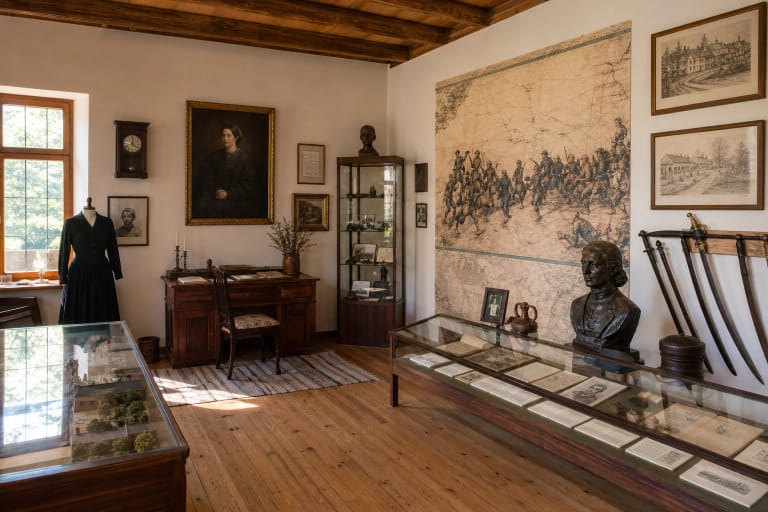
The exhibition presents photographs, books, letters, and recollections concerning Gustaitis's life and writing. Audiovisual and computer media layer the narrative, which is conceived as though Gustaitis himself were accompanying visitors and sharing his thoughts. That is an interpretive device, not a claim that an authentic recording of his voice or moving image survives.
Oversized letters are the exhibition's most distinctive visual motif. Some become seats, others openings or display cases, and their dark surfaces recall a classroom blackboard. Text compositions across walls and windows move Gustaitis's poetry, biography, and maxims into the rooms. The result is primarily a space for reading and discovery, not a conventional period room furnished only with domestic objects.
The official programme offers a Gustaitis-poem puzzle, a biographical crossword trail, and a session about plants in poetry and herbal tea. On 19 July 2026, listed sessions lasted 45-60 minutes, generally served groups of 10-24, and cost EUR 1 or EUR 3 per participant. Every workshop required advance registration. Confirm the age range, language, group size, current price, and whether admission is charged separately.
Conservation and renewal in 2019-2021 rescued the museum founded here in 1990
A memorial museum opened in Gustaitis's former home in 1990. Decades later, the building approached an emergency condition: published official information described cracked foundations, rot in wall logs and carved timber details, and a leaking roof. Conservation began in March 2019, with its principal stage completed in May 2020.
Work restored the fieldstone foundations, repaired decayed portions of the wall logs, and addressed interior walls, floors, and roof. Specifically documented restorations included bargeboards, the roof finial, mezzanine decoration, veranda ceiling, plinth battens, chimney, doors, window frames, and railings. This list demonstrates the survival of architectural fabric, but it does not mean that every board and interior element now visible dates unchanged from 1924.
The broader reconstruction and exhibition project cost EUR 242,419 and was financed by the European Regional Development Fund and Lazdijai District Municipality. By 2022, the municipality was presenting the reconstruction completed the previous year and the new exhibition. Visitors now encounter both a conserved memorial building and a twenty-first-century museum narrative.
In 2026, lunch and sanitation closures mattered as much as the headline opening hours
On 19 July 2026, the branch page listed Tuesday-Friday 9 am-5 pm and Saturday 9 am-3:45 pm. The museum-wide visitor policy said that it closed Sunday and Monday, paused for lunch from 12:00 to 12:45, closed on the final day of each month for sanitation and on public holidays, and shut one hour early before a holiday. Check the live official page or call +370 318 52726 before travelling.
On the same date, the Lazdijai Regional Museum website listed standard adult admission across the museum and its branches at EUR 2. Pupils, students with identification, and pension-age visitors under 80 paid EUR 1. Children under seven, visitors aged 80 or above, disabled visitors and their companions, and other listed groups entered free. The tariff does not say that one ticket covers several buildings, so ask before planning a combined route.
Official photographs show a metal ramp beside the main veranda steps, and the reconstruction project described the building as adapted for visitors. However, no detailed current statement was found for the step-free route, door widths, an adapted toilet, attic access, or marked parking spaces. If wheelchair access, assistance, or minibus space matters, agree the practical arrangements by phone instead of inferring them from the photograph.