- Place
- Gudeliškės village, Šeštokai eldership, Lazdijai District Municipality
- Region
- Dzūkija
- Type
- a 58,947-square-metre nationally significant Lithuanian partisan battlefield complex with the Meškakalnis memorial and a separate on-site burial place for human remains
- Address
- Compartments 10-12 of Kalniškė Forest, Gudeliškės village, Šeštokai eldership, Lazdijai district
- Coordinates
- 54.33966, 23.54965
- Visit duration
- 45 minutes to 1.5 hours for the memorial hill, separate burial place, and forest terrain; allow longer for sections of the interpretive route
- Best time
- a dry day in full daylight from spring to autumn; commemorations take place around 16 May, so check event and access information before travelling then
Lithuanian Partisans' Battle of Kalniškė Site Complex, Battle of Kalniškė Memorial, Hill of Heroes, Meškakalnis, Kalniškė battlefield
The Battle of Kalniškė site is a protected complex, not a single monument
The Lithuanian Partisans' Battle of Kalniškė Site Complex has Heritage Register code 37491 and covers 58,947 square metres. It contains two separately registered components: the battlefield, code 21562, and the grave of partisan remains, code 37492. The complex is a nationally significant cultural monument in Gudeliškės village, within Šeštokai eldership.
Protection extends beyond the collection of memorials. The Heritage Register identifies two forest hills, the gully between them, and the track running through it as valuable attributes. The main fighting took place on one hill, Meškakalnis. The whole property also lies within Kalniškė Landscape Reserve, making the shape of the forest ground part of the historic place rather than a picturesque backdrop to a monument.
Coordinates 54.339662, 23.549653 reproduce the official KPD spatial-data point for object 21562. The marker is labelled representative: it helps locate the protected battlefield but does not promise a car park, the bottom of the steps, or a single entrance at that exact point. The burial place and principal monument are separate elements, while the fighting extended across a broader area of forest.
Meškakalnis preserves a layer of family-made remembrance, not just one monument
The hill's main landmark is a low memorial of rounded fieldstones, with a dark plaque and metal cross, designed by Jurgis Nevulis of Marijampolė. The Genocide and Resistance Research Centre inventory dates its unveiling to 13 May 1991. It was blown up on 21 May and rebuilt on 29 May. VLE attributes the explosion to Soviet army paratroopers exercising nearby, while the Heritage Register uses the more cautious description of hostile persons.
Unequal wooden, metal, and stone crosses, wayside shrines, and smaller memorials surround the central stonework. They do not follow one architectural masterplan. Relatives of those killed, former comrades, political prisoners, deportees, riflemen, schools, and local communities added them over time. The official inventory records many additions between 1991 and 2006, while a 2013 Register survey describes dozens of individual dedications.
The Lazdijai municipal account describes an aspiration to have 44 memorial signs and 44 oaks for the partisans. That number is best understood as a commemorative composition, not an independent archival roll of the dead. Read individual dedications where they remain legible, but do not touch fragile timber, climb on the stonework, or leave candles where they could start a forest fire.
The encirclement on 16 May 1945 became a day-long defensive battle
Jonas Neifalta-Lakūnas's company drew fighters from the Krosna, Simnas, Šeštokai, Šventežeris, and other communities of Užnemunė Dzūkija. VLE explains that the enlarged company had been divided into six sections of 12-20 men. On the eve of battle, however, three sections had left camp to protect civilians because deportations were feared, and some men had briefly returned home. The total strength of the company was therefore not the same as the number who fought on Meškakalnis that day.
Forces of the NKVD 220th Border Regiment surrounded the forest and blocked its tracks. Some partisans returning towards camp were killed or scattered at the forest edge, while more than half the company reached Meškakalnis. They formed a circular defence on the highest hill and repelled several attacks. To understand that defence on the ground, look beyond the memorials towards the slopes, gully, and narrow approaches between the trees.
With ammunition running short in the late afternoon, the partisans were ordered to withdraw. VLE describes two break-out groups led by Jonas Neifalta-Lakūnas and his deputy Albinas Senkus-Vanagas. Lakūnas escaped and continued fighting until his death in November 1945. Those killed at Kalniškė included section commander Aleksandras Padimanskas-Šarūnas and Lakūnas's wife, partisan Albina Neifaltienė-Griškonytė-Pušelė.
Numbers of fighters and casualties change with the source, date range, and counting method
The latest VLE synthesis estimates that roughly 60-80 partisans fought directly, while the Heritage Register, the Genocide and Resistance Research Centre, and some official commemorative accounts give about 100-120. Part of the difference comes from whether a source counts Lakūnas's whole company and returning sections or only those who reached the main Meškakalnis position. The safest conclusion is that the company was larger than the group defending the hill.
VLE records 40 members of Lakūnas's company and its support network killed on 16 May, followed by another five deaths during pursuit on 17 May. Other government pages commonly use 44, while an older Register account says more than 40 and notes a figure of 62 in operational records. These totals may define different groups of people, different date limits, or lists revised as identities were researched.
The divide is even wider for NKVD losses. VLE reports that NKVD documentation listed 4-6 dead and 2-7 wounded, while Juozas Lukša's memoir and partisan memory spoke of roughly 400 killed, a number later often broadened to killed and wounded. Soviet operational language labelled the partisans bandits, whereas Lithuanian remembrance turned the battle into a symbol of heroic resistance. Neither Soviet minimisation nor commemorative tradition should be converted into an unexplained precise figure, so the versions remain clearly separated here.
The forest grave and Simnas cemetery preserve different parts of the story of the remains
After the battle, NKVD forces took the bodies to Simnas, abused them publicly in the town square, and buried them beside Lake Simnas several days later. An archival report by the Genocide and Resistance Research Centre states that remains found there were moved to Simnas cemetery on 23 June 1989 together with remains of other partisans killed in the area. Simnas cemetery is therefore the main reburial place, but it is not within the Kalniškė Forest memorial complex.
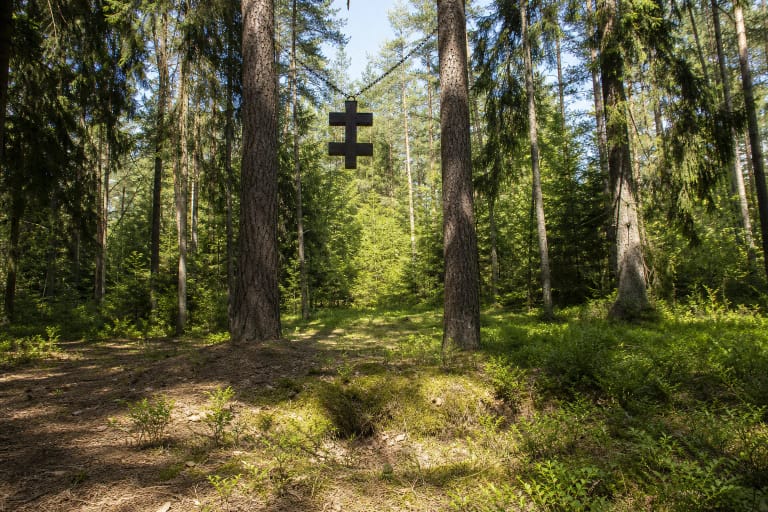
A different burial place remains in the forest. The Heritage Register documents that relatives buried fragments of human remains, battle relics, and blood-soaked earth gathered beside the hill after the fighting. Battle participant Edmundas Austrevičius-Kurtas erected a cross there in 1988. The official memorial inventory also records a metal cross placed in August 1991 to remember the remains buried on the spot.
For visitors, this creates three distinct places within the protected complex: the wider battlefield terrain, the dense group of memorials on top of Meškakalnis, and the quieter burial place lower in the forest. A fourth place of remembrance is Simnas cemetery. Do not call every cross a grave or assume that remains lie beneath the central fieldstone memorial: the Register's component structure allows these sites to be distinguished accurately.
Admission is free, but this forest site is not a conventional managed museum
The official sources checked on 19 July 2026 listed no admission charge, gates, or permanent opening hours. It is an open forest remembrance site, but full daylight is the safest time to visit. Annual walks, Mass, and commemorations take place around 16 May, when temporary traffic arrangements, larger crowds, or organised transport may apply. Check Lazdijai Municipality's event information before making a special journey then.
The Genocide and Resistance Research Centre inventory locates Meškakalnis in compartments 10-12 of Kalniškė Forest, about 600 metres east of the Lazdijai-Krosna road. Local signs, forest-road conditions, and municipal visitor-improvement works may change. Use the representative Register point for navigation, then follow signs on the final approach. Do not park across a forest road, block access, or drive onto the memorial hill.
Steps and uneven forest paths lead to the crosses, and the slopes can be slippery after rain. The reviewed official sources did not confirm a fully step-free route, toilet, or permanently maintained car park, so visitors with mobility needs should ask the municipality about current conditions. Wear sturdy shoes, protect against ticks, stay outside fenced burial areas, and never dig or remove anything from this state-protected complex.