- Place
- Vilnius City Municipality
- Region
- Vilnius
- Type
- Lithuania's main Catholic shrine and separate bell tower
- Address
- Katedros a. 2, Vilnius
- Coordinates
- 54.68580, 25.28780
Vilnius Cathedral Basilica, Cathedral Bell Tower
Lithuania's main Catholic shrine
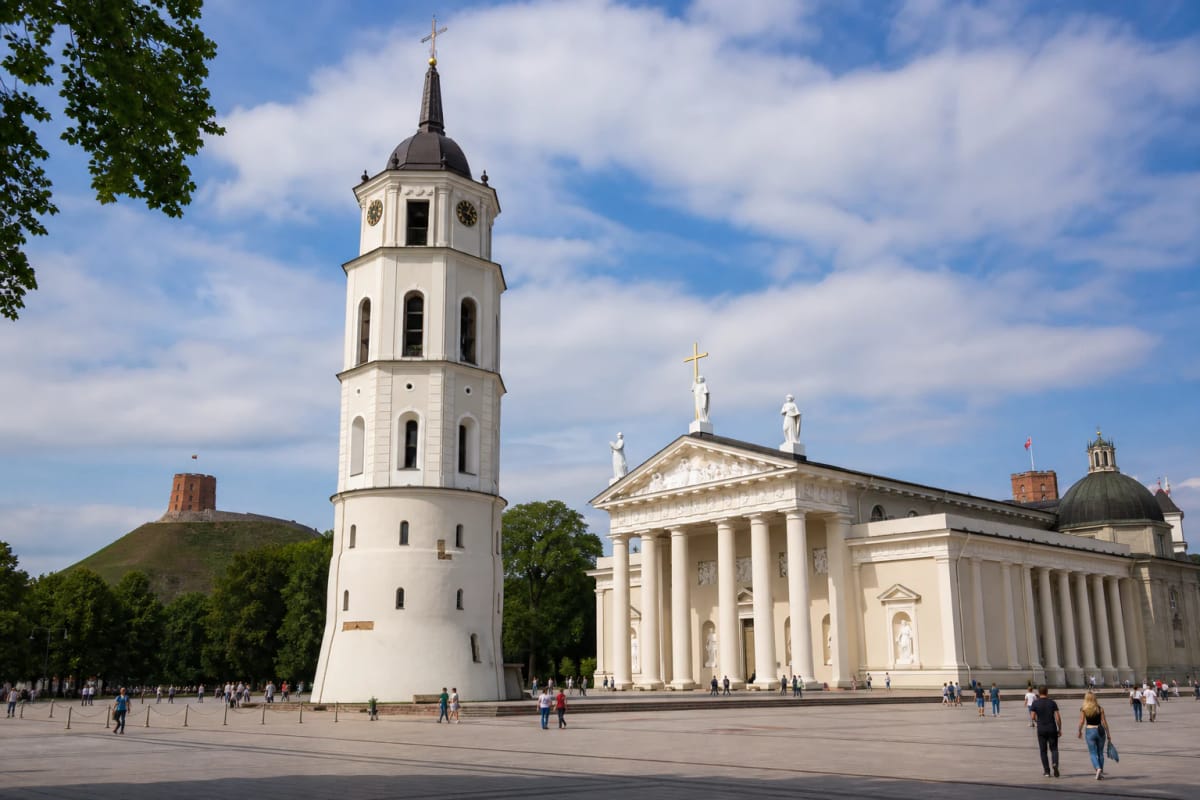
Vilnius Cathedral, officially the Cathedral Basilica of St Stanislaus and St Ladislaus, is Lithuania's main Catholic shrine and the country's most important Classical monument. VLE notes that it stands in the former Lower Castle territory, while Cathedral Square was shaped in the nineteenth century after the castle wall was demolished.
This place works on two levels: as an active church and as a historic monument. The first cathedral is thought to have been built in the late thirteenth century, while a new church was built in 1387 on Jogaila's initiative, marking Lithuania's Christianization. Visitors should separate prayer space, tourist viewing, and museum parts such as the bell tower or crypts.
Gucevičius' Classical face
The present white facade is the best-known work of Laurynas Gucevičius. VLE states that reconstruction began in 1783 to his design and was completed in 1801 by architect M. Šulcas, giving the building its current Classical form with a Doric six-column portico.
Under the antique-looking exterior are Gothic, Renaissance, and Baroque layers. VLE notes that the interior spatial structure is Gothic while the decoration is Classical. The statues of St Helena, St Casimir, and St Stanislaus on the pediment (1792, by K. Jelskis) were removed and destroyed by Soviet authorities in 1950 and restored in 1997 (sculptor S. Kuzma).
Crypts, burials, and rulers' memory
VLE records more than forty art monuments in the cathedral and more than twenty crypts in the cellars, including a late-fourteenth-century fresco of the Crucified Christ. That is a strong reason to look beyond the square and choose a deeper visit.
The cathedral is also a state pantheon. Vytautas, his wife Ona, Žygimantas Kęstutaitis, Švitrigaila, St Casimir, and both wives of Sigismund Augustus, Elisabeth of Austria and Barbara Radziwiłł, are associated with burials here. In December 2024, hidden royal funeral insignia from 1939 were found in the cathedral crypts.
The cathedral treasury is another major story: in 1985, about 189 liturgical valuables hidden before the Soviet occupation were found in a walled-up room. The collection includes chalices, monstrances, reliquaries, bishops' rings, croziers, votives, and liturgical textiles, some of which were transferred to secular museums during the Soviet era.
St Casimir's Chapel
St Casimir's Chapel is one of the cathedral's most important interior spaces and one of Lithuania's finest Baroque interiors. VLE states that it was built in 1623-1636 on the initiative of Sigismund Vasa, designed in early Baroque style by C. Tencalla, richly decorated with frescoes by M. Palloni in 1692, and holds the remains of St Casimir.
The chapel helps explain the cathedral as a space of dynasty, state memory, and sanctity. In 1953, after Soviet authorities took the cathedral away from believers, St Casimir's coffin was moved to St Peter and St Paul's Church; in 1989 it was solemnly returned.
Vilnius Cathedral Bell Tower
The bell tower stands separately from the cathedral, making Cathedral Square's composition easy to recognize. VLE and the Church Heritage Museum give its height as 57 m including the cross; the lower round part is Gothic, while the upper parts are Baroque and Classical.
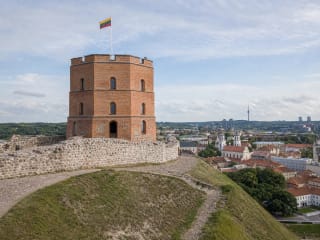
The oldest underground square part of the bell tower dates to the thirteenth century and is one of Lithuania's oldest masonry remains, probably a remnant of a Lower Castle defensive tower. The bell tower is therefore not just a clock tower, but part of old Vilnius castle territory.
Practical visiting
The cathedral itself is usually free to enter, while the bell tower, crypts, and Church Heritage Museum are separate paid objects. According to Church Heritage Museum data, at the time of review the bell tower was open Monday to Saturday (closed on Sundays and public holidays): 10:00-19:00 from May to September and 10:00-18:00 from October to April; the ticket office closed thirty minutes before the end. Visitors climb to the top floor at about 45 m, while cameras installed above 52 m stream the panorama for those who do not climb.
At the time of review, a single bell tower ticket cost about 4.50 EUR (reduced 2.50 EUR), a combined ticket to two objects about 7.50 EUR, and a combined ticket to three objects (bell tower, cathedral crypts, and Church Heritage Museum) about 10 EUR. The crypts can be visited only with a guide and advance registration. Ticket prices and opening hours change, so check official pages before travelling. Tourist groups should avoid visiting the cathedral as a sightseeing stop during services.