- Place
- Veliuona, Veliuona Eldership, Jurbarkas District Municipality
- Region
- Panemunių Regional Park
- Type
- active three-nave masonry Roman Catholic hall church built in 1636-1644 and the core of a protected six-part ensemble
- Address
- 4 Draugystės Street, Veliuona, LT-74442 Jurbarkas District
- Coordinates
- 55.07814, 23.27580
- Visit duration
- 30-50 minutes for the interior and churchyard; longer when attending worship or if an additional visit is arranged in advance
- Best time
- during the published daily opening from 9 to 10 am, after checking the parish information and avoiding tourist viewing during worship
Veliuona Church, Church of the Assumption of the Blessed Virgin Mary in Veliuona, Veliuona Assumption Church
The parish's beginnings and Vytautas's lost churches
Kaunas Archdiocese associates the foundation of Veliuona parish with Vytautas the Great in 1421 and dates the first church to 1426. A scholarly study published in 2021 offers an earlier reconstruction: a first wooden sanctuary may have been built around 1414 and a second in 1418 after the first was burned. Direct evidence for the earliest construction is not conclusive, so these dates should be understood as different historical and parish-tradition interpretations.
The essential distinction for visitors is between those early timber churches and the masonry building standing today. Neither of the Vytautas-era structures survives. The present church is the third Catholic sanctuary known at Veliuona and was erected only in the 17th century. It is reasonable to speak of continuity with Vytautas's foundation, but not to call today's building a 15th-century church.
Radziwiłł's church between Gothic and Renaissance
Construction of the present masonry church began in 1635 or 1636. The project was financed and promoted by Albrecht Stanisław Radziwiłł, Grand Chancellor of the Grand Duchy of Lithuania and Elder of Veliuona. A document of 1642 already describes the work as complete, and Samogitian Bishop Jerzy Tyszkiewicz consecrated the church on 10 January 1644. The register's 1636-1644 range therefore embraces construction and liturgical completion rather than a single day of building.
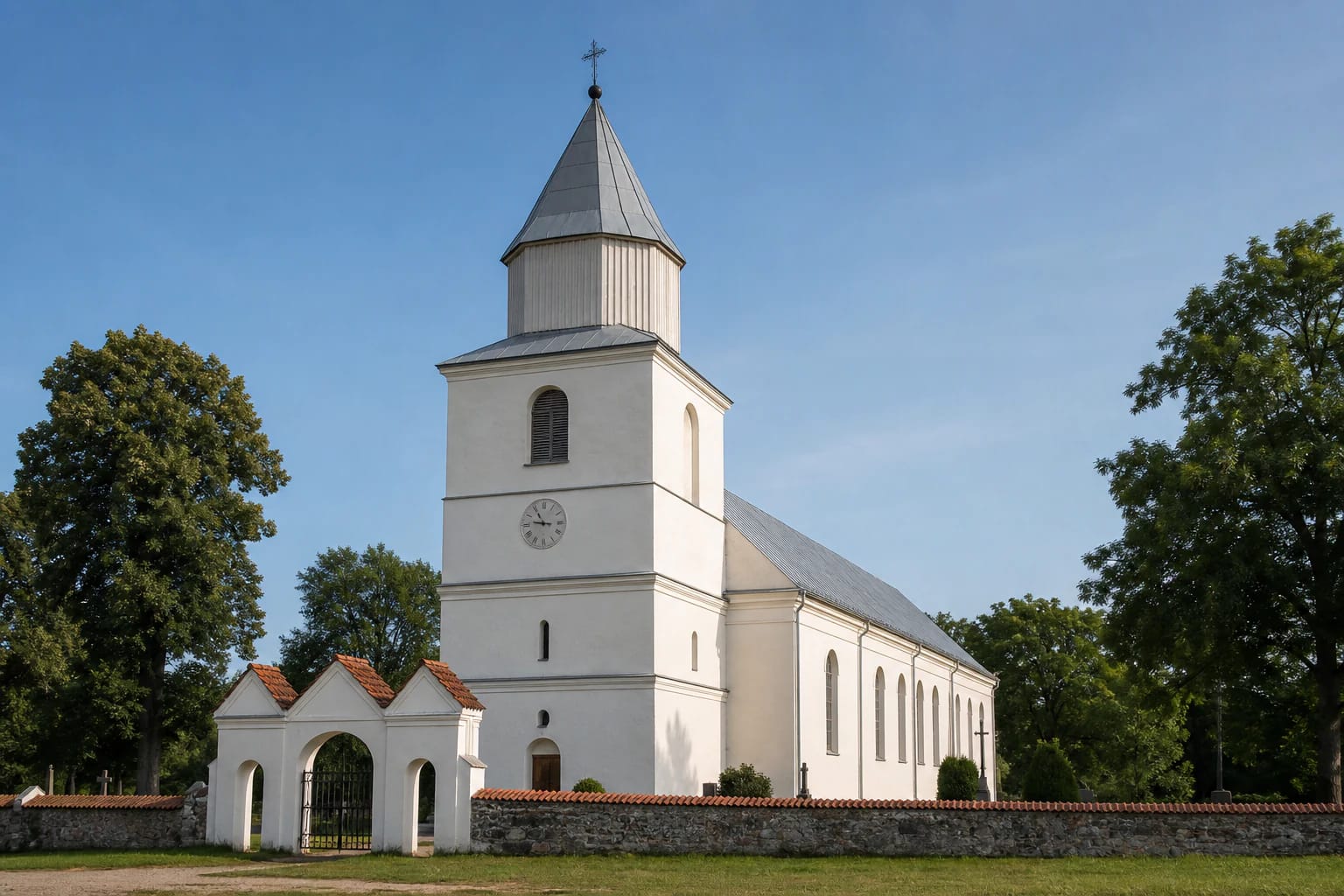
VLE calls the church Renaissance, while architectural historians also describe its essence as Mannerist. The three-nave hall, where the aisles read as one tall space, continues a late Gothic tradition. A square three-stage west tower, a narrower presbytery terminating in a semicircular apse, Tuscan pilasters outside and decorative plaster ribs inside explain why no single stylistic label captures the entire building.
Coats of arms, an epitaph and centuries of painting
The presbytery vault carries plaster ribs imitating a Gothic star and coats of arms recalling the patrons. The heritage register identifies those of Vytautas, Radziwiłł's wife from the Lubomirski family, and the Pac family. An epitaph to Jan Kazimierz Brzostowski dating from around 1650 survives beside a side altar; its centre holds the late-17th-century painting Christ Crowned with Thorns.
The church preserves art from the 17th to the 20th centuries. VLE highlights Michał Elwiro Andriolli's Saint Joseph of 1864 and Petras Kalpokas's Saint John of Nepomuk, Mary Magdalene and Saint Anthony. Kalpokas worked in Veliuona during preparations for the parish's 500th anniversary in 1920-1922. Other notable objects include late-18th-century sculpture, 19th-century Stations of the Cross, a Baroque chalice dated 1634 and two brass bells cast in 1766 and 1804.
A rebuilt tower and recovered 17th-century colour
The church is not an unchanged survival from 1644. Lightning destroyed the tower top in 1688; it was altered in the late 17th century, in 1821 and again in 1930 to designs by Vladas Švipas and Algirdas Šalkauskas. The nave roof was lowered, a porch added and a masonry organ loft built in the late 19th century. The First World War shattered the tower, breached the vaults and destroyed part of the glazing.
The foundations and façades were restored in 2015-2017, major interior work followed in 2018-2020, and conservation continued in 2021. Conservators removed some damaging later material, returned the walls and vaults to an ochre and pale-ochre scheme informed by the mid-17th-century finish, and conserved fragments of consecration crosses. A clock returned to the tower façade in 2021. The restored interior still preserves multiple periods rather than presenting an invented, stylistically pure 17th-century room.
Opening hours, worship and access to the tower
Kaunas Archdiocese states that the church opens daily from 9 to 10 am. Mass is listed at 9 am Monday to Friday, 10 am on Saturday and noon on Sunday. No separate tourist admission charge is published. Schedules may change for festivals, funerals or parish events, so check the official page or contact the parish before making a dedicated journey.
The official address in the heritage register and archdiocesan listing is 4 Draugystės Street. Google Maps displays 1 Draugystės Street, officially the rectory address, but its coordinate 55.0781426, 23.2757968 accurately marks the church. The register records a viewing platform installed in the tower in 2002, but no current public-access schedule is published, so any ascent must be agreed with the parish. Google Maps marks an accessible entrance and parking; because this is a historic sloping site with old thresholds, confirm the exact route. Do not photograph during worship without permission or disturb private prayer.