- Place
- Ilguva, Šakiai District Municipality
- Region
- Suvalkija
- Type
- wooden folk-Classicist manor homestead by the Nemunas
- Address
- Dvaro g. 27, Ilguva, Kriūkai Eldership, Šakiai District
- Coordinates
- 55.06400, 23.32460
Panykiai Manor
Ilguva Manor by the Nemunas
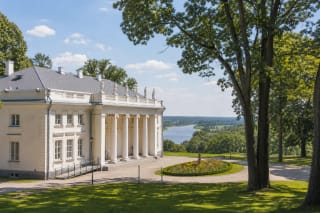
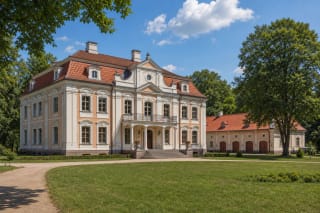
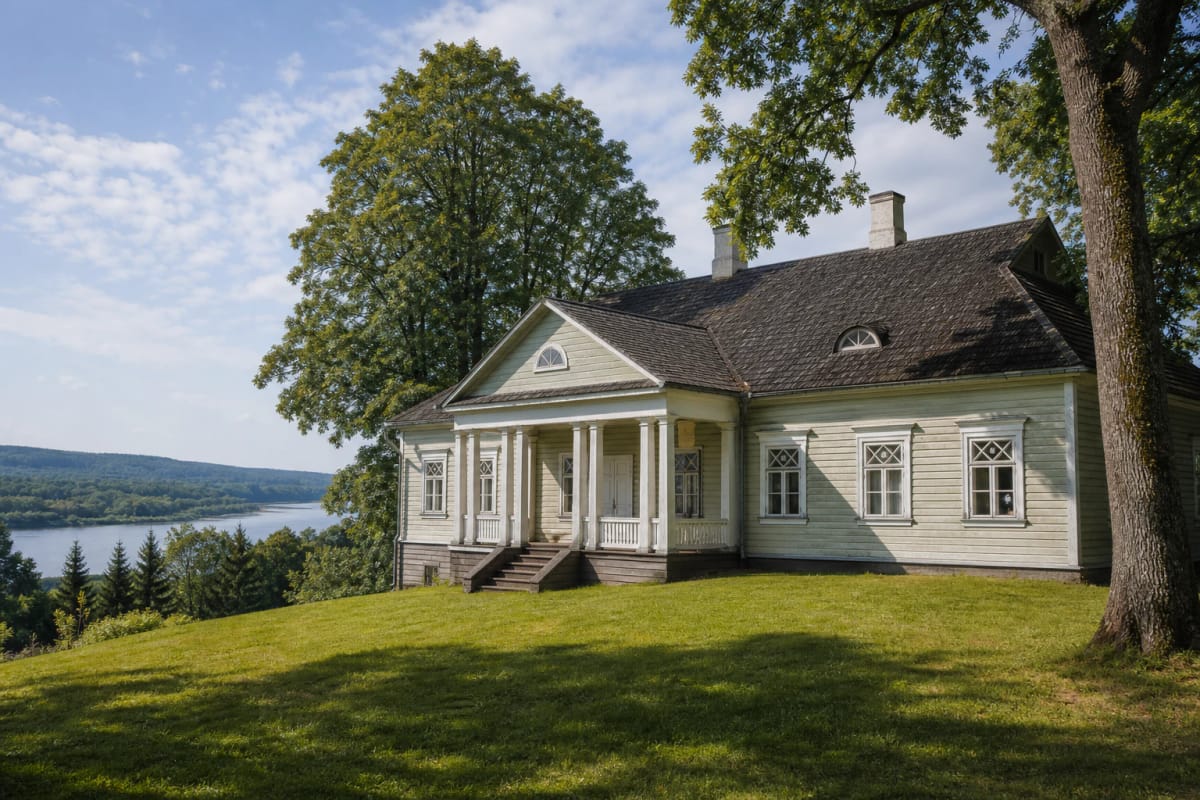
Ilguva Manor stands on a terrace of the left bank of the Nemunas, in Ilguva village, Šakiai District, within Panemunių Regional Park. It is one of the region's best-preserved wooden manors: its palace and surrounding buildings were built in a folk-Classicist style. A park stretches around it, and the confluence of the Nemunas and Nyka is nearby.
It is important to distinguish the manor from other manors in Šakiai District. Ilguva is a wooden manor by the Nemunas, while the nearby Zypliai and Kiduliai manors are separate masonry ensembles. Nor is it a Neo-Gothic or Baroque palace; it is specifically a wooden homestead of folk Classicism.
From Panykiai to Ilguva
The manor was first mentioned in documents in 1583 as Panykiai Manor, a name derived from the Nyka stream. In 1758 the manor was acquired by prelate Viktoras Talko-Grincevičius, also called Ilgauskas, and the present place name Ilguva comes from his surname. In 1794 Ilguva became an independent parish.
In the nineteenth century, the manor's owners, the Grincevičius brothers, supported the 1863-1864 uprising and were arrested and exiled to Siberia for it. The anthropologist Julian Talko-Hryncewicz is also connected with the manor. This shows that Ilguva was not only an economic centre but a cultural and political one as well.
A homestead of music and culture
Music brought Ilguva particular fame. From 1895 the manor was owned by conductor Emil Młynarski, founder of the Warsaw Philharmonic, who married Ona Grincevičiūtė. In his time the manor became a centre of musical culture, with a large library and concerts.
Prominent artists of the period came to Ilguva to visit and create: pianist and future Polish prime minister Ignacy Paderewski, composer Karol Szymanowski, violinist Paweł Kochański, and painter Ferdynand Ruszczyc. The celebrated Lithuanian singer Beatričė Grincevičiūtė spent her childhood here, and summer music festivals bearing her name are still held at the manor.
Buildings: manor house and church
The main manor building is a wooden landowner's house built around 1790 from pine and larch, standing on a high terrace above the Nemunas valley; it was restored in 1996. Other folk-Classicist buildings have also survived, including a servants' house, barn, service wing, and stables.
Beside the manor stands the wooden Church of the Finding of the Holy Cross, built in 1814, with a bell tower. It preserves a valuable painting, "Mary with Child", by M. E. Andriolli. An older church built in 1765 burned down in 1813, so the present one is a later sanctuary.
How to visit Ilguva Manor
Ilguva Manor is easy to combine with other Panemunių Regional Park manors and castles, including Gelgaudiškis, Belvederis, and the Panemunė Castles Route. For the exterior, church, and park, 1-1.5 hours is usually enough; remember to pause for the Nemunas valley panorama.
It is important to know that the Ilguva pensionatas, a social-care institution, still operates in the manor buildings. This is not a standard ticketed attraction or museum. Visits are best aligned with cultural events held here, and current information should be checked in advance.