- Place
- Seredžius, Jurbarkas District Municipality
- Region
- Panemunių Regional Park
- Type
- hillfort with foot settlement and burial grounds
- Coordinates
- 55.08030, 23.40660
Palemonas Hill, Pieštvė Castle Hill
Palemonas Hill in Panemunė
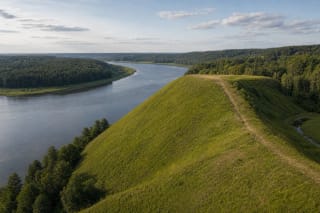
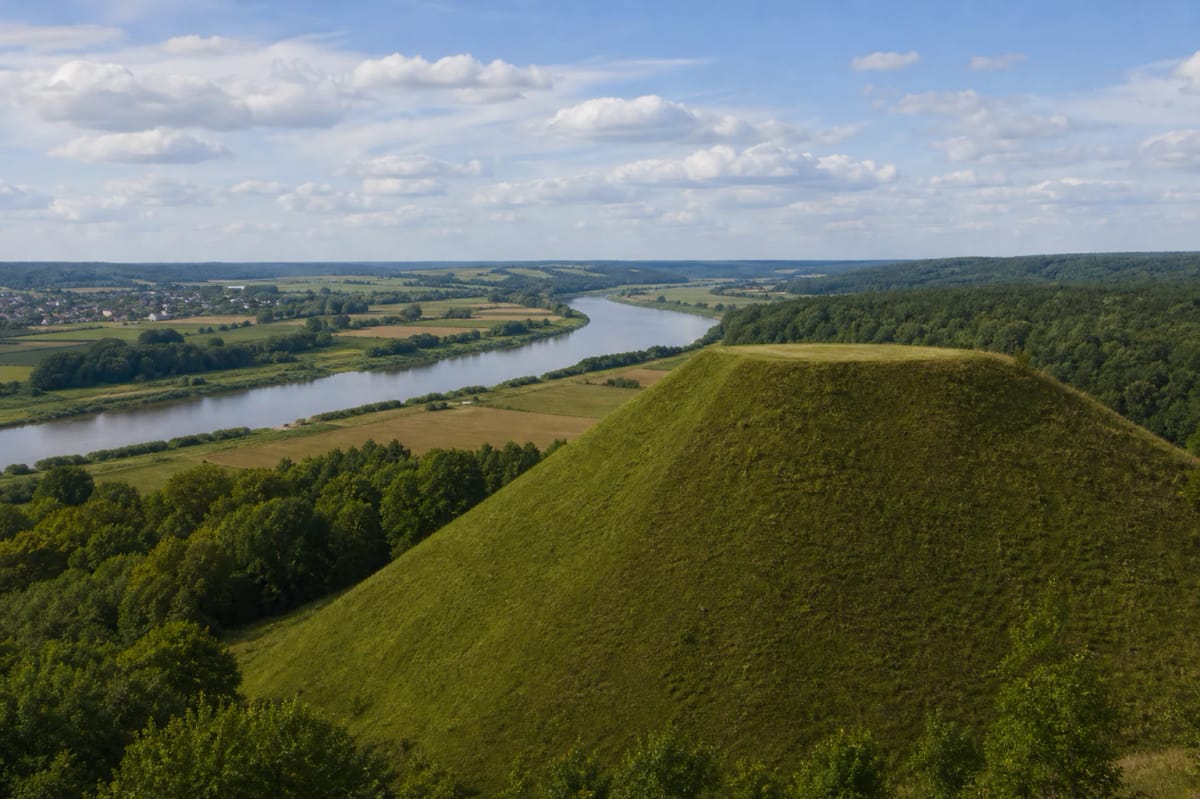
Seredžius Hillfort is most often recognised as Palemonas Hill. It rises by the town of Seredžius, near the confluence of the Nemunas and Dubysa, making it both a historical and landscape stop on the Panemunė road.
VLE's article on Seredžius says the town stands by the Dubysa and Nemunas confluence, within Panemunių Regional Park. This explains the site's logic: on a Panemunė journey, Seredžius is a natural pause between historical hillforts, manors, and Nemunas valley views.
The Site of Pieštvė Castle
VLE states that the fourteenth-century Lithuanian castle Pieštvė stood on Seredžius Hillfort, or Palemonas Hill. In the town-history article it is described as an important Lithuanian defensive point in Panemunė against Teutonic Order aggression.
Several severe episodes are recorded in Seredžius history: in 1293 the Teutonic Order burned the outer settlement east of the hillfort; in 1319, 1322, and 1336 it tried unsuccessfully to take the castle; and in 1363 Pieštvė Castle was destroyed.
The Shape of the Hillfort
VLE describes the hillfort as built on a height with a triangular 35 x 50 m platform. At the eastern end a rampart 7 m high and 20 m wide was raised; beyond it is a ditch about 10 m wide and 4 m deep, and by the ditch there was another rampart 3 m high and 10 m wide.
The slopes are steep and reach up to 30 m. VLE dates the hillfort broadly from the mid-first millennium to the beginning of the fifteenth century, meaning that the fourteenth-century Pieštvė Castle was only the late episode of a long site history. When visiting, do more than climb and photograph: imagine how the height edge, ramparts, ditches, and control of the Nemunas valley worked defensively.
Foot Settlement and Burial Grounds
VLE states that a 1.5 ha foot settlement lies at the eastern and southern foot of the hillfort. Fragments of rough and wheel-thrown pottery, clay daub, and animal bones were found there.
It is also important that the official VLE object name includes not only the hillfort but burial grounds. The first cemetery, dated roughly to the third to fifth centuries, was investigated in 1936-1937 under J. Puzinas, in 1964 by M. Michelbertas, and in 1974 by Juozas Markelevičius; in an area of 1 ha, 64 inhumation and 2 cremation graves were found with tools, axes, spearheads, and ornaments. The second cemetery, dated to the sixth to fourteenth centuries and located in the Nemunas valley, was investigated in 1985-1987 and 1989 by V. and S. Urbanavičius; in 787 sq m, 23 cremation and 2 inhumation human burials were found, along with 27 inhumed horse burials with bits, stirrups, and harness. All finds are kept in the National Museum of Lithuania, so the place is a wider archaeological complex rather than only a viewpoint hill.
Palemonas and Careful Reading
Seredžius has a strong legendary layer. VLE's article on the town says that, according to the Lithuanian Chronicles, Seredžius was founded by the Roman prince Palemonas, who arrived by boat with his retinue. Because of this tradition, the hillfort is called Palemonas Hill.
Treat the legend as part of cultural memory, not as an archaeologically proven biography. The site's historical value does not depend on the legend being literally true: Pieštvė Castle, Order attacks, the foot settlement, and burial grounds already give Seredžius a firm historical foundation.