- Place
- Raudonė, Jurbarkas District Municipality
- Region
- Jurbarkas District
- Type
- residential castle, park, and Panemunė-road landmark
- Address
- Pilies g. 1, Raudonė, LT-74456, Jurbarkas District
- Coordinates
- 55.09710, 23.13070
A Castle on the Nemunas Slope
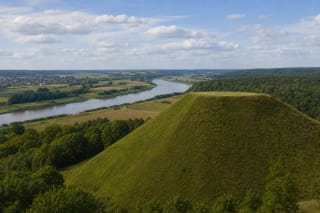
Raudonė Castle stands on a high, steep right-bank slope of the Nemunas, in the landscape of Panemunių Regional Park. VLE describes it as a late-sixteenth- to nineteenth-century castle preserved in the Nemunas terraces of the town of Raudonė.
It is not a medieval defensive fortress in the narrow sense. Raudonė is better understood as a private residential castle whose red-brick architecture, towers, and park now form one of the strongest views on the Panemunė road.
Architecture and Towers
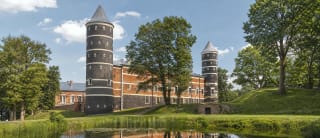
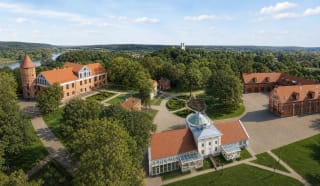
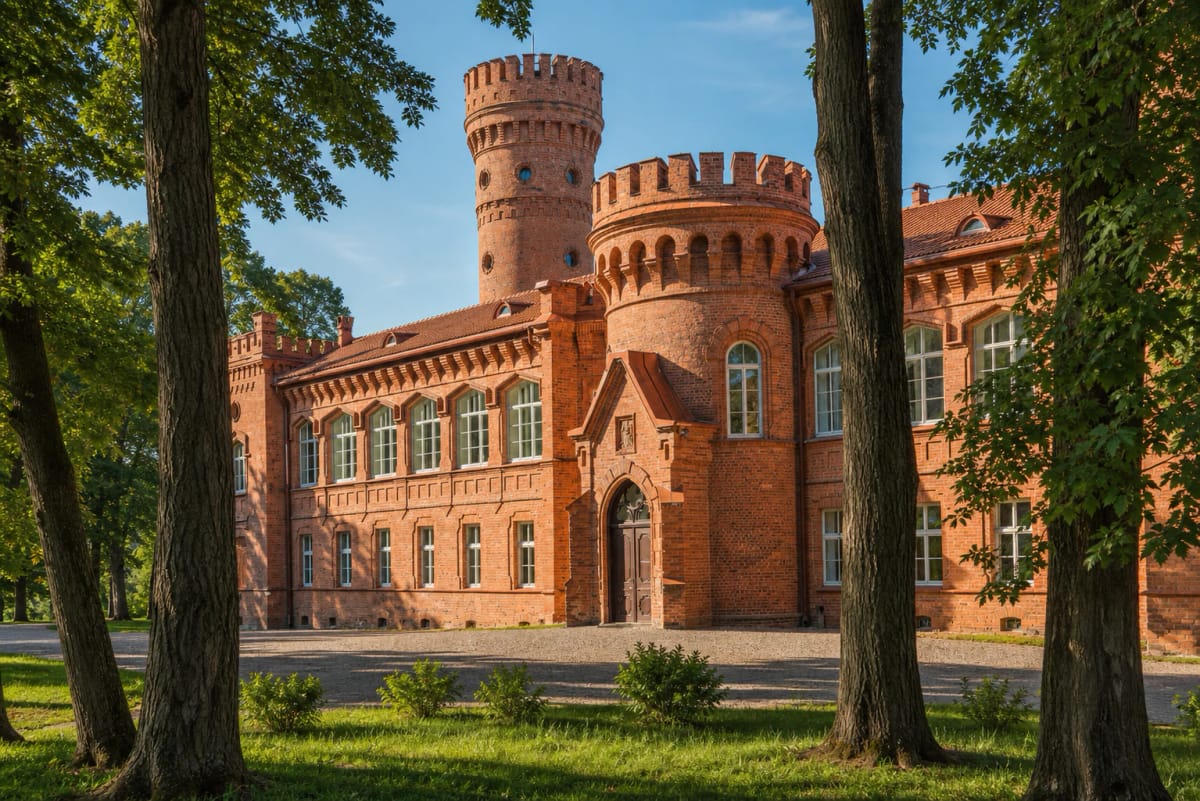
VLE states that the castle consists of three two-storey wings arranged around a semi-enclosed courtyard. On the outside of the wings are six round towers, while the tower in the middle of the southern wing reaches 33.5 m and is visible within a radius of 10-15 km.
The castle is built of red brick. Massive corbelled cornices decorate its wings and towers, while crenellated parapets crown the tower tops. Its present appearance is especially tied to nineteenth-century reconstructions, when the building acquired Neo-Gothic features.
From Kiršenšteinas to Zubov and de Faria e Castro
VLE writes that around 1343 the Teutonic Order had built the second Bayerburg Castle on the site of the present castle; Lithuanians destroyed it in 1384. Raudonė Castle itself was begun in the fourth quarter of the sixteenth century: after receiving Raudonė Manor from Grand Duke Sigismund Augustus, Krišpinas Kiršenšteinas built a private castle-residence in the late sixteenth century.
In the eighteenth century the Olendskis owned the castle, and later Raudonė passed to Platon Zubov. From 1875 the castle belonged to the Portuguese de Faria e Castro family. This succession of owners explains why the palace history contains Gothic, Renaissance, Classicist, Neo-Gothic, and romantic narrative layers.
Fires, War, and Reconstruction
Raudonė Castle burned and was rebuilt more than once. VLE mentions an 1812 fire, and after S. Kaisarova inherited the castle, the 1856-1877 reconstruction by architect C. L. Anichini gave it Neo-Gothic elements. In 1934 the indebted owners lost the castle to the Bank of Lithuania, restoration began in 1936, and in 1939 a Byzantine-style Orthodox church added to the northern wing was demolished.
In 1944 the Nazis blew up the great tower, and the explosion collapsed much of the southern wing. After the Second World War a school operated in the castle; in 1968, according to a project by architects S. Čerškutė and V. Jurkštas, the southern wing was rebuilt, the other wings were repaired, and a viewing platform was installed in the great tower.
Park, Viewpoint, and Legends
The castle is surrounded by a park. VLE states that the park was laid out in the sixteenth to eighteenth centuries and includes a mill; old lime-tree alleys and natural monuments are now an important part of the castle ensemble.
Raudonė has many romantic stories: about Gediminas' oak, Bayerburg connections, or the Balanda legend. These should be treated as local tradition and part of the visitor experience, but not confused with the precisely documented history of the castle's construction.
How to Visit Raudonė Castle
The address is Pilies g. 1, Raudonė, LT-74456, Jurbarkas District. When travelling the Panemunė road, the castle combines easily with Veliuona, Panemunė Castle, and stops along the Nemunas banks.
The key impressions here are the exterior architecture, the park, and the Nemunas valley setting. Before travelling specifically for the tower or interior, check current local information: community fairs, exhibitions, concerts, and festivals take place at the castle, and visiting rules can change.