- Place
- Veliuona, Jurbarkas District Municipality
- Region
- Panemunių Regional Park
- Type
- hillfort complex and Nemunas defensive-line site
- Coordinates
- 55.07700, 23.28000
Gediminas' Grave, Gediminas Hill, Castle Hill, Ramybės Hill, Junigeda, Pilaitės
A Three-Part Complex above the Nemunas
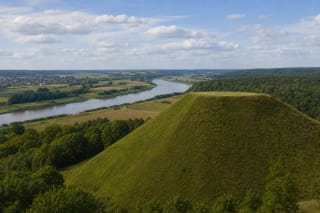
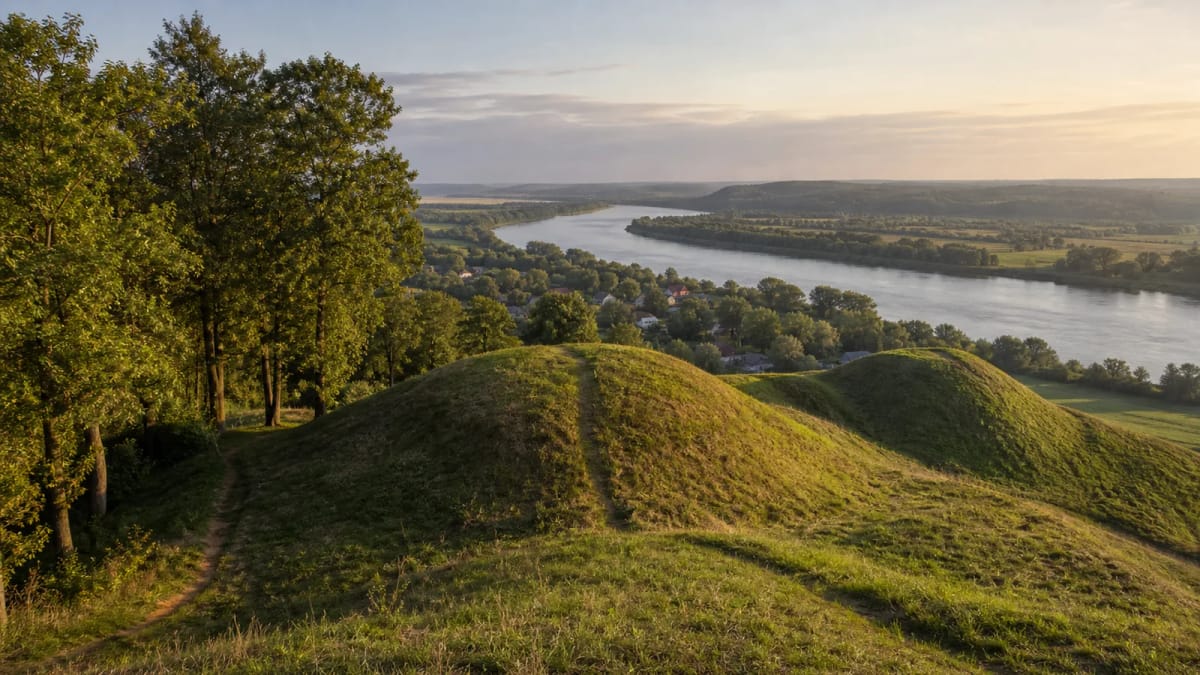
The Veliuona Hillforts stand on the right bank of the Nemunas, in the southern part of Veliuona town, at one of Panemunių Regional Park's most important historic sites. VLE states that this is not one hill but two hillforts and a separate castle site: Gediminas' Grave, Castle Hill to its west, also called Ramybės Hill, and Pilaitės 2.65 km farther west. The different names mark different memory layers of the same defensive node.
Saugoma.lt presents the site as the Veliuona Hillfort Complex: two hillforts, Gediminas' Grave and Ramybės Hill, with a foot settlement. Visitors should not go to only one summit, but read the whole relationship between hills and the Nemunas: defence, communication, and town history depended directly on the river. Gediminas' Grave and Ramybės Hill are separated by a deep ditch, about 30 m wide and 17 m deep, whose bottom now carries a road into town.
Junigeda and Veliuona Castle
VLE states that until 1315 Veliuona was called Junigeda and that from the thirteenth to fifteenth centuries it was one of the most important Lithuanian defensive posts along the Nemunas west of Kaunas. Junigeda Castle, later Veliuona Castle, stood on Gediminas' Grave; according to VLE it was built in 1291 and rebuilt several times after the Teutonic Knights burned it. The third reconstruction, probably in 1411, was on Ramybės Hill. In 1291-1319 the Teutonic Knights unsuccessfully attacked the castle 11 times; they captured it in 1348 and 1369, and in 1367 the defenders themselves burned it.
After the Battle of Grunwald in 1410, Veliuona Castle lost its military importance but remained diplomatically significant. VLE states that in 1411-1422 the castle hosted consultations between rulers of the Grand Duchy of Lithuania and Poland and the masters of the Teutonic Order. This matters: Veliuona was not only a beautiful town beside the Nemunas but a strategic defensive-system point, where Seredžius, Veliuona, and other Panemunė sites had a precise military function.
Gediminas' Grave: History and Legend
The first hillfort is called Gediminas' Grave. It is an archaeological monument of national significance, registered from 1992 and dated to the thirteenth to fifteenth centuries. VLE states that its slopes are steep and up to 30 m high, the quadrangular platform measures 25 x 54 m, from the north it is bordered by a pit 10 m in diameter and 2 m deep, and on the western edge there is a 2.5 m high and 20 m wide rampart, beyond which lies a 30 m wide and 17 m deep ditch.
According to legend, Grand Duke Gediminas died on this hillfort, and a monument to him was erected here in 1925. This name should be presented as local tradition, not as a proven burial fact: Gediminas' death circumstances are ambiguous in historical sources, and the grave has not been archaeologically confirmed. The distinction matters throughout the page. Veliuona has a documented core and legendary names, and both are valuable when clearly separated.
Krzywicki Excavations and Finds
The Veliuona Hillforts are a genuinely investigated archaeological site. VLE states that in 1912 an expedition led by Liudvik Krzywicki examined about 1,000 sq m of the Gediminas' Grave platform and found parts of burned buildings, pavements, human remains, weapons including crossbow bolt heads, tools, and household items. The ancient settlement at the southern and western foot of the hillfort was investigated in 1992, 1995, and 2003.
The second hillfort, Ramybės Hill or Castle Hill, has been an archaeological monument of national significance since 1997 and is also dated to the thirteenth to fifteenth centuries. Its steep slopes reach up to 30 m, and its elongated east-west platform is about 150 x 40 m. In its eastern part the Lietuvai pagražinti draugija erected a granite altar monument, while in the middle of the platform a granite and fieldstone monument was raised in 1934. In 2010, a monument to the goddess Veliona by sculptor Erikas Daugulis was unveiled by Ramybės Hill.
Pilaitės and the Teutonic Bajerburg
The third part of the complex is the Veliuona castle site called Pilaitės, 2.65 km west of Gediminas' Grave. VLE dates it to the fourteenth century. Its slopes are steep and up to 8 m high, and it consists of two small hills with quadrangular platforms, 16 x 18 m and 10 x 24 m, encircled by ramparts and ditches. The Teutonic Order's Bajerburg Castle stood here, which helps distinguish the Lithuanian Veliuona Castle from the enemy-built bastion nearby.
In 1965, an expedition of the Institute of Lithuanian History led by Adolfas Tautavičius investigated about 370 sq m and found, in a cultural layer up to 1.3 m deep, building remains, weapons including arrows, crossbow bolt heads, and stone projectiles, tools, and household items. VLE states that the finds are kept in the National Museum of Lithuania and the National M. K. Čiurlionis Museum of Art, so Veliuona heritage can be encountered both on site and in museums.
How to Visit the Veliuona Hillforts
Allow 1-2 hours for the Veliuona Hillforts. It is best to start from the town centre with Vytautas the Great Square and the monuments to Gediminas (1925) and Vytautas (1930), then walk across Gediminas' Grave and Ramybės Hill, pausing where the Nemunas opens below. If you want to see the Teutonic side, Pilaitės require a separate trip about 2.65 km west.
After rain the slopes can be slippery, and the ramparts and summit edges are sensitive to trampling, so keep to existing paths and do not disturb the relief. Veliuona combines well with Seredžius Hillfort, Raudonė Castle, and the wider Panemunė Castles Route, making it possible to read the Nemunas defensive line as a continuous landscape.