- Place
- Telšiai, Telšiai District Municipality
- Region
- Samogitia
- Type
- a public sculpture park founded in 2011, where student works from different periods trace the development of the Telšiai art school
- Address
- Western shore of Lake Mastis beside 29A Muziejaus Street, LT-87356 Telšiai
- Coordinates
- 55.97695, 22.23908
- Visit duration
- 30-60 minutes for the sculptures; 1.5-3 hours with the Lake Mastis waterfront and Žemaičių Museum Alka
- Best time
- a bright morning or evening from April to October, when granite and metal stand out clearly against the green shore and the works are not obscured by thick fog or snow
Akademija Sculpture Park, VDA Telšiai Faculty Akademija Sculpture Park, Lake Mastis Sculpture Park in Telšiai
Akademija is a distinct outdoor art display on the western Lake Mastis shore
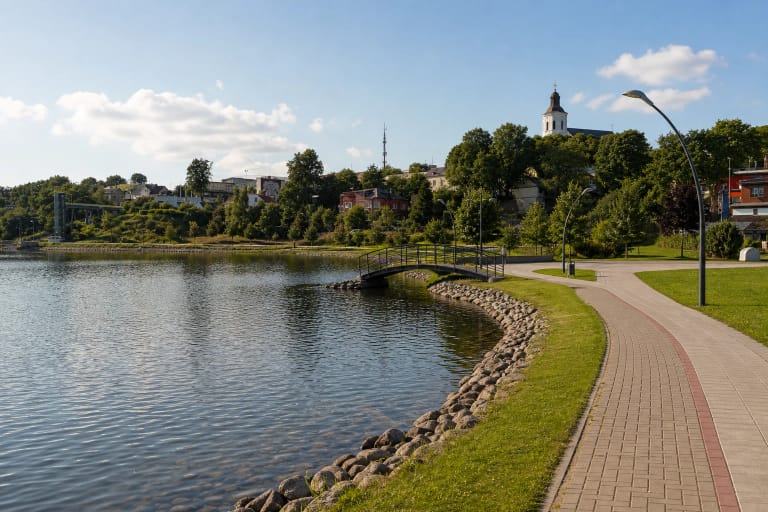
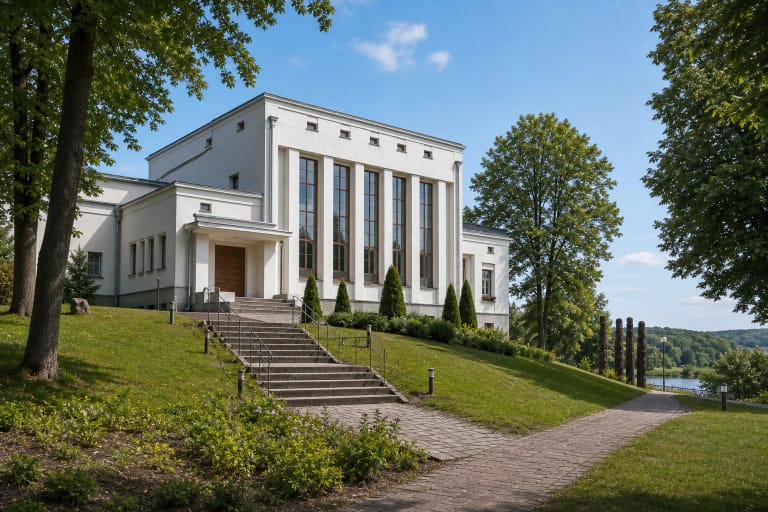
The sculpture park occupies the western part of the Lake Mastis waterfront and adjoins the grounds of VDA's Telšiai Faculty, the Telšiai Arts Incubator, and Žemaičių Museum Alka. It is neither the entire long promenade nor a closed faculty courtyard. Works stand in a public green space among lawns, mature trees, the lake, and waterfront paths.
Coordinates 55.976952, 22.239084 mark a representative point among the sculptures. They do not mark a ticket office, formal gate, or parking bay. VDA's building at 29A Muziejaus Street is the clearest written landmark, but access to the faculty interior and visiting the public outdoor park are separate matters.
The official sources publish no shared admission charge, ticket desk, or gate-controlled opening schedule for the outdoor display. VDA interiors, the Arts Incubator, the museum, and individual events keep their own hours and prices, so check the relevant institution's official page if you intend to go inside.
The park works as an evolving open-air archive of student sculpture
VDA describes the park as a joint project with Telšiai District Municipality begun in 2011. It brings together works made when the institution operated as the Telšiai Technical School of Applied Arts, the later Higher School of Applied Arts, and today's VDA Telšiai Faculty. Its artists are therefore graduates from several generations rather than one group working at a single symposium.
An older public visitor description listed 21 sculptures, yet VDA emphasises that Akademija is an ongoing project supplemented by new objects from young artists. Outdoor works may also be conserved, moved, or temporarily removed. Twenty-one is therefore useful as a historical inventory figure, not a guarantee that every visitor will count exactly that number along one fixed route.
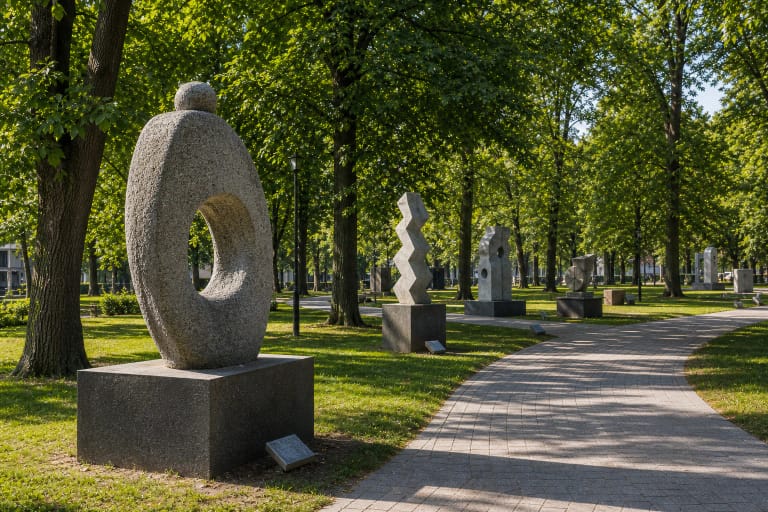
Changes in material reveal the collection's underlying story. Granite and its physical mass dominate many earlier works, while later objects bring in steel, concrete, and alternative materials. The park shows not only finished forms but how students across different periods learned to control weight, surface, support, rhythm, and an artwork's relationship with public space.
An educational tradition begun in 1931 gives the park its longer historical context
The roots of VDA's Telšiai Faculty reach back to 1931, when the Telšiai Secondary State Crafts School opened with carpentry and furniture-making specialisms. The school was repeatedly reorganised and renamed in later decades before becoming a division of Vilnius Academy of Arts in 1998. That institutional sequence explains why artwork labels refer to a technical school, a higher applied-arts school, and the Academy.
The park itself has not existed since 1931. It was founded in 2011, and an older visitor record gives an exact opening date of October 21 that year. The same record identifies architect Professor Algirdas Žebrauskas and sculptor Associate Professor Osvaldas Neniškis as the authors of the idea. In short, 1931 begins the educational tradition, while 2011 begins its public outdoor display.
The project moves older coursework and diploma pieces out of the teaching process and into the town's shared memory. Rather than celebrating one famous artist, it reveals how hands-on knowledge of material developed into a sustained school of applied art and sculpture in Telšiai. That educational lineage is what distinguishes Akademija from an ordinary collection of monuments.
Four works reveal granite from a gathering circle to an image of sunset
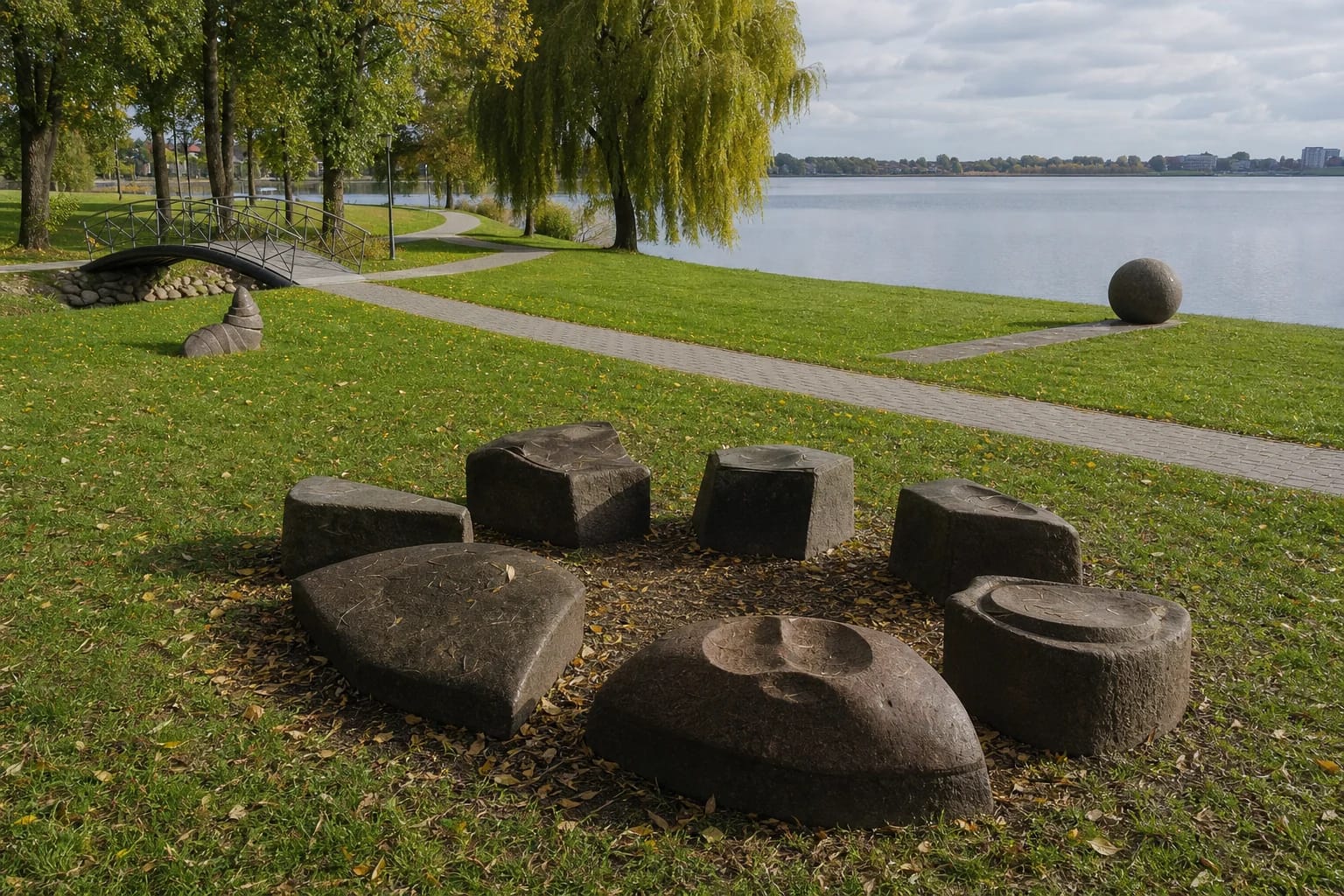
The 1983 fourth-year project Bendravimo stalas, or Conversation Table, is formed from low granite elements of differing shapes arranged in a circle beside the lake. VDA credits Raimundas Poškus, Juozas Bagdonas, Rolandas Repšys, Ovidijus Šileika, Audrius Jonušas, Kęstutis Lenkauskas, and Igoris Rimeika. An older description calls it Bendravimo ratas, Conversation Circle, but the current VDA caption uses Bendravimo stalas.
Evaldas Adomkus's Vikšras, Caterpillar, is a low segmented form emerging from dark granite and is particularly legible from the path above it. Arvydas Šlaustas's 1997 diploma work Saulėlydis, Sunset, connects a large stone sphere with a long granite plane marked by repeating circular impressions. Both demonstrate how an exceptionally heavy material can suggest movement or the passage of time.
Rimantas Jurašius's 2004 diploma work Pėstininkas, Infantryman, combines steel and concrete in a raised vertical suggestion of a figure. Older inventories also name Petras Rimkus's Dekoratyvinė forma, Leonardas Kaleinikovas's Laiptai, Ovidijus Šileika's Pumpuras, Vytautas Borusas's Stalas, and Arūnas Guokas's Tik įspėti. Because the display evolves, use the labels and actual placement found on the day of your visit rather than assuming every historic inventory item occupies its original position.
A slow circuit from the faculty towards the lake turns separate objects into one story
For a first visit, begin on the faculty and museum side, descend into the green space, and scan for works between trees and across the lawn. Lower granite forms readily merge with the terrain, so change your viewing height and walk around objects where the ground permits. The lake horizon is particularly important to Bendravimo stalas and Saulėlydis, whose compositions become clearer when read towards the water.
No reliable official source presents the display as a strict, numbered chronological route. To follow the school's development, begin with each date and material before interpreting the form. Granite works from the 1970s and 1980s, stone-and-metal combinations of the 1990s, and later steel and concrete solutions create a more meaningful sequence than whichever direction you happen to walk.
Do not confuse this park with the small bear figures installed on Lake Mastis footbridges or with other art details around central Telšiai. The bears belong to a separate small-public-art trail, while Akademija presents sculpture made by students of the Telšiai art school. Both layers fit one waterfront walk, but their artists, scale, and purpose differ.
Hard-surfaced waterfront paths help, but not every sculpture stands directly beside one
Landscaped hard-surfaced paths run beside the park, but some works stand on grass, a slope, or among trees. An older public visitor description calls the site accessible to disabled people, yet no detailed audit of step-free access to every sculpture was found. A substantial part of the display can be seen from the main paths, although wet grass and relief may prevent close approach to individual objects.
Stone surfaces, fallen leaves, and sloping grass can be slippery after rain. These are outdoor artworks, not automatically certified climbing equipment, so do not climb on them or move smaller elements unless on-site guidance explicitly permits interaction. Children can enjoy the park as a visual search, but supervise them near both the sculptures and the water.
Allow 30-60 minutes for the sculptures. Continue along the Lake Mastis waterfront for a longer walk, and reserve separate time for Žemaičių Museum Alka after checking its official opening hours and tickets. Temporary waterfront works, events, or conservation can alter the usual approach, so the map pin should never be read as a promise of free parking at that exact point.