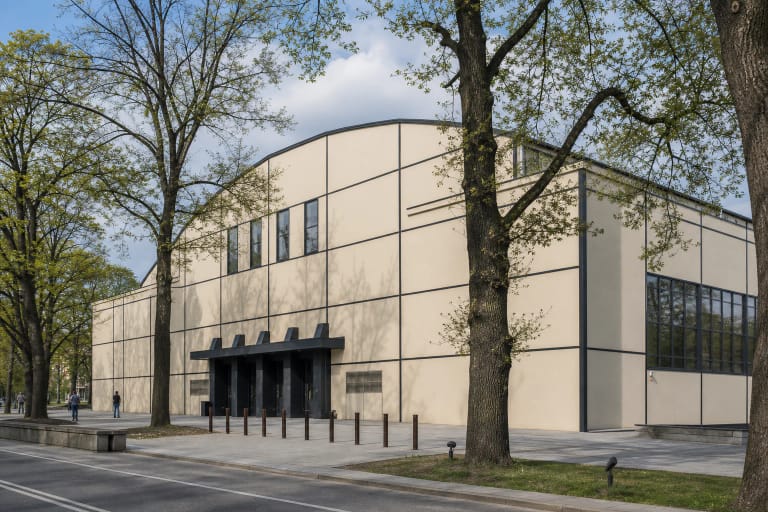
- Place
- Kaunas City Municipality
- Region
- Kaunas
- Type
- rendered-masonry single-tower three-nave Catholic church
- Address
- 11 Radvilėnų Avenue, Kaunas
- Coordinates
- 54.90615, 23.94766
- Visit duration
- 20-40 minutes for the exterior and a quiet interior visit; longer during Mass or a parish event
- Best time
- in daylight, when the pale facade, red tower roof, and churchyard sculptures are clear; enter only when the church is open
Žaliakalnis Church of St Anthony of Padua, Gričiupis Church of St Anthony of Padua, St Anthony of Padua Church in Kaunas
Recognising the church in Gričiupis
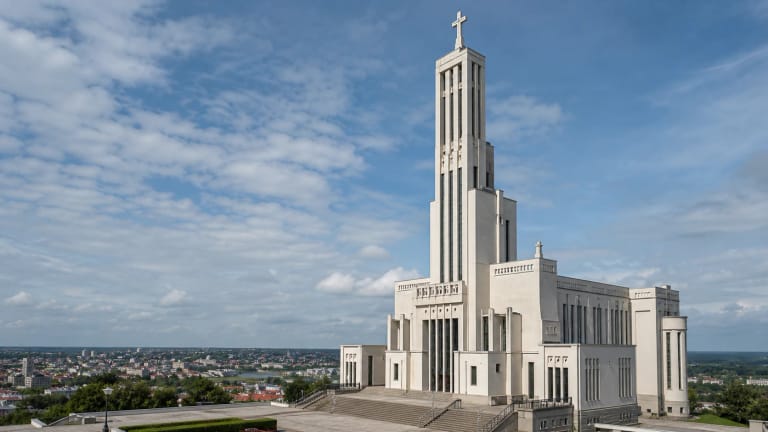
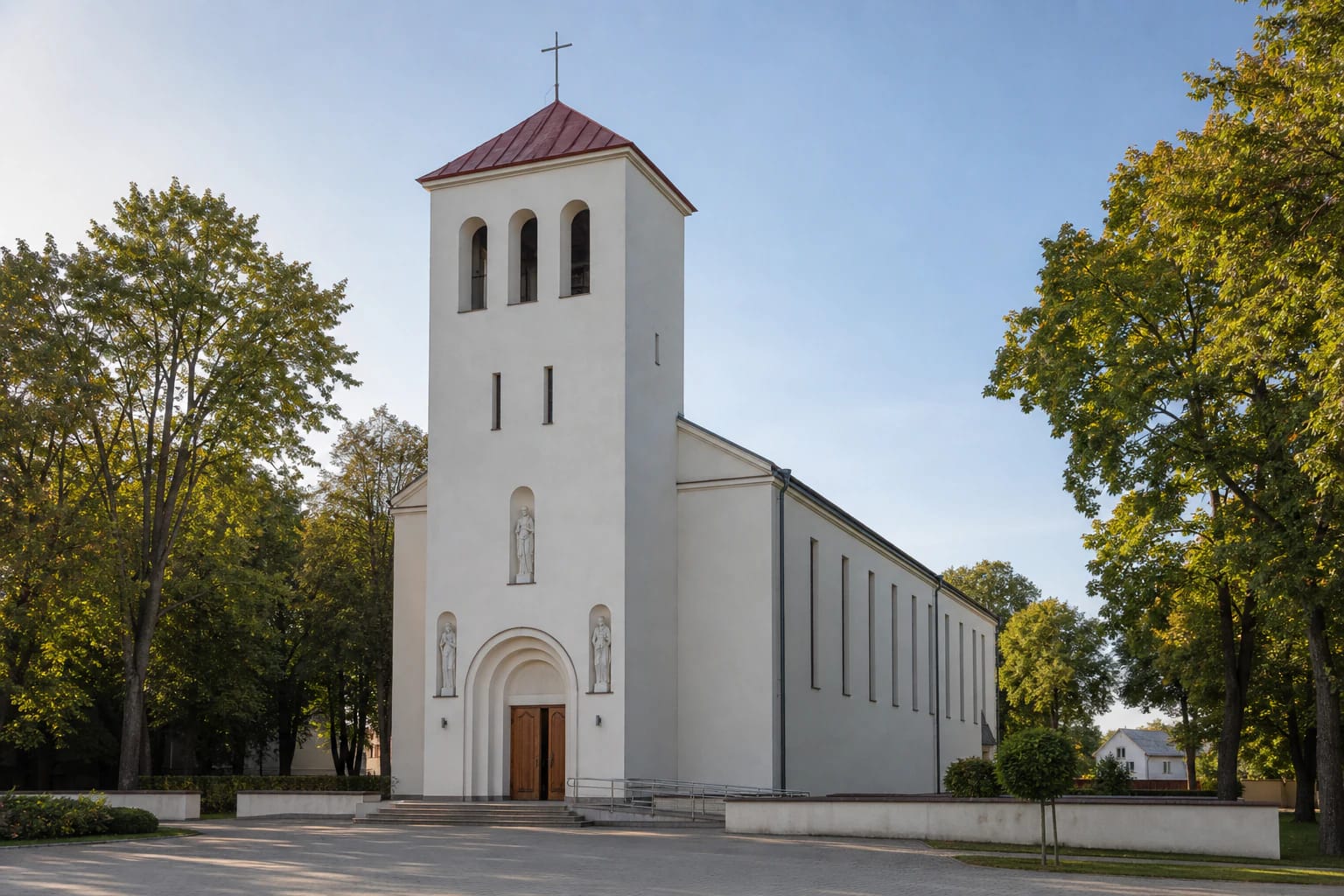
Kaunas Church of St Anthony of Padua stands at 11 Radvilėnų Avenue, in the Gričiupis part of Žaliakalnis. Coordinates 54.9061505, 23.9476594 mark the entrance approach rather than the whole parish grounds. From the street, the pale rendered-masonry volume, single tower with a red pyramidal roof, and tree-filled churchyard appear first.
This is a rectangular-plan, single-tower, three-nave church: the central nave rises above the side aisles. Three tall arched openings are visible in the upper tower, while saints stand in shallow niches on the main facade. Restrained cornices, tall windows, a ramp, and broad steps give the entrance a calm, practical composition.
The churchyard boundary and mature trees make a clear transition between the busy avenue and the place of prayer. The exterior is easiest to read from the front and side, but entry, photography, and movement around the grounds remain subject to the liturgy and parish rules.
A 1933 parish and its temporary chapel
The parish of St Anthony of Padua was founded in 1933, when the growing Žaliakalnis district had outgrown the capacity of a single Church of the Resurrection. Parish history records about 15,000 believers in the area, creating a need for an independent place of worship. Canon Juozapas Želvys became the builder and first organiser of the project.
Before the permanent church existed, parishioners met in a temporary chapel in the buildings of the St Vincent de Paul Society shelter. The chapel was blessed on 16 July 1933, while the community raised funds and prayed for a new church. The temporary chapel brought worshippers, families, and ministries together while the parish established its permanent place of worship.
The present church grew from local residents' need for their own parish and sustained community work. The parish still brings together community, choir, Caritas, youth, and family activities alongside Mass information.
Six months of construction in 1936
Construction of the masonry church began on 28 March 1936 to a design by engineer Antanas Bistrickas. The parish history describes an exceptionally fast build: the church was completed on 23 October of the same year, after six months and 25 days. The Kaunas County Library account also records the 1936 construction and Bistrickas's authorship.
The exterior uses a rational composition: a higher central volume, lower side aisles, one unified tower, and restrained decoration. The red roof edge sharpens the pale stucco surfaces, while the arched tower openings give the disciplined mass a vertical rhythm. Its character comes from proportion and light rather than abundant ornament.
The foundations were blessed on 10 May 1936, and the church was blessed that year by Canon Juozas Byla. On 9 May 1937, the sculpture of St Anthony of Padua by Juozas Zikaras was solemnly blessed; President Antanas Smetona was also present. These details connect the church with both its engineer and the sacred-art culture of interwar Lithuania.
Consecration, sculpture, and living memory
The church was consecrated on 20 September 1942. Archbishop Metropolitan Juozapas Skvireckas performed the rite, and Bishop Vincentas Brizgys celebrated Mass. The consecration took place during the war, so the building's story joins the rapid construction of independent Lithuania with the difficult history of the twentieth century.
The churchyard has an oak cross, later cement sculptures of St John Bosco, the Sacred Heart of Jesus, and St Thérèse, and plaster Stations of the Cross hung in 1957. Some details may not be visible today; ask the parish before photographing or looking for them inside.
The church also carries a living layer of personal remembrance. On 29 May 2021, the remains of the Servant of God Elena Spirgevičiūtė were reburied beside the church; the parish presents her as a twentieth-century martyr of faith. The site is therefore not only an architectural object but also a current place of prayer and memory.
Visiting an active parish church
The Kaunas Archdiocese lists the church as open Monday-Sunday from 6:30 to 19:00. This is an indicative access window; Masses, funerals, repairs, or events can change the arrangement and access to some spaces.
The published timetable gives Masses at 7:00, 8:00, and 18:00 on Monday-Friday; 8:00, 10:00, and 18:00 on Saturday; and 8:00, 9:30, 11:00, 12:30, 13:30 from October to May, and 18:00 on Sunday. Check the parish or archdiocesan information again before travelling because schedules and repair work can be updated.
This is an active parish church: arrive quietly, stand at the back if a service is under way, do not photograph people without permission, and do not disturb prayer. Allow 20-40 minutes for the exterior and churchyard; fit an interior visit around parish services and access arrangements.