- Place
- Kaunas City Municipality
- Region
- Kaunas
- Type
- zoology and natural-history museum on Laisvės aleja
- Address
- Laisvės al. 106, Kaunas
- Coordinates
- 54.89830, 23.90395
Kaunas Zoological Museum, Tadas Ivanauskas Zoological Museum, Zoological Museum on Laisvės aleja, Kaunas nature museum
A nature museum in the city centre
Tadas Ivanauskas Zoological Museum operates in the very centre of Kaunas, at Laisvės al. 106. It is not a zoo and not only a children's walk between display cases. The museum shows how animal life has been collected, prepared, classified, studied, and explained from the early natural-science history of the University of Lithuania to today's museum education.
The official museum description emphasizes its scale: over more than a century, a collection of about 300,000 animal specimens has been assembled, and about 17,000 exhibits are presented to visitors. The exhibition covers about 2,500 square metres and is arranged by evolutionary and systematic principles across seven halls.
The beginning in 1919
The museum history page dates the beginning to July 15, 1919, when a museum was established in Kaunas, on Vilniaus Street, together with the Nature Research Station. Its core was the zoological collection belonging to station director Tadas Ivanauskas, brought from the Ivanauskas noble family's Lebiodka manor in the Lyda region.
A few years later the Nature Research Station was transferred to the emerging university and became the Department of Zoology and Comparative Anatomy. At that time the museum had a double function: it was a teaching tool for students and a storehouse of scientific collections.
Tadas Ivanauskas and natural science
VLE presents Tadas Ivanauskas as a Lithuanian naturalist, zoologist, and pioneer of nature protection. He studied at Saint Petersburg University and the Sorbonne, created a laboratory of natural-science visual aids, taught at the Higher Courses, was one of the founders of the University of Lithuania, and headed the Zoology Department.
That biography matters in the museum as more than a name on the sign. Ivanauskas's work joined science, expeditions, ornithology, nature protection, and public knowledge of nature. His initiatives are linked with the Vente Cape ornithological station, Zuvintas reserve, and Kaunas Zoo, so the museum halls are part of a broader Lithuanian natural-history story.
A journey through addresses
In 1929 the museum moved to new premises on K. Donelaičio Street, where it could already arrange an exhibition accessible to the public. During the first Soviet occupation in 1940, the Department of Zoology and Comparative Anatomy was moved to Vilnius University, but the nature museum remained in Kaunas.
In 1945 the museum came under the Biology Institute of the Academy of Sciences of the Lithuanian SSR, forming an independent institution: the Kaunas Zoological Museum. In 1948 it moved into the former bank premises at Laisvės al. 106, where it still operates. In 1970 the museum was named after its founder and long-time coordinator Tadas Ivanauskas.
The building layer
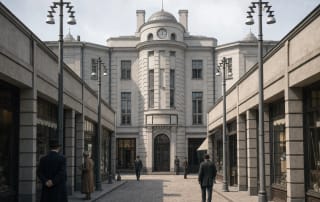
Laisvės al. 106 has its own architectural history. In the interwar period this address held the Central Jewish Bank and passage, and that lost heritage layer is best read on the separate Jewish Bank in Kaunas page. For a zoological-museum visitor, the key point is that today's public access is to a natural-history institution, and the bank-passage structure no longer recreates the earlier experience.
In 1975-1982 the museum building was reconstructed and a new exhibition installed. Today's museum interior is therefore defined not only by the historic Laisvės aleja facade, but also by museum halls formed in the Soviet period: display-case rhythm, taxidermy collections, dioramas, educational compositions, and the scale of a large city museum.
Seven exhibition directions
The official exhibitions page divides the museum into clear themes: invertebrates, insects, fish, amphibians and reptiles, birds, mammals, palaeontology and osteology, and hunting trophies. This arrangement lets visitors see not a random cabinet of curiosities, but a systematic story of animal life.
The invertebrates hall displays more than 4,500 exhibits from Lithuania and other parts of the world. The insects hall shows about 10,000 insects belonging to more than 2,600 species. These numbers explain why the museum deserves more than a quick half-hour.
Birds, mammals, and dioramas
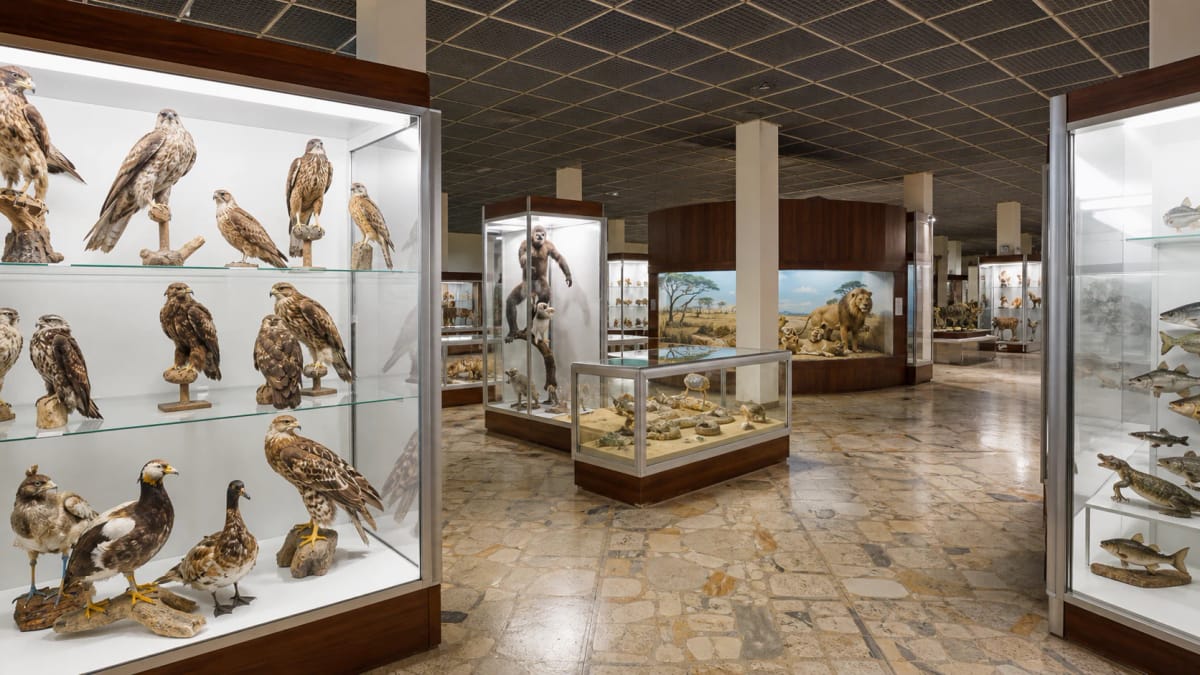
Visually, the bird and mammal halls often remain strongest in visitors' memories. Official museum photos show bright cases with birds of prey, fish and reptile displays, mammal halls with larger dioramas, and the classic natural-history museum aesthetic: wood finishes, glass, gridded ceilings, and long display-case lines.
This is a museum where it is worth looking not only at the largest or most exotic objects. Smaller specimens, eggs, skulls, skeletons, liquid-preserved examples, and species comparisons show how natural history becomes science, not only spectacle.
Lithuania's largest zoological collection
The collections page states that the museum holds the largest zoological collection in Lithuania: more than 300,000 units of varied zoological specimens, including taxidermy mounts, skeletons, skulls, skins, eggs, liquid-preserved examples, mummified material, and other specimens.
The museum explains that some specimens are used for teaching, display, and demonstration, while others are for scientific purposes. Collections are prepared from dead animals received by the museum, usually those that died in nature or captivity. This detail matters because it helps visitors understand that the museum is not a trophy warehouse but science and education infrastructure.
Connection with bird ringing
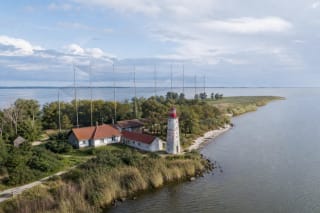
Vente Cape Ornithological Station and the Lithuanian Bird Ringing Centre are important in the museum's structure. They continue the bird-observation and migration-research direction begun by Tadas Ivanauskas. If the bird hall is the visitor's strongest interest, Vente Cape becomes a natural second route point beyond Kaunas.
In this way the Laisvės aleja museum works as an urban gateway to wider knowledge of Lithuanian nature: from the exhibition case to bird migration, from children's education to scientific collections and databases.
How to plan a visit
The official opening-hours page states that the exhibition is open Tuesday-Sunday 10:00-18:00, visitors are admitted until 17:15, and the exhibition is closed on Mondays and specified public holidays. On the eve of national holidays, the museum closes one hour earlier, so check the website before travelling.
The ticket page lists an 8 EUR standard museum ticket, 4 EUR reduced ticket, and 20 EUR family ticket. Guided tours cost extra, and tour participants must also buy exhibition tickets. Practically, the museum is convenient because it is on Laisvės aleja, close to other Naujamiestis sites and public transport.