- Place
- Kaunas City Municipality
- Region
- Kaunas
- Type
- interwar military science laboratory building and KTU faculty premises
- Address
- Radvilėnų pl. 19, Kaunas
- Coordinates
- 54.90449, 23.95110
Armament Board Research Laboratory, Research Laboratory of the Ministry of National Defence Armament Board, KTU Faculty of Chemical Technology palace, Research Laboratory in Kaunas
The face of a secret laboratory
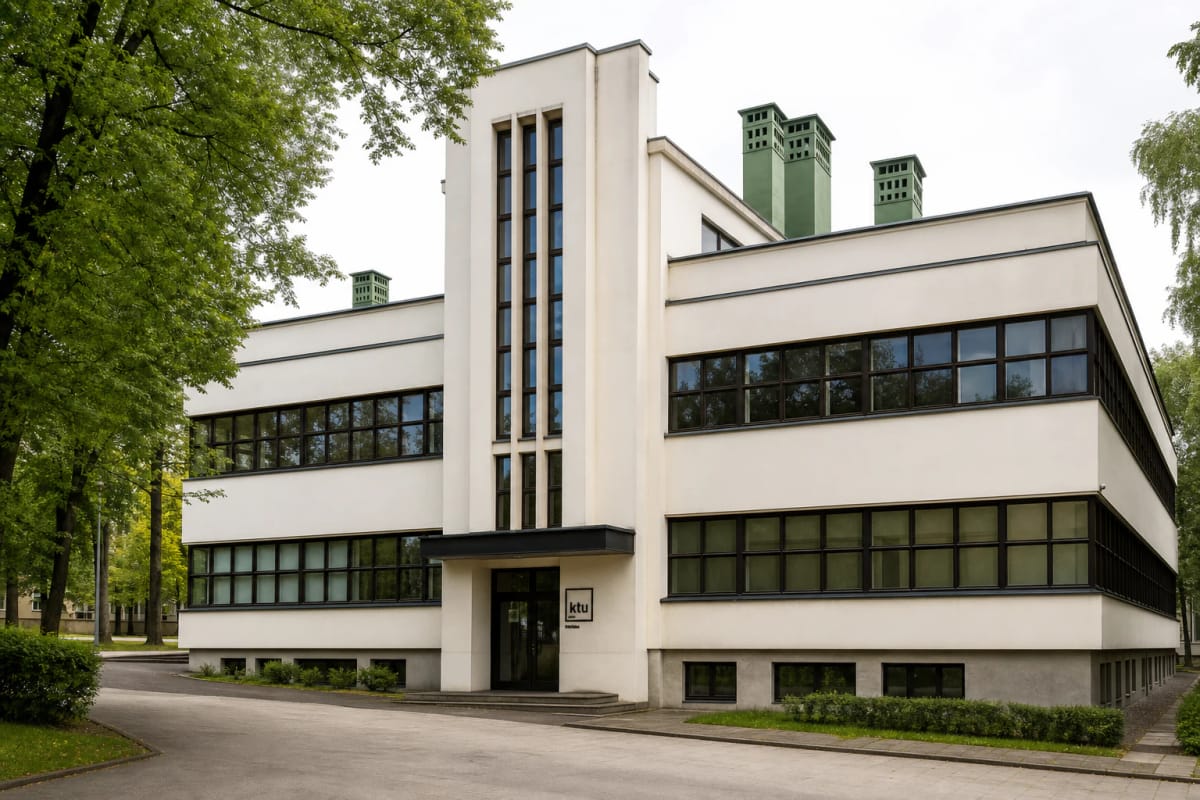
At first glance the Research Laboratory in Kaunas looks like a pure modernist manifesto: white walls, flat roof, ribbon windows, corner glazing, and a taller central part. Its history, however, is not only about elegant form. It was the modern science and technology base of the Ministry of National Defence Armament Board.
Today the building is still alive. It houses the KTU Faculty of Chemical Technology, so visitors encounter not a museum exhibit but a working interwar laboratory. That makes the object especially interesting: one of the most technical architectural programmes of the First Republic has not lost its scientific function.
Why the laboratory was needed
Vaidas Petrulis's text published by AUTC links the laboratory's beginning with a 1930 military discussion in which shortcomings in Lithuania's armament were named. The decision to establish a laboratory developed as a response to the need for a place where chemical, mechanical, physical, and other defence-related research could be carried out.
The location was not obvious. Moving the laboratory farther from Kaunas was considered, and the reuse of Kaunas Fortress forts was assessed, but those options did not fit. Kaunas won because of its proximity to the university: the laboratory needed libraries, specialists, and the environment of natural sciences, technical, and medical faculties.
Competition and architect
On September 30, 1932, the minister of national defence gave basic approval to build the laboratory. On October 31 of the same year, the project competition was won by Vytautas Landsbergis-Žemkalnis, one of the most important architects of interwar Lithuania.
AUTC gives the construction period as 1933-1935, while KVR and research literature show a broader equipment horizon up to 1937. The clearest visitor wording is this: the building rose in 1933-1935, and specialized laboratory equipment and internal systems continued to be installed later.
What was researched here
The laboratory was planned as applied-science infrastructure for the Armament Board and other institutions of the Ministry of National Defence. AUTC mentions organic chemistry, microbiology, toxicology, pathological anatomy, ballistics, explosives, technical chemistry, metallurgy, mechanics, optics, and goods testing.
That list explains the architectural strictness. This was not a representative palace for receiving guests. The building had to unite laboratories, safe testing, technical communications, specialized ventilation, shelters, and work with sensitive materials.
Function as architectural language
The laboratory is often regarded as one of the clearest examples of interwar functionalism in Kaunas. Its modernity appears not only in the white facade plane or ribbon windows. The reinforced-concrete frame, flat roof, clear volumes, and undecorated walls arise from the technical task of the building.
At the same time, this is not an anonymous international-style box. The central entrance volume has monumentality, the composition is fairly symmetrical, and the facade creates a precise, state-serious posture. It is a Lithuanian version of functionalism: rational, but not cold.
Green turrets and ribbon windows
The most recognizable detail is the green roof turrets. AUTC explains them as fume-hood chimneys, part of the laboratory ventilation system. They are therefore not decoration or a later architectural oddity, but a direct trace of building technology.
The ribbon windows also had practical meaning. AUTC cites the explanation of long-time KTU chemistry faculty dean Zigmuntas Jonas Beresnevičius: in the event of a possible experimental explosion, the windows were meant to break rather than the walls collapse. This detail shows how modernist aesthetics coincided with safety logic.
What the register protects
In the Cultural Heritage Register the laboratory building has unique code 1150, monument status, and national significance. The wider Armament Board Research Laboratory complex is marked with code 28567 and includes other buildings on the site.
KVR is especially important because it protects more than the exterior. The descriptions mention laboratory tables, fume hoods, sinks, bronze taps, electrical equipment, lifts, terrazzo stairs, lamps, doors, fittings, shelter doors, and other technical details. That level of protection distinguishes it from many other modernist objects whose interiors survive only fragmentarily.
Shelters and underground infrastructure
The laboratory programme included more than daily scientific work. The complex had anti-aircraft and anti-chemical defence elements, and KVR and research descriptions mention a tunnel connecting the laboratory with the administrative building.
These details change the way the building is seen. From the street it looks calm and academic, but its internal logic was tied to interwar Lithuania's questions of defence, chemical protection, and technological independence.
From army to university
When the occupation began in 1940, the laboratory's history took an unexpected turn. The KTU Museum states that on August 23, 1940, on the initiative of colonel Juozas Vėbra, the Armament Board Research Laboratory was transferred to Kaunas University.
That decision helped preserve the scientific base, equipment, and continuity of specialists. The building became home to the Faculty of Technology with a Chemical Technology section, and in later KTU history it became part of the identity of the Faculty of Chemical Technology.
UNESCO modernism context
The Research Laboratory belongs to the Kaunas modernism story recognized by UNESCO in 2023 as the World Heritage property Modernist Kaunas: Architecture of Optimism, 1919-1939. The most accurate presentation is to call it part of this modernist urban heritage protection context, connected with the Research Laboratory Complex.
The building reveals the architecture of optimism especially clearly: the young state built not only ministries, schools, and banks, but also laboratories, technical systems, university science, and professional engineering infrastructure.
How to visit today
This is not a regular museum, so free interior visiting should not be planned. The building is used by KTU, and KVR does not list public opening hours. The safest route is an exterior view from Radvilėnų plentas and the university surroundings.
On site, look for three things: the central vertical entrance axis, long horizontal bands of windows, and green ventilation turrets on the roof. If Kaunas modernism tours, open days, or KTU programmes are taking place, check interior access possibilities through official organizers.