- Place
- Kaunas City Municipality
- Region
- Kaunas
- Type
- 84.42 ha protected urban park with 100-320-year-old oaks, a historic path network, Natura 2000 habitats, and visitor infrastructure
- Address
- 15A Radvilėnų Road, Kaunas
- Coordinates
- 54.89954, 23.94570
Ąžuolyno parkas, Kauno Ąžuolynas, Kaunas Oak Grove, Oak Grove Park
The 84.42 ha park is not one continuous stand of trees and has no single main gate
Ąžuolynas Park occupies part of Kaunas's Žaliakalnis district between Vydūnas Avenue, Radvilėnai Road, and Tunelio, Sporto, K. Petrausko, Parodos, and Radastų streets. The Google Maps address, 15A Radvilėnų Road, and coordinates 54.8995381, 23.9457049 mark a convenient point on the eastern side, but paths enter from many directions. When navigating to a specific feature, such as the Sports Hall, Song Valley, or Adam Mickiewicz Valley, select that destination's nearest approach instead.
The Cultural Heritage Register assigns the park code 17381 and a protected area of 844,200 sq m, or 84.42 ha. Kaunas Municipality and city visitor material describe Ąžuolynas as Europe's largest oak grove surviving within a city, although such a comparison depends on the definitions used for both an urban area and an oak grove. The securely documented figure is the protected park area.
Oak does not cover all 84.42 ha. The Žaliakalnis cultural reserve plan identifies about 34.4 ha of oak stands, 7.9 ha of lime woodland, and smaller areas of birch, grey alder, and maple. The south-eastern edge descends through deep post-glacial erosion ravines towards the Girstupis valley, while meadows, a former nursery site, the sports complex, and Song Valley interrupt the woodland elsewhere.
The old oaks are a relic forest remnant fragmented by timber trade, fortress construction, and urban growth
The Kaunas area's climate and clay subsoil long favoured oak, so the present habitat is considered very old and may have persisted for several thousand years. Once commercial waterways opened after the Battle of Grunwald, Lithuania's oak woods were felled intensively and the timber exported to Western Europe. Ąžuolynas is therefore not a park planted from nothing, but a modified fragment of an older forest.
Another rupture came when construction of Kaunas Fortress began in 1882. Woodland was cleared especially heavily on the left bank of the Nemunas, while fortress roads, including today's Tunelio Street, separated the Žaliakalnis and Aukštieji Šančiai oak woods. The surviving tract lay between an expanding city and the north-eastern defences, making its present boundaries partly a legacy of military urbanism.
Oaks aged roughly 100-320 years predominate, with some trunks measuring 100-160 cm in diameter. A 1982 inventory counted 1,009 old oaks and considered 81 percent viable, while later municipal communications often cite about 770. The figures are not directly comparable because the dates, boundaries, and counting methods differ, so it is more accurate today to speak of hundreds of old trees than one timeless total.
Interwar plans might have destroyed the grove, but eventually shaped it as a free-form English landscape park
Antanas Jokimas and Peter M. Frandsen proposed new streets across the oak wood in their 1923 Kaunas plan; full implementation would have severely damaged the stand. Some plots between today's Vaižganto Street and Perkūnas Avenue were sold in 1922-1925, a municipal horticultural operation settled here in 1930, and the stadium, Palace of Physical Culture, Sports Hall, and agricultural and industrial exhibition grounds expanded nearby.
Edmundas Frykas produced an unrealised park plan in 1930. A second design by an unidentified author was approved by the city council in 1935; paths and a broad memorial axis for a future Darius and Girėnas monument were begun, but work remained incomplete when the Second World War arrived. Surviving paths appear on a 1947 plan, and architect Teodora Šešelgienė's 1976-1977 project largely returned to the 1935 structure.
Since 2006 the Cultural Heritage Register has protected the free-form English layout, the path network established by 1940, the oak stands and habitat, ravine relief, Girstupis valley, a bridge, decorative sculptures, Song Valley, and the former greenhouse area. The heritage value therefore lies not only in individual ancient trees, but in an entire layered relationship between nature and urban planning.
Hollow and even declining trees sustain the hermit beetle
Kaunas Oak Grove, code LTKAU0020, is a habitat-protection site in the European Natura 2000 network. Its key target species is the hermit beetle, a rare insect whose larvae develop for several years in cavities and decaying wood inside old broadleaved trees. The adult lives only briefly, so the population depends on an uninterrupted succession of hollow veteran trees.
A 2014 inventory in Ąžuolynas and its approaches reliably found beetles or traces of their activity in cavities and bark cracks of old trees. The habitat requires sun-warmed trunks, so an overly dense spontaneous understorey of lime, maple, or hornbeam can be as harmful as removing veterans. Conservation work therefore thins young broadleaved growth in places while retaining dry and hollow oaks.
A fallen limb, standing deadwood, or a large cavity covered by a grille may look like neglect, although it often reflects deliberate biodiversity protection. Stay on paths, do not climb into cavities, disturb decaying wood, or trample roots close to trunks. Surveys in 2005 also recorded 59 bird species, confirming that the grove is much more than a collection of trees.
Adam Mickiewicz and Song valleys connect Romantic memory with mass cultural events
The Girstupis stream valley on the south-eastern edge is associated with Adam Mickiewicz, who lived in Kaunas from 1819 to 1823. It is said that the poet enjoyed walking here and mentioned the valley in his poem Grażyna, while at his farewell friends named the place for him at the suggestion of his beloved Karolina Kowalska. Initials and his departure year were carved into a stone, with lines from Grażyna added later; the cultural association is documented, although details of individual episodes survive through storytelling.
Architect Vladimiras Zubovas designed the Song Valley amphitheatre. The Cultural Heritage Register dates its design and installation to 1964-1965, while the municipal technical project gives 1967 as the completion year, making the mid-1960s the safest formulation. Song festivals and Poetry Spring events took place here; after its latest reconstruction, the valley reopened for large events in 2024 and remained active in 2026.
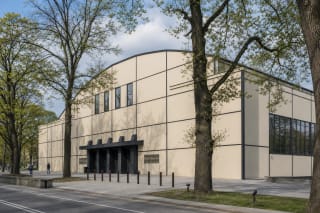
Darius and Girėnas Stadium, Kaunas Sports Hall, and other sports facilities adjoin the park on its south-western side. Ąžuolynas is consequently not just a quiet wood: one route brings together a natural habitat, an interwar physical-culture centre, poetic memory, and contemporary concerts. On event days, the eastern and north-eastern sections are better choices for a calmer walk.
The 2022 renewal provided 10 km of walking paths, although natural ravines remain steep
After eighteen months of work, the renewed park reopened to the public in September 2022, and the EUR 5.6 million project was administratively completed in 2023. It provided about 7 km of natural-surface and 3 km of asphalt walking paths, a separate cycleway of roughly 1 km, a nature interpretation route, rest areas, children's play and exercise grounds, lighting, and two automatic public toilets.
The principal renewed infrastructure accommodates disabled visitors, but this does not make the entire park level. The Girstupis ravines, natural paths in Adam Mickiewicz Valley, and steps towards Tunelio Street and Radvilėnai Road have considerable gradients. Wheelchair users and families with pushchairs should favour the asphalt main routes entering from Vydūnas Avenue or the flatter approaches along Radvilėnai Road.
The park has no admission ticket and Google Maps lists it as open around the clock, although events in Song Valley, the stadium, or other individual venues may charge and restrict access. On 13 July 2026, the Google entry Oak Grove Park had 6,094 reviews averaging 4.7 out of 5. Vehicles must not be left on paths or park soil; for major events, public transport or only designated outlying parking is the practical choice.