- Place
- Kaunas City Municipality
- Region
- Kaunas
- Type
- 2019 community mural
- Address
- 62 Kranto Avenue, Kaunas
- Coordinates
- 54.86774, 23.93054
- Visit duration
- 10-20 minutes; 45-75 minutes with a Nemunas riverside walk and other Šančiai sights
- Best time
- in daylight, preferably morning or late afternoon, when the grayscale details are easier to see
Šančių laikai, Šančiai Times, Šančiai Times wall painting
The mural waits beside the Nemunas in Lower Šančiai, not in the city centre
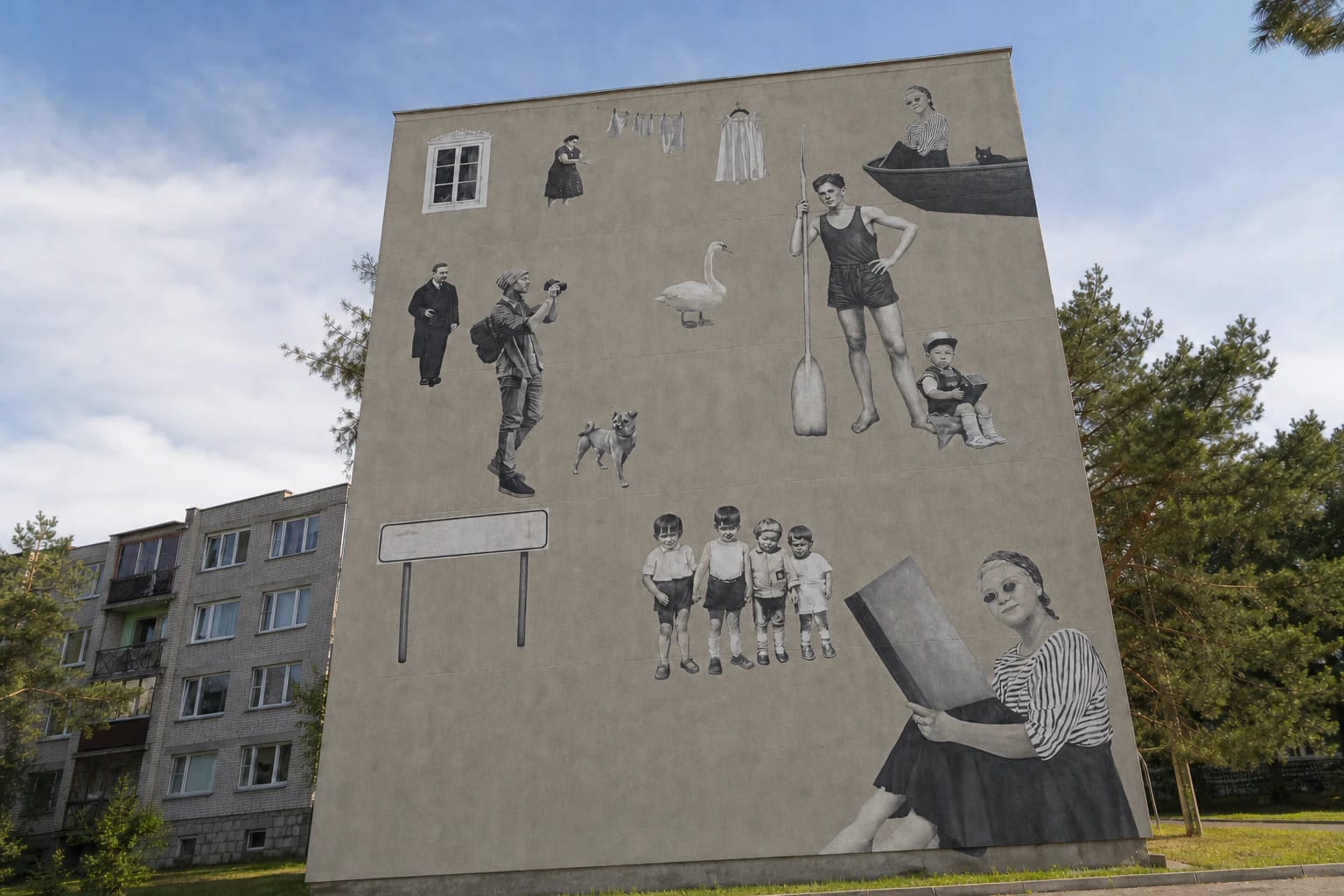
“Šančiai Times” covers the blind gable wall of the apartment block at 62 Kranto Avenue. The coordinates 54.86774, 23.93054 mark the facade itself, not a ticket office, car park, or entrance to the building. Kaunas City Municipality introduced it as a work beside the Nemunas walking and cycling path, making it a natural stop on a riverside walk.
From a distance the wall is restrained: large areas of bare greyish plaster separate figures of different sizes, giving the composition the rhythm of an open district photo album. Clothes, faces, a boat, the long paddle, and details copied from old photographs emerge as you approach. Step back first to read the whole arrangement, then return to the individual characters.
This is not a fenced gallery site. People live in the adjoining building, so view the work from publicly accessible space, never enter stairwells or a private part of the yard, and do not block vehicle access. There is no official visitor desk or car park dedicated to the mural.
A grayscale collage joins a washerwoman, rower, photographer, and neighbours
At the top of the composition, an old wooden Šančiai window sits near a woman washing clothes beside the Nemunas and laundry hung to dry. A boat occupies another fragment, while a tall interwar rower and long paddle command the centre. A present-day tourist or photographer with a backpack and camera, a white swan, a dog, and a seated boy with an accordion appear around him.
Below them, four boys were transferred from a Soviet-era photograph. The large seated woman reading a book represents Vida Bliumkienė, who fostered community activity in the district. The artists' accounts also identify a figure of President Antanas Smetona, included in connection with his visit to Šančiai Military Cemetery. The figures do not form a chronological history lesson; different periods are deliberately placed on a single wall.
The swan evokes the Nemunas bank and its local bird-feeding tradition, the wooden window recalls older Šančiai architecture, and the people came from residents' photographs and memories. The artists also set visitors a small search game: three cats and a mobile phone are hidden within the composition. How clearly those small details appear now depends on light and the condition of the paint.
The 2019 project was created with residents of the apartment block and the wider district
The idea developed among local residents, but the wall had to wait until the apartment block's renovation was complete. The design was transferred to the facade during the night of 4 to 5 August 2019, and painting continued despite changeable weather until 30 August. A public meeting with the artists and an introduction to the characters followed on 30 September.
The principal artist was Šančiai resident Gražvyda Andrijauskaitė. Street artist and Nykoka festival initiator Tadas Šimkus contributed as co-author and consultant. Austėja Bliumkytė-Padgurskienė of the Šančiai Kiosk community initiative managed the project, while Darius Ruzgas represented the apartment owners' association as its chair.
The wall's approximate height of 10.5 metres and width of 7 metres matter, but scale alone is not the point. Residents recognised childhood photographs, familiar people, and architectural details. A renovated apartment block consequently became a canvas for neighbourhood memory rather than an anonymous decorative surface.
Documented sources and viewers' interpretations are not the same
Several images have clearly identified prototypes. The four boys reproduce an old photograph, the woman reading is Vida Bliumkienė, and the athlete refers to interwar rowing culture. Those documented links should be kept separate from a viewer's interpretation, such as imagining that the long paddle or boat symbolises the entire district's passage through time.
The wall does not present a continuous date-by-date history. Instead, its artists assembled fragments of local memory: a president's visit, a childhood photograph, a wooden window, washing in the river, sport, and a contemporary photographer. Read it as a community album in which documentation, ordinary life, and artistic juxtaposition work together.
When a figure has no clear label or published explanation, it is safer not to guess who it represents. The project's presentation material identifies major characters, but it does not assign a declared symbolic meaning to every pose and object.
No ticket is needed for the outdoor wall, but choose a bright and quiet time
On 29 July 2026, the official pages published no fixed opening hours, admission charge, or registration requirement for independently viewing the facade. It is visible outdoors, although daylight is best for finding faces and hidden details. Check current official Kaunas information before making a special long journey, because facade repairs, path works, or events could temporarily change access.
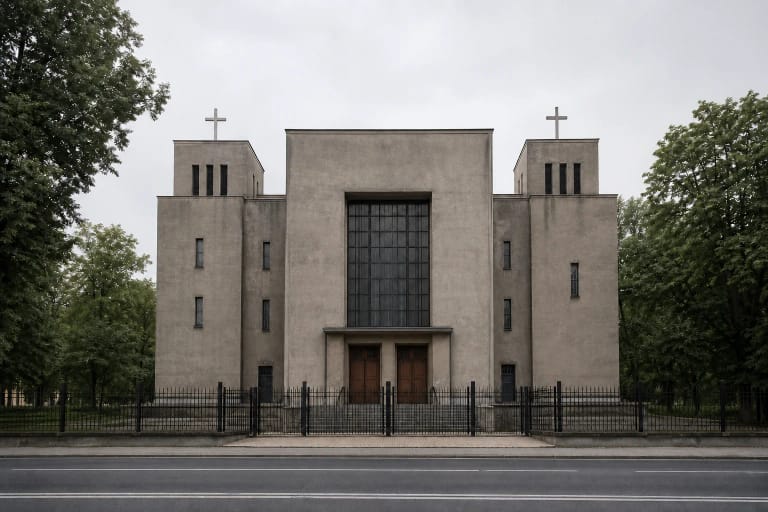
Allow 10-20 minutes for the mural alone. For a longer route, combine it with the Nemunas riverbank and the Sacred Heart of Jesus Church in Šančiai. Leave a bicycle or car where it will not obstruct the path, the building entrance, or residents' parking spaces.
No official wheelchair-access statement is published. The mural is viewed from outside and requires no entry into the building, but paving, kerbs, and temporary obstacles can change. Visitors who require a fully step-free approach should check current conditions locally or with the municipality.