- Place
- Pasvalys District Municipality
- Region
- Aukštaitija
- Type
- protected and restored watermill, wool cardery, and spinnery museum with educational programmes
- Address
- 5 Taikos Street, Raubonys, Pasvalys District
- Coordinates
- 56.12361, 24.47704
- Visit duration
- about 1 hour for the main programme; 2-4 hours for a separate wool-felting workshop
- Best time
- at a pre-arranged time from spring to autumn; check the current programme before travelling for the annual Wool Days
Raubonys Mill, Raubonys Cardery and Spinnery, Raubonys Watermill
The 1770s mill site and late-nineteenth-century brick building are different layers
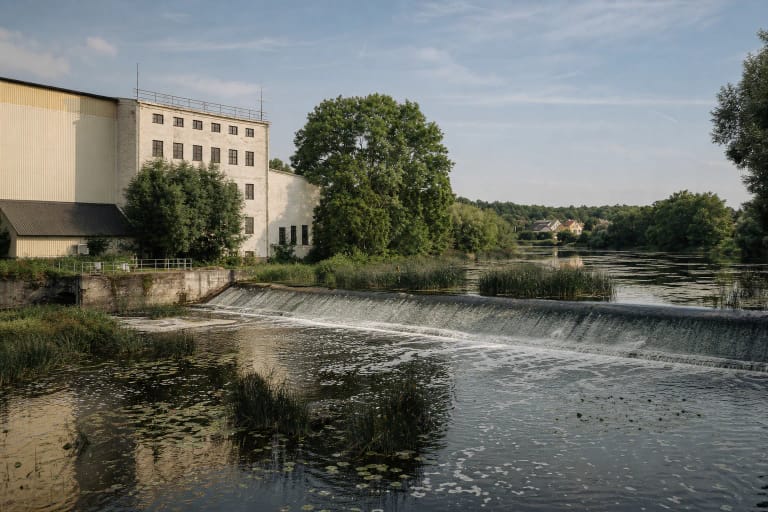
A watermill on the Tatula at Raubonys is documented in the 1770s: the venue gives 1775, while the Cultural Infrastructure Centre cites a 1777 inventory with an illustration. The secure conclusion is not one exact year but that a watermill, then the only one in Krinčinas parish, was recorded here by that decade.
The surviving two-storey red-brick structure is not the eighteenth-century building. The cultural register dates it to the late nineteenth century, while historical accounts associate construction with the period after Lui von Ropp acquired the estate in 1860. 'After 1860, in the late nineteenth century' is more accurate than an unsupported single completion date.
In 1907, owner Jonas Ribbė established a water-turbine grain mill, wool cardery, and spinnery. Documents from 1924 show substantially the present form, except for the later southern extension. KVR dates the northern extension to the 1950s and the southern one to the 1990s.
Brick decoration and the hoist balcony reveal its working architecture
The principal volume is rectangular with an attic, steep clay-tile gabled roof, and brick chimneys. Segmental-arched openings, pilaster strips, shallow connecting arch fields, toothed eaves and gable bands, and a brick floor course give this practical building a Historicist architectural language.
A covered timber loading balcony projects from the wall and belongs to the system that hoisted sacks to upper floors. External stairs, a mixed fieldstone-and-brick base, and low later extensions show how the complex was adapted for work. Restoration clarified these layers without pretending that every part belongs to one period.
The water-power landscape involved the Tatula, pond, channel, culvert, and turbine pit. Visitors should not expect a giant exposed wheel or waterfall: a turbine supplied the historic drive, and diesel then electric motors replaced it under Soviet rule. The pond was drained, the dam dismantled, the channel filled, and the turbine opening sealed.
Milling, hoisting, carding, and spinning survive as one chain
KVR lists a millstone drum with stones, hoppers, and frames; a timber sack hoist with metal scissors; wooden pulleys in the hoist room; and hanging scales. The first millstones and lifter survive, but the protected-areas account dates most milling equipment to the post-war period and 1950s.
The wool line includes three English-made carders and their transmission, a wool-opening machine, roving device, and an early-twentieth-century Swedish spinning machine inscribed MOSES HALBEING DVINSK. The official account places the carding and spinning equipment in the interwar period. It is therefore inaccurate to call every machine original nineteenth-century equipment.
Restored machinery can run during an educational programme, allowing visitors to follow material from grain or wool through successive stages. Public sources do not confirm that today's demonstrations are water-powered, however. Arrange the precise demonstration and programme content when booking.
From Chachelis Zivas's modernisation to eighteen years of silence
Chachelis Zivas acquired and modernised the complex around 1936-1938. The Cultural Infrastructure Centre documents that he was murdered in Biržai in August or September 1941. This is not an incidental anecdote but part of the industrial history and the local life severed by the Holocaust.
Other power sources gradually replaced water after the war. The protected-areas authority says milling continued until 1985, while the venue's history also contains 1987; the mid-1980s is the safest formulation. The cardery and spinnery closed on 13 June 1997.
The local community took over the complex under a loan-for-use agreement in 2014. Machinery restarted for education on 12 September 2015 after an eighteen-year pause. Restoration and adaptation stages ran from 2016-2018 to 2023; the site reopened more broadly during Wool Days on 27 August 2022, with final work completed in August 2023.
Interior visits require booking, and operable machinery needs supervision
The protected-areas authority says visits can be arranged Monday-Sunday by calling +370 698 14 356 or emailing raubonys@gmail.com. This means appointments are possible on any day, not that there is a permanent walk-in schedule. Without a booking, view the exterior only from publicly accessible surroundings and do not enter uninvited.
The main mill-cardery-spinnery programme lasts about one hour, while a separate wool-felting workshop takes 2-4 hours. No current general ticket or core-programme price is published, so confirm group size, cost, payment, and demonstration scope when booking. A €12 price found elsewhere for the Raubonys dumpling programme belongs to another activity at another address.
Adaptation added a lift and sanitary facilities, while a car and coach park and pedestrian path were renewed in 2024. Google marks accessible parking, but confirm lift operation and the complete multi-level route before travelling. Follow the guide beside moving belts, millstones, carders, and hoists, do not touch machinery, and supervise children.