- Place
- Panevėžys City Municipality
- Region
- Aukštaitija
- Type
- active timber Orthodox parish church built in 1891-1892 within a protected old-cemetery complex
- Address
- 6 J. Tilvyčio Street, Panevėžys
- Coordinates
- 55.72586, 24.35487
- Visit duration
- 20-35 minutes for the exterior and cemetery complex; longer if interior access has been arranged or you attend a service
- Best time
- in daylight for a quiet exterior and cemetery visit; check the parish's official contacts and service time before planning to enter
Panevėžio Kristaus Prisikėlimo cerkvė, Panevėžio Viešpaties Prisikėlimo cerkvė, Panevėžys Church of the Resurrection of the Lord, Храм в честь Воскресения Господня
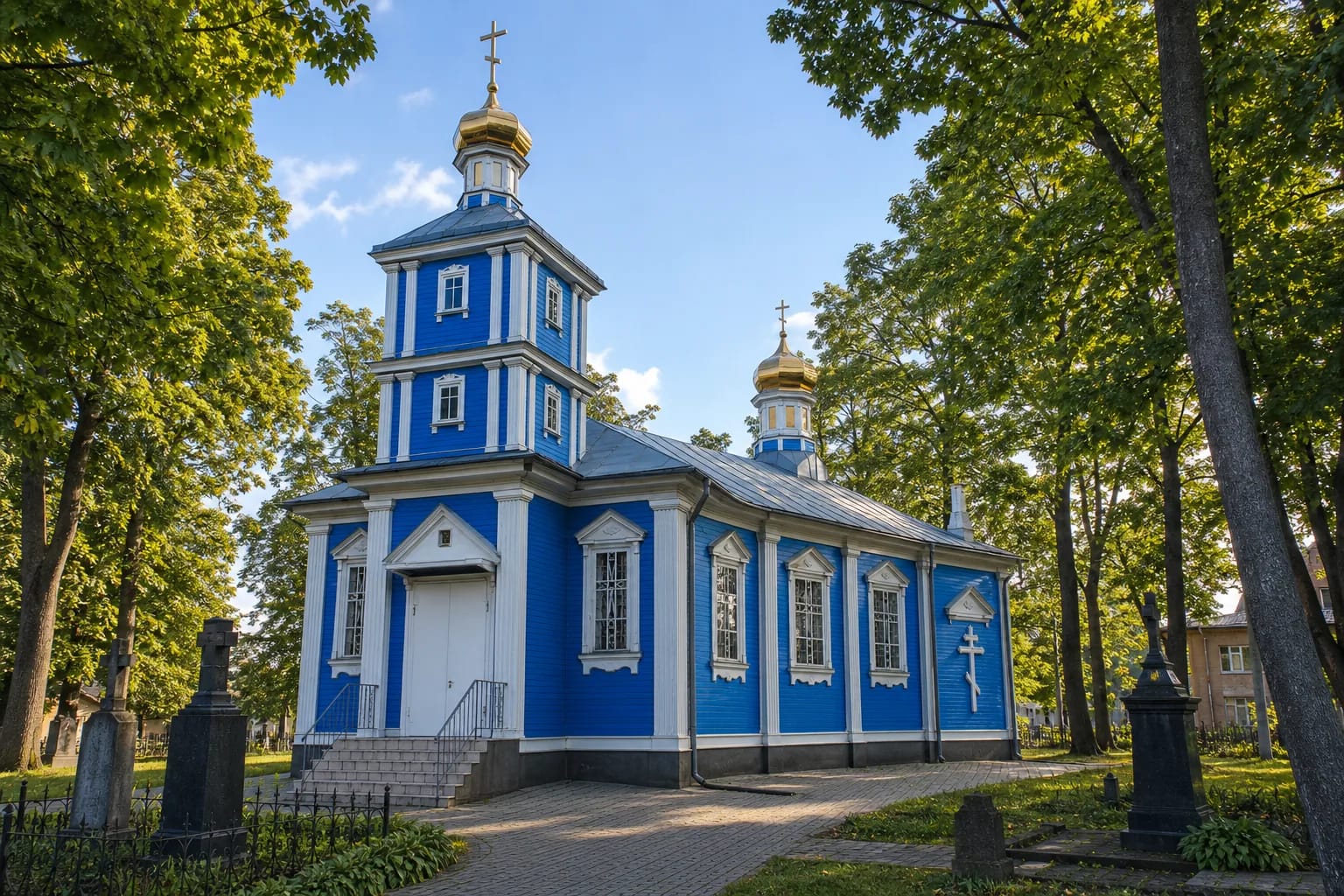
The blue church stands at the centre of an active cemetery, not in a public square
The church is at 6 J. Tilvyčio Street, within the old Orthodox cemetery bounded by J. Tilvyčio, Krekenavos, and Klaipėdos streets. Mature trees and gravestones partly screen it from the road. The coordinates 55.72586, 24.354873 mark a point inside the building footprint. They are not the cemetery gate, a parking place, or a particular grave, which is why the map uses pinType site.
KVR registers the entire 10,728-square-metre area as the Panevėžys Old Orthodox Cemetery Complex, code 38507. Its components include the old cemetery, the church, First World War graves of soldiers of the Russian Empire, and several separately identified individual graves. The protected eastern gate and a fieldstone memorial chapel in the south-east are cemetery features, not displays inside the church.
After the Second World War, part of the cemetery's western side was separated for the burial of Soviet soldiers. KVR treats that as another burial site, code 10758, so the neighbouring military grave groups belong to different periods and are not one component. Visitors should stay on paths and remember that this remains a cemetery and place of prayer.
The Lithuanian names Kristaus Prisikėlimo cerkvė and Viešpaties Prisikėlimo cerkvė refer to the same building. KVR and AUTC more often use the first form, while a Panevėžys municipal language guide and several maps use the second. They are not two different Orthodox churches.
The 1891-1892 church inherited the site of an earlier Piarist cemetery chapel
Piarists settled in New Panevėžys in 1727, and their cemetery here is recorded by the second half of the eighteenth century. Early nineteenth-century inventories describe a timber cemetery chapel on masonry foundations. Town residents and pupils of the noble school used it after the 1831 uprising; it closed after the uprising of 1863 and was demolished in 1872.
Panevėžys's Orthodox community formed in 1841. It first worshipped in a rented house by the Nevėžis and later adapted the masonry Piarist church, today's Church of the Holy Trinity. Conversion work began in 1847, while AUTC dates its Orthodox consecration to 8 May 1849. Those dates describe different stages of one process rather than contradicting each other.
The KVR cemetery record says the Orthodox community enlarged the former chapel foundations and built the present timber church in 1891-1892. AUTC and VLE use the shorter date 1892, and AUTC gives the exact consecration date of 23 October 1892. In other words, 1891-1892 is the construction span and 1892 is the completion and consecration year.
Following the First World War, the masonry Holy Trinity sanctuary returned to Catholic use and the timber cemetery church became the Panevėžys Orthodox parish church. The sources differ by one year: AUTC dates the masonry church's return to 1918, while KVR associates the timber church's parish role with the period after 1919. It is safest to describe a 1918-1919 transition rather than collapse both records into one supposedly exact day.
A Catholic-like single tower is completed by Orthodox cupolas and crosses
The principal facade and three-stage bell tower face west toward Krekenavos Street, while the three-sided apse points east. The church is a single-storey, single-nave timber building with a near-rectangular plan, western porch, fieldstone plinth, log walls, and horizontal weatherboarding. Its single-tower outline can initially resemble a small Catholic church.
Orthodox identity is clearest in the onion-shaped cupolas above the octagonal tower bases and in their six-ended crosses. White corner and intermediate pilasters rhythmically divide the present blue weatherboarding. KVR notes that the tower has been altered, so old and recent photographs may show different metal colours and small cupola details.
Tall rectangular windows carry profiled timber surrounds and triangular pediments. The AUTC study describes cross-shaped window patterns assembled from small geometric forms with green, red, and yellow glass inserts. Other details worth noticing include fluted pilasters with capitals, a narrow frieze, and the profiled eaves cornice.
Inside, the principal room is a small hall beneath a flat ceiling. A low iconostasis separates the eastern apse from the worshippers, with the altar and clergy room beyond. KVR protects not only the elevations but also the overall interior arrangement, window subdivisions, main and side doors, and memorial plaques built into the foundation.
The original Surdegis icon moved to Kaunas, while a Tikhvin copy remains in Panevėžys
The low iconostasis is not a decorative tourist screen. Its Royal Doors open according to the Orthodox liturgy, and the sanctuary behind them is reserved for clergy. A 2025 virtual exhibition by the Panevėžys city library documented a Surdegis Mother of God image, an icon of the Vilnius martyrs Anthony, John, and Eustathius, and a Saint Luke of Crimea icon painted by Panevėžys artist Irina Nosova. This records the interior at that time; it does not guarantee that every object will always be visible.
The original and later images must be separated in the history of the Surdegis icon. The Lithuanian Orthodox Church says the old icon regarded as miraculous returned to Lithuania in 1921 and was kept in Panevėžys for a period. Since the Second World War, the original has remained in the Annunciation Cathedral in Kaunas, so the Surdegis image seen in this Panevėžys church should not be labelled the original sixteenth-century icon.
Another sacred image is tied to the annual summer procession to Gegabrasta. An official 2026 notice explains that a new copy of the Tikhvin Icon of the Mother of God was painted after the old image at Gegabrasta's Church of St Nicholas was stolen. The copy normally remains in the Panevėžys Resurrection Church and is carried to Gegabrasta in summer. The Tikhvin copy and the Surdegis image are two different icons with distinct histories.
Interior access depends on the parish, while the cemetery requires quiet and respect
This is an active parish and cemetery church, not a museum with permanent ticketing. On 2026-07-19, the official clergy directory listed the rector and deacon of the Panevėžys Resurrection Church with contact details, but the official pages did not publish separate tourist hours, a complete weekly service table, or an admission tariff. Use that maintained directory before making a special trip or expecting to enter.
An open door before or after worship is not an all-day visitor schedule. If a funeral, service, or parish event is taking place, sightseeing must wait. Enter quietly, remove men's headwear, do not enter the sanctuary, and ask permission before photographing the iconostasis, icons, or anyone at prayer.
The principal western entrance is reached by steps, and cemetery paths and older surfaces can be uneven. No recent step-free audit of the entire complex was found, so wheelchair users should ask the parish about assistance and any alternative entrance. Leave cars only in signed street spaces, never block the gate, and do not drive along cemetery paths.
Allow 20-35 minutes for the exterior and the principal cemetery layout. More time is needed if the church is open and a quiet view of the iconostasis is permitted. The most meaningful continuation is the Church of the Holy Trinity, because the two buildings are directly linked in the history of Panevėžys's Orthodox community.