- Place
- Panevėžys City Municipality
- Region
- Aukštaitija
- Type
- a state-protected single-towered fieldstone church combining Classical, Neo-Romantic, and Gothic Revival features
- Address
- 2 Sodų St, Panevėžys
- Coordinates
- 55.72656, 24.35821
- Visit duration
- 30-45 minutes for the exterior and interior when open; about 1 hour with the rectory setting and Nepriklausomybės Square
- Best time
- daylight for the architecture; before or after Mass for the interior, after checking the current schedule
Holy Trinity Church in Panevėžys, Former Piarist Church in Panevėžys, Panevėžys Garrison Church
One building on Nepriklausomybės Square contains several different histories of Panevėžys
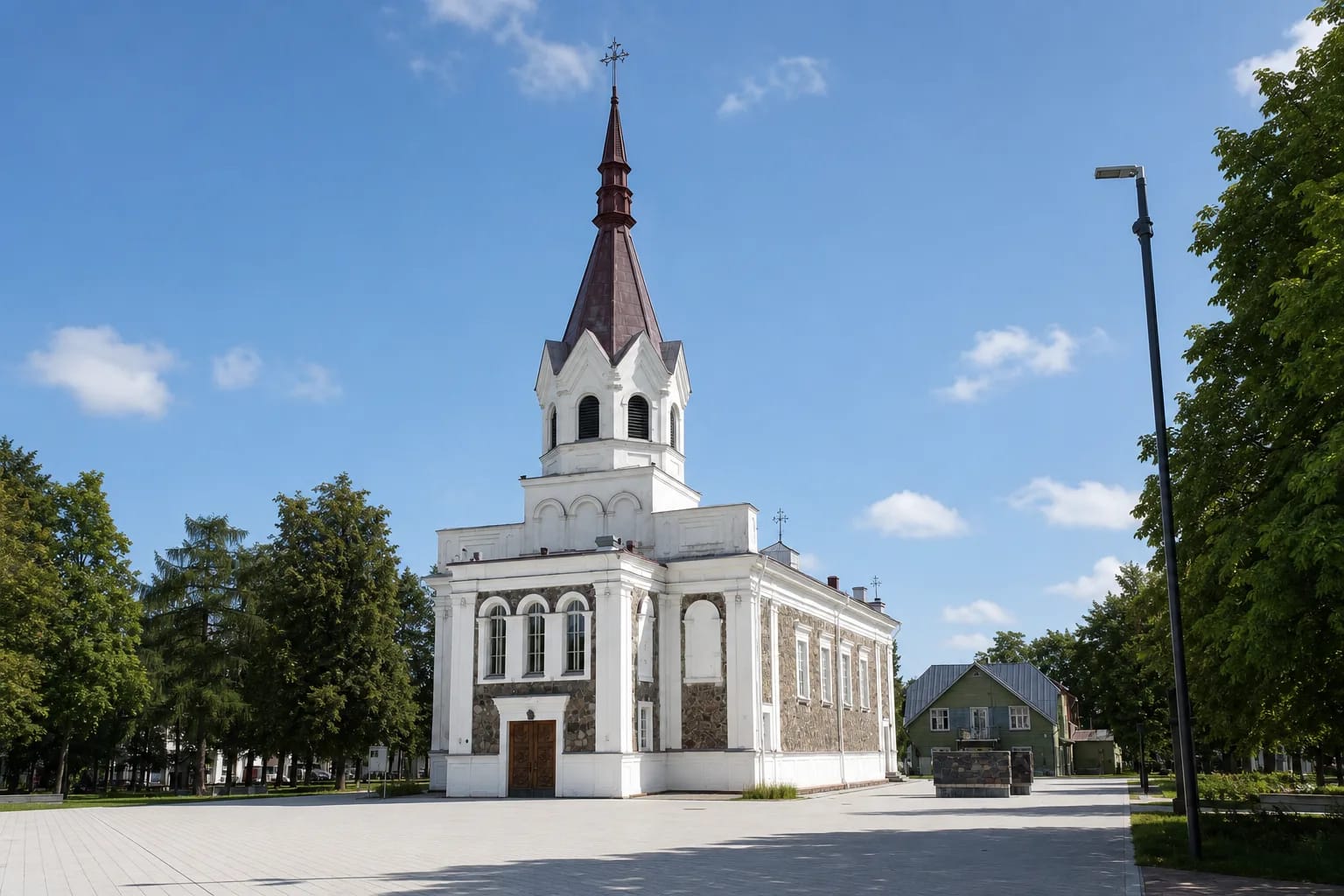
The Church of the Holy Trinity stands at 2 Sodų Street beside Nepriklausomybės Square, southwest of Laisvės Square. The coordinate on this page marks the building itself, not a confirmed main entrance or parking space. The historic rectory across Sodų Street is a separate property, so a rectory or administrative address shown on an official contact page should not be confused with the church address in the heritage record.
From the square, the building is readily recognized by white plastered divisions, darker panels of exposed fieldstone, one central tower, and a pointed spire. VLE describes the old core as a Classical stone church, while the detailed local heritage account sees a combination of Neo-Romantic, Classical, and Gothic Revival features. The difference is informative rather than embarrassing: the present appearance emerged through a long sequence of building and alterations.
The Register of Cultural Values records the church as a state-protected individual property of regional significance, unique code 4707. Its stated value is architectural, while the architect remains unidentified. Assigning it to a named designer or reducing the whole building to one narrow stylistic label would therefore go beyond the evidence.
Piarist origins, the fire of 1790, and the unfinished meaning of the 1803 date
Piarist monks settled in Panevėžys in 1727 and built a timber church, monastery, and school. A fire on 12 May 1790 destroyed the complex. The replacement fieldstone church is conventionally dated to 1803, the year given by the Cultural Heritage Register, VLE, and the local heritage profile.
Yet 1803 should not automatically be treated as the year when every part was finished. Correspondence between Napoleon's army and officials of the Upytė subprefecture, published by historian Petras Juknevičius, still describes uncovered roofs, incomplete window frames, and open gables in 1812. Flour was being stored in the church, and the papers called it a building that was still under construction.
The most defensible conclusion is that 1803 is the established construction or building date, while the 1812 evidence shows that significant work remained. Those papers do not establish one precise later completion day, so this guide does not relabel 1812 as the church's opening or completion year.
Closed after the uprising, converted into an Orthodox church, and returned to Catholics
In 1832 the church contained five timber altars decorated with images of the Holy Trinity, Our Lady of Sorrows, Saint Anthony, Our Lady of Częstochowa, and Saint Joseph. After the 1831 uprising, the Russian administration closed the Piarist monastery, school, and church. In 1847 the sanctuary was converted into an Orthodox church dedicated to Our Lady of Kazan.
During the First World War, the German authorities used the building as a prisoner-of-war camp. It was returned to Catholics in 1918. Three altars brought from Klovainiai and an organ were installed, while small towers added during the Orthodox period were removed. Priest J. Ruškys oversaw the work.
Until 1927 it served as a garrison church for soldiers of the 4th Infantry Regiment of the Lithuanian King Mindaugas, stationed in Panevėžys. Two memorial tablets inside honor members of the regiment who fought and died for Lithuanian freedom in 1919-1923. They connect the interior to a specific chapter of the city's military history, rather than to independence in the abstract.
The Marian period, five altars, and the oldest surviving paintings
The church passed to the Congregation of Marian Fathers in 1927. Rector and priest Jurgis Tilvytis organized the decoration of the interior, and Bishop Kazimieras Paltarokas consecrated the sanctuary. In 1931, Martinas Kšanauskas donated a bell carrying a Latin appeal for peace; priest J. Senkus arranged another redecoration in 1936.
Piers divide the present interior into three naves, and the heritage account records five altars. Among the oldest surviving paintings, it singles out a canvas of Saint Michael the Archangel painted by Mielnicki in Warsaw in 1881 and an image of the Holy Trinity. These works do not date from the same moment as the building, and should not be described as original fittings from 1803.
The church was damaged during fighting in 1944. Rector and priest S. Mažeika repaired the building, restored the altars, and added paintings to the interior. That postwar renewal proved brief before the building underwent another radical change of use.
From Soviet warehouse and exhibition hall to one of Lithuania's early church returns
The Soviet authorities closed the church in 1949. It was first used as a warehouse, later for concerts and dancing, and from 1973 until 1989 as the Panevėžys Exhibition Hall. This is a significant part of the institutional history of art exhibitions in the city, although the building's sacred function had been suppressed.
At the beginning of the national revival, worshippers elected a committee to seek the church's return in July 1988. The diocesan curia, priests, and the church committee approached the city executive committee in August. Municipal officials resisted because they intended to retain the building as an art gallery and organ-music concert hall while the city lacked other cultural premises.
The Panevėžys City Executive Committee adopted its decision on 24 April 1989 and transferred the building to the religious community from 1 May. This preceded the Lithuanian law on returning houses of worship to religious communities, adopted on 14 February 1990, and a local historian consequently identifies it as one of the country's early returns. Under parish priest Robertas Pukenis, the church was restored, adapted, and reconsecrated on 10 June 1990.
An active church: Mass times, admission, and the real limits of visitor information
Today the Church of the Holy Trinity is an active rectorate of Panevėžys Diocese, not a museum with a permanent ticket office and tourist opening hours. On 18 July 2026, the official diocesan page listed Mass at 8:30 and 18:00 on weekdays, 10:00 and 18:00 on Saturdays, and 8:30, 10:00, 12:00, and 18:00 on Sundays. Schedules, holy-day services, and unlocked hours can change, so check that official page or contact the rectorate before making a special trip.
No separate visitor ticket is stated in the official information. Entry to a church for worship is normally not charged, although a donation is a personal choice and a concert, guided visit, or other event may have separate conditions. The interior is easiest to appreciate outside services. During Mass, avoid disruption, do not photograph people without consent, and ask before professional or group photography.
The reviewed official sources do not provide sufficiently precise current details about step-free entry, an accessible toilet, or reserved visitor parking. The paved square around the building is level, but that does not confirm the threshold or interior route. If access determines whether you can visit, ask the rectorate to confirm the present arrangements in advance.