- Place
- Panevėžys City Municipality
- Region
- Aukštaitija
- Type
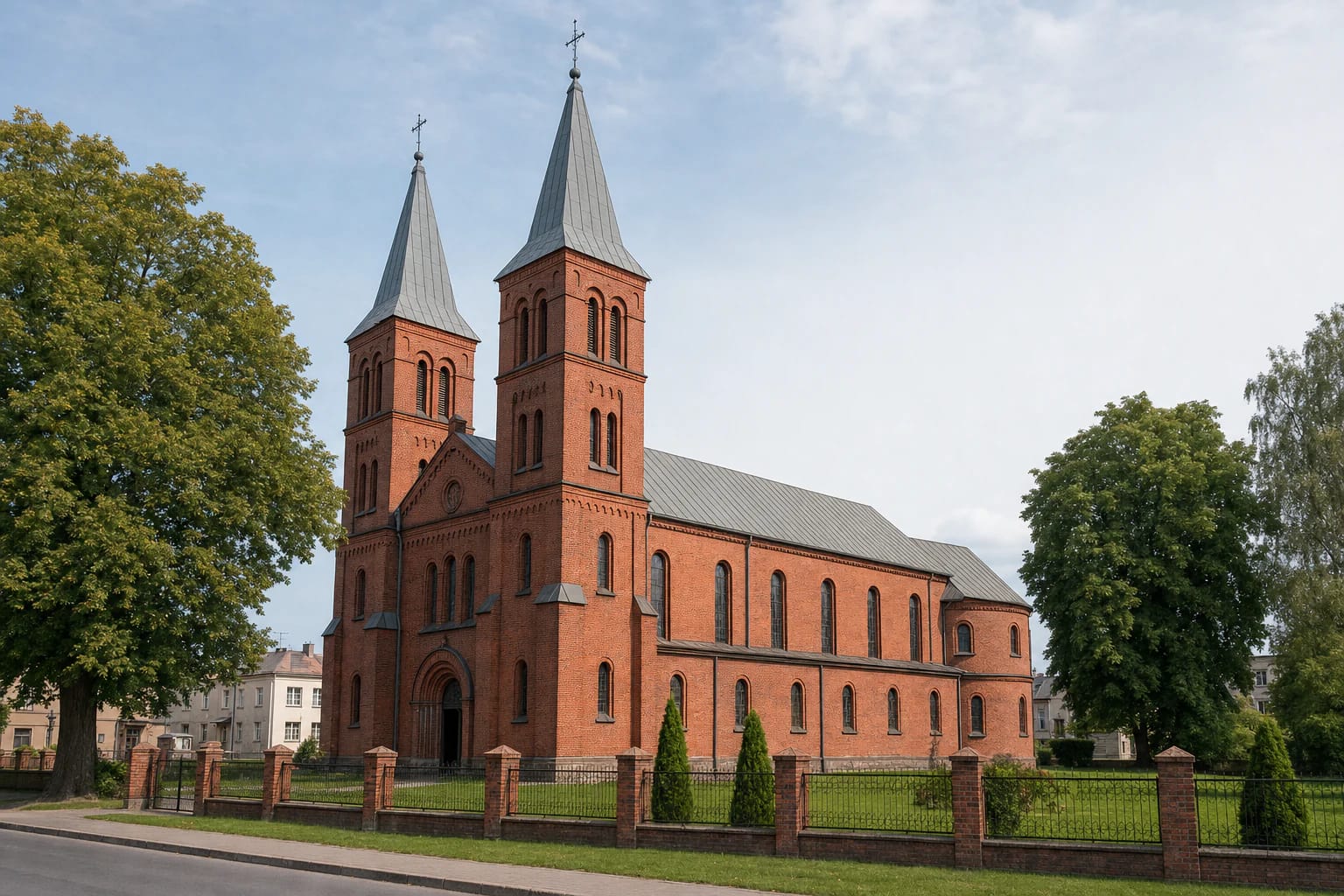
- 1885 red-brick Neo-Romanesque twin-towered basilica with three naves and a semicircular apse
- Address
- 10 Smėlynės St, Panevėžys, LT-35143
- Coordinates
- 55.73227, 24.36939
- Visit duration
- 30-60 minutes; longer if the church is open and you want to see the organ and churchyard
- Best time
- daylight for the exterior; before or after Mass for the interior, after checking the parish arrangements
Panevėžys St Peter and St Paul Church, The Red Church of Panevėžys
The parish beginning and three earlier churches
The history of Panevėžys Church of Saints Peter and Paul begins on the right bank of the Nevėžis. In 1507 the first Panevėžys church was built here and the Old Town filial church, belonging to Ramygala Parish, was established. A rectory, farm buildings, and other settlement functions grew around it, and in 1528 the establishment of a parish school was proposed. The sources mention an independent parish from about 1568.
The first timber church had deteriorated by the beginning of the seventeenth century. In 1629-1631, parish priest Jurgis Tiškevičius built another timber sanctuary with three altars, but in 1655 it was badly damaged and later used for a time as military barracks and a hospital. It had deteriorated or burned down by about 1780.
In 1781, Mikalojus Tiškevičius, a canon of the Vilnius Chapter, built a new timber church on the right bank of the Nevėžis near New Panevėžys and moved the parish from Old Panevėžys. This was the third church in the sequence and became the predecessor of the present red-brick basilica.
The present basilica and dates that need careful wording
Construction of the present masonry church began in 1877. Parish priest Mykolas Chodoravičius organised the work, and the Cultural Heritage Register names Justinas, or Ustinas, Golinevičius as architect. Bishop Aleksandras Beresnevičius blessed the foundations in 1877, and construction was completed around 1885.
The sources give different dates: the Register records the building as 1885 and the start as 1877, while Panevėžys Diocese and the municipal guide also give 1885. The VLE architecture entry mentions 1884. The safest wording is therefore the construction period 1877-1885, with 1885 as the completion date most often given by the local official sources.
A new altar was installed in 1894, and the church was consecrated in 1898 by Bishop Gasparas. The Register uses the surname form Cirtautas, while the older Panevėžys City Guide and some local texts spell it Girtautas. This page preserves the source discrepancy rather than silently deciding which spelling to use.
Red-brick Neo-Romanesque architecture in Smėlynė
The church is an unplastered red-brick basilica with a rectangular plan, a semicircular apse, and two tall towers on the facade. Its interior has three naves, while the facade is marked by a central arched entrance, round and semicircular window forms, and restrained brick decoration. It is neither a Gothic nor a Neo-Baroque sanctuary, so its sober Neo-Romanesque expression should not be confused with Panevėžys Cathedral of Christ the King.
The churchyard is enclosed by a brick-masonry and metal-mesh fence. The heritage complex record separately identifies the gates, the memorial sculpture of St Aloysius Gonzaga, and several tomb monuments. The adjacent old Panevėžys city cemetery is an important part of the Old Town landscape, but it should not automatically be treated as the church building's interior or visitor area.
The church stands on Smėlynės Street in the historic urban area on the right bank of the Nevėžis. From Senvagė and the left bank, its red-brick towers form a strong city-silhouette landmark, while the churchyard retains the scale of a working parish rather than a formal monumental square.
Organ, altars, Stations of the Cross, and wartime traces
In 1887 the church received a 23-stop organ by Vilnius master Juozapas Radavičius, donated by Leonas Misevičius. This is one of the sanctuary's most specific documented musical and artistic features, and should be treated as a recorded heritage highlight rather than a generic mention of an old organ.
The church preserves a late-nineteenth-century cycle of fourteen Stations of the Cross paintings, attributed in the local heritage description to A. Glembockis. The Register and library description also mention three altars. After the Second World War, the altar, Stations of the Cross paintings, confessionals, and the vestibule tambour were renewed.
During the First World War, four church bells were taken to Russia. The church was badly damaged in 1944 during the Second World War and was later repaired under Canon Vladas Butvila. Three bells were acquired through the efforts of Prelate Jonas Grabys. From 1970 to 2002, Monsignor Jonas Juodelis led the parish and oversaw the construction of the rectory.
An active parish, visiting, and the exact map point
This is an active parish church of the Diocese of Panevėžys, so visitors must work around the liturgy. The official sources reviewed do not provide fixed tourist opening hours, guaranteed daily unlocking, a separate admission ticket, a visitor-parking plan, or a detailed step-free access description. Plan an interior visit before or after Mass, ask the parish in advance about groups, photography, and access, and keep silence during services.
During research, the Panevėžys Diocese parish listing gave Mass at 7:30, 8:00, and 18:00 on weekdays; 7:30, 9:00, 10:00, 11:00, and 18:00 on Saturdays; and 7:30, 9:00, 10:30, 12:00, and 18:00 on Sundays. The older Panevėžys City Guide gives a different evening time, 19:00, and an additional Saturday time at 10:30. This is a genuine source mismatch, not a reliable way to predict the current schedule, so check the parish or diocesan website before travelling.
Coordinates 55.73227, 24.36939 mark the church building rather than a confirmed door or parking point, so the pinType is site. On 15 July 2026, the exact Google Maps listing showed 4.7/5. Its Place ID is ChIJx2lFZhAy5kYR0rPSRW92N38. This is a changing public-platform metric, not a rating of heritage condition.