- Place
- Panevėžys City Municipality
- Region
- Aukštaitija
- Type
- historic Nevėžis oxbow and city-center park with a pond, island, and fountain
- Address
- Entrance from Elektros Street, Panevėžys
- Coordinates
- 55.73034, 24.36275
- Visit duration
- 45-90 minutes for the pond, island, and terraces; 1.5-2.5 hours with an evening fountain show and nearby city-center sights
- Best time
- May-October for greenery and the fountain; arrive before dark for a projection and check the current year's schedule
Senvagė, Panevėžio Senvagė, Panevėžys Senvagė Park, Nevėžis old riverbed
Senvagė is not the Nevėžis's present channel but its old bend in the city center
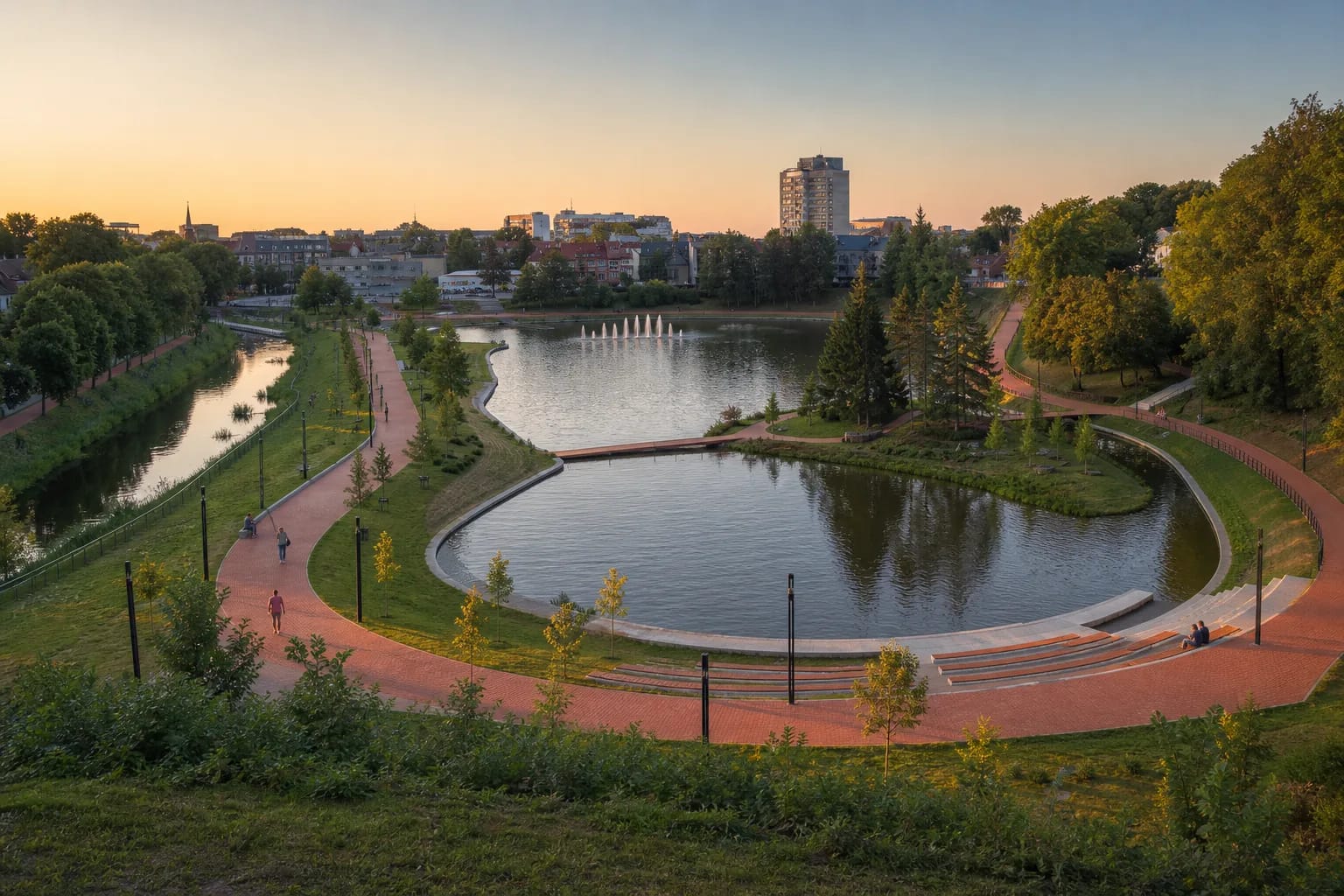
At first glance, Senvagė resembles an ornamental lake in a city park, but its origin is different. The pond occupies an old natural bend of the Nevėžis, while the active river now runs beside it through a straighter channel dug by people between two city bridges. The park is therefore both a landscape and a highly visible record of how Panevėžys altered its urban hydrology.
The public space encompasses the pond, upper and lower terraces, an island, bridges, slopes, and a connection to the present Nevėžis waterfront. The municipal renewal implemented from 2017 to 2023 covered 9.03 ha. Its red clinker-brick path curves around the water, widening in places into seating and viewing areas while linking different elevations and entrances.
The map pin, 55.730343, 24.362747, marks a representative visitor point beside the main pond and floating fountain rather than the geometric center of the entire park. From here, a first visit can follow the banks, cross onto the island, and climb to the upper terrace. Several paths negotiate the slopes, and because no single official loop distance was found in reliable sources, this page does not invent one.
Flooding, pollution, and sewer construction drove the interwar decision to straighten the river
When the Nevėžis still followed the old bend, spring floods eroded its left bank, inundated nearby streets, and threatened buildings on Kranto Street. As Panevėžys grew without a sewer system, household waste and wastewater also entered the river. Summer low water left mud and refuse exposed, and interwar newspapers associated the contaminated river with serious public-health risks.
The city began preparing sewer works in 1935, laid the first pipe in 1937, and completed a central line in 1940. During the same broad period, workers built an embankment and cut a new, straighter channel for the Nevėžis. The intervention was intended to reduce flood damage and clean up a difficult central stretch, but separating the old bend did not immediately create a park.
Once the river flowed through the new channel, stagnant water remained in Senvagė. Residents later recalled a muddy pool, scrub, and crucian carp, although local children and neighbours continued to use the area informally. This intervening phase explains why today's orderly pond is neither a purely natural relic nor one single design project: it is the outcome of several major engineering and landscape transformations.
The reconstruction begun in 1972 turned a muddy former channel into a public landscape
The detailed plan for central Panevėžys prepared in 1967 proposed improving Senvagė, but reconstruction did not begin until 1972. Forming the slopes required 12,000 cubic metres of clay-rich fill and 41,000 cubic metres of ordinary soil. Work continued through most of the decade: the bottom was dredged, slopes were shaped, the river channel was reinforced, and stairs and a fountain were installed.
The completed lower terrace was ceremonially opened and formally accepted by a state commission in 1981. Work later continued on the upper terrace, while the resulting body of water covered approximately 3 ha. The date therefore marks an important phase in Senvagė's transformation into a city park, not the origin of the old river bend itself.
This account was prepared by Emilija Juškienė, a senior historian at Panevėžys Local Lore Museum, drawing on historical evidence and residents' recollections. The documented sequence of river straightening and landscape reconstruction should be kept distinct from legends repeated in popular descriptions but unnecessary for understanding a visit today.
The renewal completed in 2023 linked the island, terraces, and red-brick route
The latest comprehensive renewal ran from December 15, 2017, to January 31, 2023. The municipal record lists renewed and newly built walking and cycling paths, recreation, sports, play, and viewing areas, waterfront improvements, planting, lighting, storm-water and water-supply networks, and CCTV. Terraces, new trees and shrubs, and children's play areas were delivered during the 2021-2022 construction phase.
The small island was reshaped and connected to the banks by bridges. Urban plazas and greener edges alternate along the route: visitors can sit on widened sections of red brickwork, look over the pond from terraces, descend to the lower level, or continue beside the present Nevėžis. It is more varied than a single straight promenade, so exploring several levels is part of the experience.
Much of the main route has a firm surface, but an individual itinerary may include gradients, steps, or bridge approaches. No recent accessibility audit for every part of the 9.03 ha site was found. Visitors with limited mobility should select an entrance beside a gentler terrace and assess slopes on arrival. Clinker paving and waterside edges can also become slippery after rain.
The fountain installed in 2021 combines water jets with music, light, and projected images
The contract for the floating synchronized fountain was signed in 2020, and its first program was shown during Panevėžys's 518th birthday celebration in 2021. It draws water directly from the Senvagė pond. The jets oxygenate that water, so the installation creates a spectacle while also helping to slow the silting process.
Evening images appear on a fan-shaped water screen measuring 18 m high and 36 m long. Jets, music, lighting, and video operate as a coordinated program. The screen is easiest to see after dark from the more open banks and terraces, but the most popular viewpoints fill earlier on show nights.
For 2026, the municipality named audiovisual artist Linartas Urniežius as the projection director. Some works connect the city's development with the relationship between people and nature, while the program titled Meno ritmu uses motifs from the work of Stasys Eidrigevičius. The daytime jets and an evening projection are not the same performance: the image on the water screen requires darkness.
The park is free and ungated, but the fountain follows a seasonal schedule that can change
There is no ticket office or general admission charge for the paths, island, and municipal public spaces, so the park is free to visit. No gate-controlled opening time is listed either. Daylight makes it easier to judge slopes, while late-evening visitors should observe public-space rules and take particular care at the water's edge. The scheduled municipal fountain viewing is likewise not advertised as a paid event.
In May, June, and July 2026, projections were announced for Fridays and Saturdays from 23:00 to 23:30. The stated times moved to 22:30-23:00 in August, 21:00-21:30 in September, and 20:00-20:30 in October. Extra shows were scheduled for June 23 and July 6, while times for the September 11-12 city-birthday events were to be announced separately. The daytime program was listed for 10:00-22:00 Monday-Thursday and until 23:00 Friday-Sunday.
That timetable applies to the 2026 season and may be adjusted for darkness, weather, technical conditions, or events. Check the latest Panevėžys City Municipality notice before travelling specifically for a projection. The official sources used here describe Senvagė as a park pond and fountain setting, not a city beach; do not enter the water or assume that winter ice is safe based on appearance alone.