- Place
- Poškakaimis beside Bijotai, Bijotai Eldership, Šilalė District Municipality
- Region
- Samogitia
- Type
- roughly four-hectare historic estate park with eight oak sculptures by Pranas Petronis and a miniature Baublys
- Address
- 4516 1, Poškakaimis, LT-75228 Šilalė District
- Coordinates
- 55.47060, 22.57897
- Visit duration
- 45-75 minutes; up to 1.5 hours for a leisurely look at the sculptures, miniature Baublys, Lourdes grotto and recreation grounds
- Best time
- from late spring to autumn in daylight, when carving details and outdoor interpretation panels are easiest to see
Norbertas Paškevičius Park, Bijotai Wooden Sculpture Park, Dionizas Poška Poem Character Sculpture Park
An 1825 park whose estate buildings have disappeared
The history of the Bijotai estate is associated with the old Paškevičius family, which owned Bardžiai and Bijotai lands from the mid-16th century. The Krašto Gidas entry prepared by Šilalė District Municipal Public Library states that the roughly four-hectare park was planted in 1825 by Dionizas Poška's stepbrother Norbertas Paškevičius. VLE notes that the Bijotai estate remained in the Poška, or Paškevičius, family until 1847.
None of the small estate's historic buildings survives, so visitors should not expect a preserved manor house or original interiors. The site's value lies in its old planting structure and the cultural features later placed within it. It now serves as the Bijotai Eldership recreation area, with a main path, summer stage, restored pond and shelters.
Eight oak sculptures based on a poem by Dionizas Poška
The works along the main path are based on Dionizas Poška's poem The Peasant of Samogitia and Lithuania. The Mažeikiai Henrikas Nagys Public Library records eight oak sculptures interpreting the poem's characters and themes. Folk artist and woodcarver Pranas Petronis created them over four summers from 2014 to 2017.
They take the form of tall figures carved from single oak trunks. Rough-hewn surfaces, emphatic faces, tools and lines of text cut into the base turn the poem from literature into an outdoor narrative. A plaque at each work records its year and sponsor, so the full sequence rewards attention rather than a stop at only the first figure.
A miniature Baublys unlocks the sculpture trail
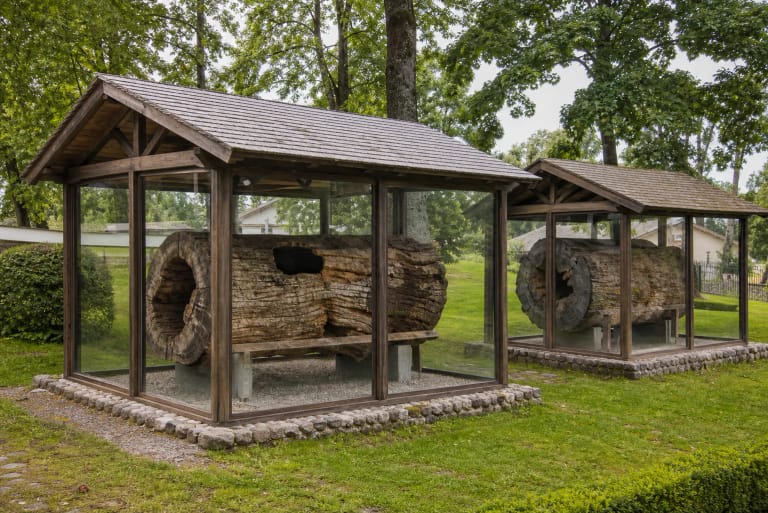
Before the eight figures came a miniature Baublys hollowed from a nearby willow, with a copy of the poem placed inside. This small structure deliberately recalls Dionizas Poška's Baubliai. It is neither one of the historic oak trunks used for the museum founded in 1812 nor a surviving estate building.
The poem addresses peasant labour, hardship and social position, so the recurring human figures, tools and text in the sculptures are best read together. Visitors do not need to know the entire poem in advance, but the copy inside the miniature Baublys and the inscriptions at the works explain why this is a coherent literary trail rather than a random collection of folk art.
Veteran trees, a pond and a grotto built from estate stone
Krašto Gidas highlights a four-stem lime, a maple with a 4.3-metre circumference, oaks and 40 straight-trunked small-leaved limes. These trees are more than a backdrop to the carvings: they preserve an old layer of the designed landscape. Younger plantings and the maintained lawn belong to the modern recreation area and should not automatically be treated as remnants of the 1825 planting.
A Lourdes grotto was built in 2013 using stone from former masonry estate buildings. Local people raised the funds and Bijotai Eldership organised the work. A municipal report also records a new outdoor shelter and lighting installed here in 2022. The park now brings together an early-19th-century landscape, a 21st-century devotional feature, a sculpture trail and an everyday community recreation space.
Planning a visit
The Google Maps coordinate 55.4706047, 22.5789685 marks the sculpture park beside Road 4516. Official cultural sources present it as the park in Bijotai, while the map address uses Poškakaimis; both identify the same visitor site beside Bijotai. No separate staffed hours, booking requirement or park admission charge are published. A round-the-clock map label does not mean the carvings are easy to appreciate after dark.
Allow 45-75 minutes and visit in daylight. Google Maps marks an accessible entrance and parking, but no verified universal-access description of the entire route, slopes or an accessible toilet was found, so assess current conditions on arrival. The opening hours and admission prices published by Šilalė Museum apply to the Baubliai museum, not this open park; check the museum's official site before combining the two.