- Place
- Paragiai, Akmenė District Municipality
- Region
- Samogitia
- Type
- memorial museum for two writers, established in 1966 at the nineteenth-century Paragiai manor estate
- Address
- Paragiai village 1, LT-85283, Papilė Eldership, Akmenė District
- Coordinates
- 56.10642, 22.62626
- Visit duration
- 60-90 minutes for the museum, granary, and park; up to 2 hours with an educational activity
- Best time
- Tuesday to Saturday after confirming the short opening hours; summer for the park and events
Lazdynų Pelėda Museum, Lazdynų Pelėda Museum in Paragiai, Paragiai Manor, Paragiai Estate
The key to the display is not an owl emblem but two distinct authors
Lazdynų Pelėda was the shared literary name of two Ivanauskas sisters. Sofija, whose married surname was Pšibiliauskienė, was born in 1867; Marija, later Lastauskienė, in 1872. Follow their biographies separately in the museum, because they lived in different places, wrote in different languages, and did not contribute to works under the joint name in the same way.
VLE states that almost everything printed as Lazdynų Pelėda between 1898 and 1908 was written by Sofija. From 1908, she also published her free Lithuanian translations of Marija's Polish prose under that name. After Sofija's death, Marija began writing in Lithuanian and published under her surname Lastauskienė.
This authorship history explains why the memorial belongs to both sisters without reducing them to one anonymous voice. Photographs, publications, and biography become clearer when visitors ask which sister wrote a particular text, in what language, and during which period.
Paragiai was a family home, workplace, and meeting point of the national revival
Paragiai Manor belonged to the Ivanauskas family from the second half of the seventeenth century. Around 1881-1882, artist Nikodemas Ivanauskas settled here with his wife Karolina, daughters Sofija and Marija, and son Gustavas. Nikodemas had studied at the art academies of Saint Petersburg and Munich; at Paragiai he kept a studio, painted, copied pictures, made sculpture, and wrote.
Both sisters returned to Paragiai at different stages of their lives. Visitors included Povilas Višinskis, Juozas Tumas-Vaižgantas, the Biržiška brothers, Petras Avižonis, Liudas Gira, and other cultural figures. The municipality's historical profile also names Polish writers Maria Konopnicka and Eliza Orzeszkowa, reflecting the multilingual world of the Ivanauskas family.
Both sisters lived at Paragiai again from the beginning of the First World War. Gravely ill, Sofija completed the novella Ponas Dramblevičius here and died in 1926. Before the Second World War, Marija wrote at the family estate using her experience of life in Saint Petersburg.
The manor house, granary, sauna, and park all belong to the visit
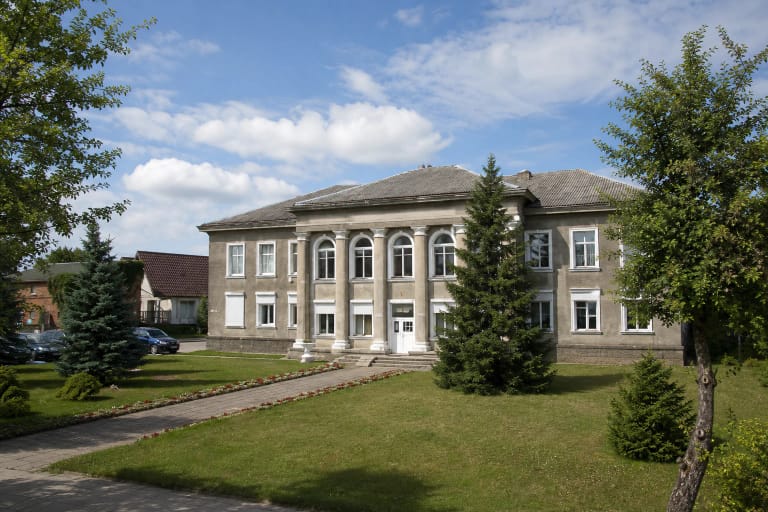
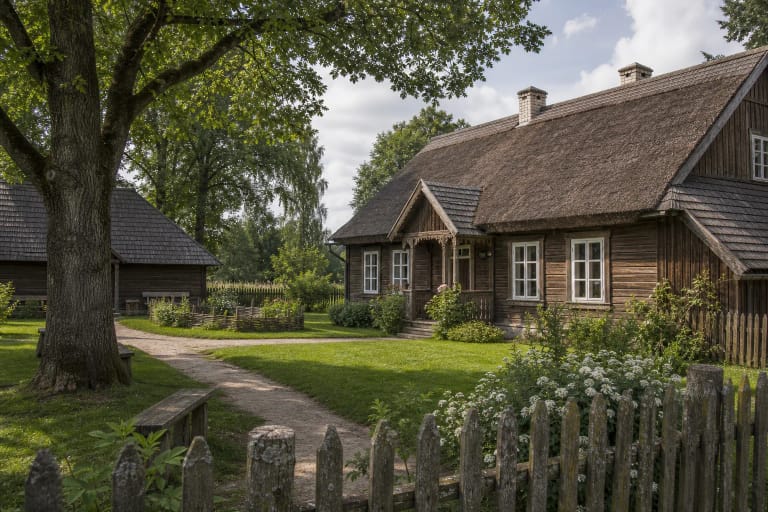
The museum occupies the nineteenth-century timber manor house. It is a single-storey building with an attic, cellar, veranda, and a raised central section with a balcony. Log walls, white window surrounds, and restrained carpentry create its vernacular appearance. Adaptation for museum use changed parts of the internal plan and openings, so not every visible detail is untouched from the sisters' lifetime.
The estate retains a nineteenth-century granary with a columned porch, a timber sauna dated to 1927, and an early twentieth-century barn. Household implements in the granary extend the story from literature to the estate's daily work. Places of lost structures are also documented, including the foundations of the threshing barn that burned in 2002.
The park was formed in the early nineteenth century, although its structure and collection of buildings changed substantially in the later twentieth century. The estate was repaired and adapted for tourism in 2012-2014. Today's Paragiai is therefore a preserved and restored memorial landscape, not an entirely unaltered nineteenth-century manor.
The museum preserves the artistic world of Nikodemas as well as the sisters
The main house presents the sisters' books, photographs, and biographical material. Akmenė District Municipality specifies that their father Nikodemas Ivanauskas's art is currently represented through reproductions and photographic canvases. The distinction matters: a reproduction helps visitors understand a work, but it is not the original painting.
Nikodemas's story explains the creative atmosphere in which his daughters learned to read and write. He was more than the father of better-known writers: he received formal art training and produced religious paintings, copies, sculpture, prose, and poetry. Some of his works are held elsewhere or survive in churches.
Artists' workshops, writing competitions, and the Sugrįžimai į Paragius amateur-theatre gathering continue both sides of the family's creative inheritance. On an event day, a quiet memorial visit can become a large cultural occasion, so check the programme before travelling.
Opening hours are short, and prices and activities need checking
On 27 July 2026, the museum's official contact page listed Tuesday 9:00-13:00, Wednesday and Thursday 11:00-15:00, Friday 14:00-18:00, and Saturday 9:00-13:00. It also invited visitors to arrange another time by telephone. No Monday or Sunday hours were published. Schedules can change, so confirm them on the official page.
The official price list gave adult admission as €3 and admission for school pupils, students, pensioners, and disabled visitors as €2, with separate Akmenė resident-card prices. Activities, a regional excursion, events, and other services had additional fees. Groups of more than ten were required to register in advance. Recheck every price before visiting.
The museum house and historic outbuildings may have thresholds, steps, and narrow passages, and no comprehensive public accessibility audit was found. Contact staff about specific mobility or sensory requirements. Closed footwear is useful in the park and on gravel surfaces, particularly after rain.