- Place
- Pavištytis, Vilkaviškis District Municipality
- Region
- Vištytis Regional Park
- Type
- Iron Age hillfort with a foothill settlement
- Address
- Pavištytis village, Vištytis Eldership, Vilkaviškis District
- Coordinates
- 54.41510, 22.78090
Pavištytis I Hillfort, Pilės kalnas
Pavištytis Hillfort in the highland region
Pavištytis Hillfort rises in Vilkaviškis District, Vištytis Eldership, about 1 km south of Pavištytis, within Vištytis Regional Park, in Lithuania's far south-western corner near the Polish and Kaliningrad Region borders. Its summit reaches 229.5 m above sea level, making it the highest-rising hillfort in Vilkaviškis District.
Several similar names need to be kept separate. Pavištytis Hillfort is not the nearby Pavištytis Hill, the highest hill of Sūduva at 282 m, and it is not Vištytis Stone. It is an Iron Age hillfort, also marked in sources as Pavištytis I Hillfort because a second Pavištytis hillfort was discovered in the park in 2005.
Hillfort form and fortifications
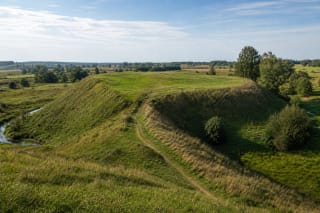
According to the Cultural Heritage Register, the hillfort platform is triangular, oriented northeast-southwest, about 30 m long and 34 m wide; its southwestern part is raised by about 2 m. On the northeastern edge there is a low rampart, about 0.5 m high and 10 m wide, with an approximately 11 m wide and 0.3 m deep ditch behind it.
Deep, marshy ravines surround the hill on the west and south, so the slopes there are steep and reach up to 30 m, while the relief is gentler on the north and east. A small settlement of about 0.2 ha lay at the northeastern foot, where rough pottery, clay daub, and burnt stones were found. The hillfort is dated to the first millennium.
Views and legends
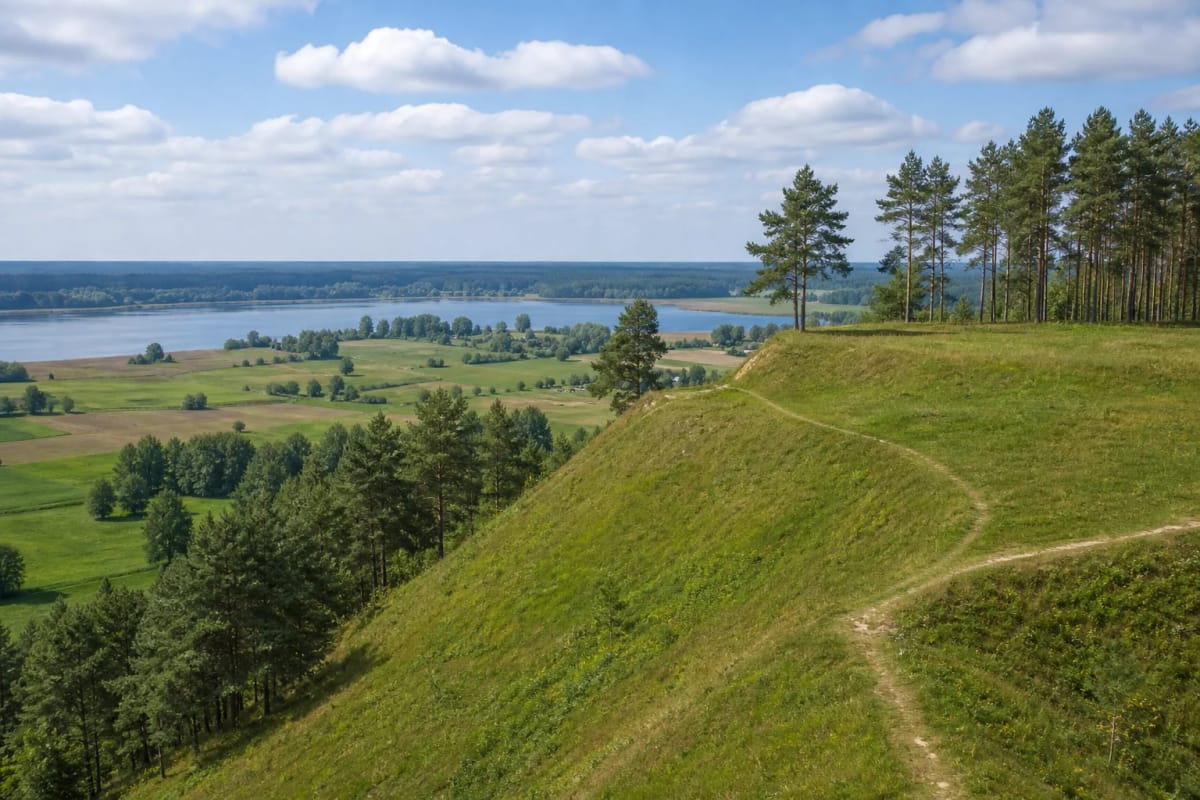
The open triangular summit is an excellent viewpoint. From it you can see far across Lake Vištytis and beyond it toward Rominta Forest in Kaliningrad Region. Because of these views and the relief, Pavištytis Hillfort is considered one of the most beautiful places in Vištytis Regional Park.
Two stories are associated with the hillfort, and both should be understood as folklore rather than history. One says that a church once sank into the hill and that bells can be heard from its depths on Easter morning, a classic motif of a sunken church legend. Another tale connects the name with a girl named Pilė, who carried earth at night and raised the hill for her dead beloved, which is why the hill is called Pilės kalnas.
How to visit Pavištytis Hillfort
The hillfort is an open, freely accessible natural and archaeological heritage site in Vištytis Regional Park; there are no tickets or opening hours. It is approached from the Pavištytis side, with a short walk and climb from the car, so comfortable footwear is useful.
A visit usually takes 20-40 minutes. Pavištytis Hillfort combines well with other Vištytis park sites: Lake Vištytis, the regional park visitor centre in Vištytis town, the second Pavištytis hillfort, and Vištytis Stone.