- Place
- Klaipėda, Klaipėda City Municipality
- Region
- Klaipėda
- Type
- a large urban park around historic Malūno Pond, with looped paths, a floating pedestrian bridge, viewing decks, and natural shoreline
- Address
- Between Mokyklos, Tilžės, Kooperacijos and Bangų streets, Klaipėda
- Coordinates
- 55.70759, 21.15338
- Visit duration
- 45-90 minutes for a walk around the pond; longer with the playgrounds, birdwatching, or a leisurely waterside break
- Best time
- in daylight from late spring to autumn, checking tree, floating-bridge, and path conditions first after a storm, heavy rain, or in winter
Trinyčiai Park, Trinyčiai Pond Park, Malūno Pond Park, Mill Park Klaipėda, Trinyčiai Pond
Where the park is, and why it has two names
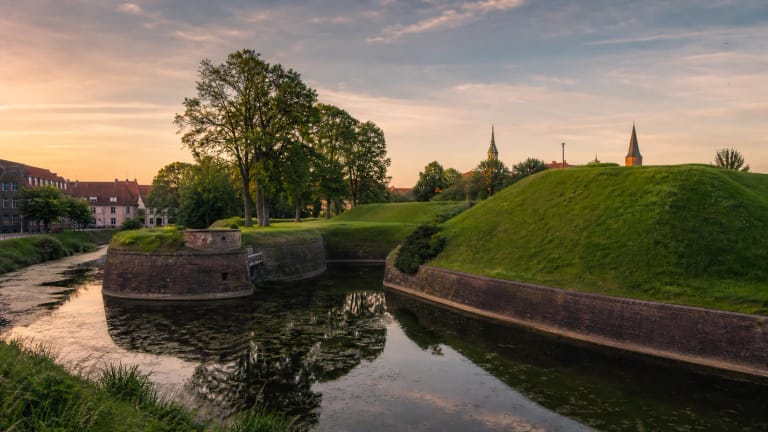
Malūno Park occupies a large green area around the pond between Mokyklos, Tilžės, Kooperacijos, and Bangų streets, east of Klaipėda's old town. The 2017 technical proposal gave the project area as 151,607 square metres, or about 15.16 hectares. This is not a fenced site with one formal entrance. Coordinates 55.707595, 21.153384 therefore mark a representative point near the middle of the park rather than a gate, car park, or sole trailhead.
On February 23, 2017, Klaipėda City Council approved the restoration of the historic name Malūno Pond and named the surrounding green space Malūno Park. Trinyčiai Park and Trinyčiai Pond are well-established older names, so both versions appear in earlier directions, local memories, and maps. They describe the same urban recreation area, not two separate parks.
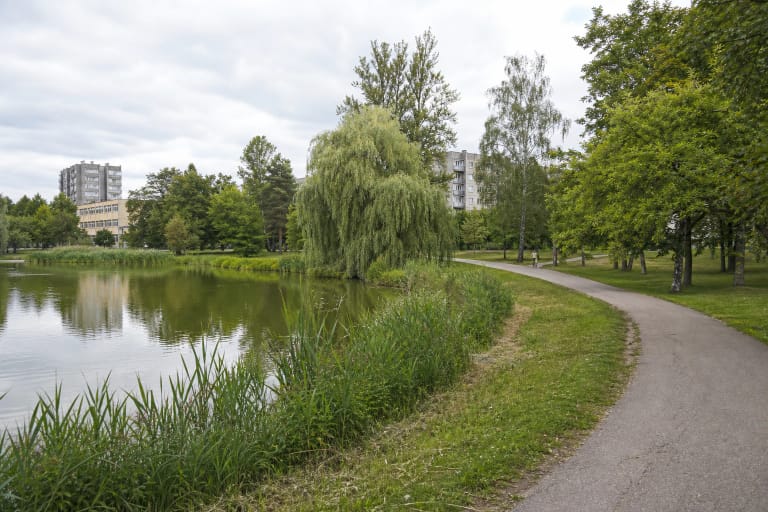
The pond itself is the park's centrepiece, edged by natural bands of reeds and other marginal plants. Parts of the western shore are steeper and more urban in character; elsewhere, the water merges into lawns, scrub, and stands of mature trees. A walk consequently changes character around the shore, moving from a formal shared pedestrian and cycle path to quieter, narrower waterside sections.
From the 16th-century Castle Mill to the Trinyčiai factory
A historical and urban study published through the Cultural Heritage Register says that a pond, dam, and channel system connected to the Dangė was created here in the mid-16th century, together with a watermill known in written sources as the Castle Mill. It remained part of royal lands until the late 17th century, and the road beside the pond crossed the dam. This documented hydraulic system explains the modern Mill name; it does not imply that a windmill should still stand inside the park.
The same heritage study warns against treating every historic site around the shore as one estate. The watermill and Joniškė Manor on the north-eastern bank developed as separate neighbouring properties. One farm building from the manor survives at Mokyklos g. 18A, while the old mill complex stands to the south beyond Bangų Street. The park is not a mill museum, and a walk across the floating bridge does not include entry to these historic interiors.
The name Trinyčiai came from the textile works that later operated beside the pond. The Encyclopaedia of Lithuania dates the enterprise to a cotton-spinning factory founded by brothers A. and R. Fainberg in 1923, while one municipal development proposal dates the factory at the pond to 1925. The wording and starting date differ between records, but both convey its importance: before the Second World War it was among Lithuania's largest textile enterprises, it was rebuilt after the war, later bore the name Trinyčiai, and went bankrupt in 2003. The factory's name remained attached to the park and pond long after production ended.
What the 2020-2023 renewal actually delivered
The renewal was built in two stages. Work on the first began in 2020 and the second in 2022; the municipality announced completion of the whole project in September 2023. The two stages together cost EUR 2.96 million. This timeline helps separate completed works from the broader ideas displayed during consultation in 2017. Visitors should rely on the later completion record rather than assume that every early concept was constructed.
The completed project provided renewed pedestrian and cycle paths, lighting, two children's play areas, a rest area, benches, cycle stands, and CCTV. Two drinking-water points, a toilet, grills, and a fenced dog area were installed, existing planting was managed, and new planting was added. Landscaped earth berms beside the busiest streets reduce the visual and acoustic impact of traffic.
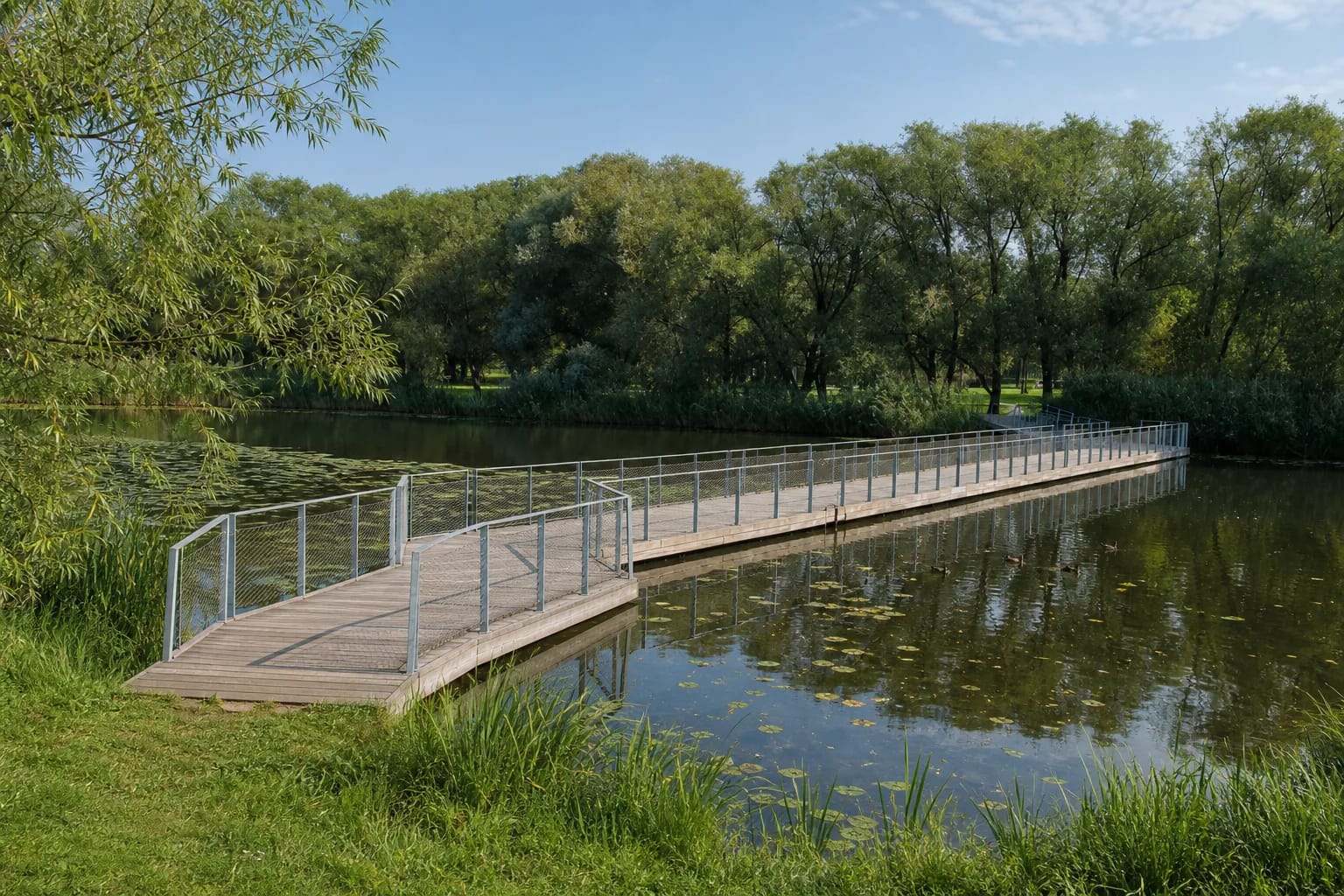
The most distinctive addition is the low floating pedestrian bridge linking two shores. Its timber deck runs across concrete pontoons, with a galvanized metal frame and mesh railings. The crossing creates shorter loops as well as alternative routes around the pond. Six separate waterside decks were also installed. They are places from which to approach or sit beside the water, not diving platforms for a bathing area.
Choosing a route and planning an accessible visit
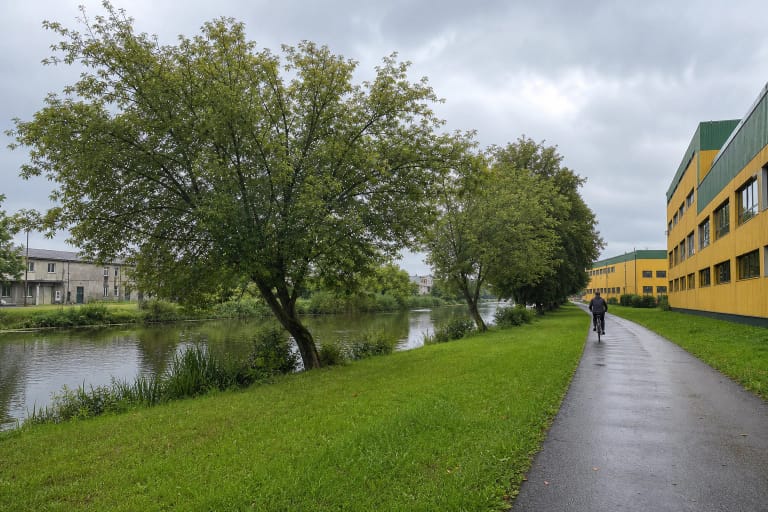
The main route circles the pond and intersects the floating bridge, allowing either a longer shore circuit or a shorter loop. The official design specified a 2.5-metre-wide asphalt main path, with a 1.5-metre strip of loose surface beside it along many sections. Narrower nature and shoreline paths were designed in gravel. The completion notice does not give one definitive distance for every possible circuit, so time is a more honest planning measure than a single promised kilometre figure.
The design required the principal paths to be firm, step-free, and no steeper than 5 percent longitudinally, with resting places at intervals of no more than 150 metres and tactile warning surfaces at junctions. These are design requirements, not an independent accessibility audit of the entire route in 2026. Pontoon movement, repairs, wet leaves, snow, or a temporary diversion may alter real conditions. A wheelchair user should favour the main path and assess its connection to the bridge on arrival.
The technical design deliberately excluded ordinary car traffic and parking from the park interior. Its paths are for pedestrians, cyclists, maintenance, and emergency access. Drivers should use only legal spaces on surrounding streets, follow current signs, and keep entrances clear. On shared walking and cycling sections, cyclists should slow down at playgrounds, viewing decks, and narrow path junctions.
Birds, bats, and the living shoreline
Municipal monitoring recorded 16 bird species in Malūno Park in 2025, compared with 27 in 2019. Despite the reduction between surveys, the 2025 summary still placed Malūno Park, together with the park between Statybininkų Avenue and Smiltelės Street, at the top for breeding-bird diversity among the monitored city green spaces. Malūno Pond also ranked among the surveyed urban waters with the greatest bird diversity, and mallards were particularly numerous.
The park remains active after dusk in a less visible way. Seven bat species were identified at the Malūno Park survey point, six of which the report lists in Lithuania's Red Data Book. The authors recommend adding roosting boxes because natural cavities are insufficient. Visitors can help simply by not shining powerful lights into cavities or boxes, avoiding disturbance, and remaining on paths beside the shoreline's nature-management zones.
Researchers found 36 aquatic and marginal plant species in Malūno Pond in both 2019 and 2025. Tall reeds and other emergent plants are not merely untidy growth; they provide habitat for birds, frogs, and invertebrates. The municipality also began protecting trees from beaver damage in 2024-2025. Watch from a path or deck, avoid trampling shoreline vegetation, and do not allow a dog to chase waterbirds.
Pond condition, facilities, and a safe visit
An attractive waterscape is not a water-quality certificate. In 2025, the fish-community index rated Malūno Pond's ecological condition as poor, at 0.38; it had been rated moderate in 2019. This is not a microbiological bathing-water test, but neither does it justify treating the pond as a safe supervised swimming place. Do not swim or jump from the decks, and follow the latest municipal notices and signs on site. Fishing remains subject to current permits, seasons, and tackle rules; a biological survey does not override them.
Malūno Park is an open public outdoor space. As of July 20, 2026, the official sources reviewed listed no admission fee, ticket office, or permanent gate hours. Lighting and CCTV do not mean that a staff member is always present. A storm, fallen tree, ice, changing water level, or repairs may temporarily close the bridge or a section of path.
The municipality's 2023 completion notice confirms a toilet, two drinking-water points, grills, play areas, and a dog enclosure. It does not provide one live status page for their current hours, seasonal operation, or every piece of equipment. Carry water as a backup, inspect equipment before use, light a fire only at a clearly designated operational grill, and observe temporary fire restrictions. Outside the fenced dog area, follow the city's animal-control rules, collect waste, and protect the park's birds.