- Place
- Klaipėda City Municipality
- Region
- Klaipėda
- Type
- creative-industries incubator and venue for performing arts, cinema, exhibitions, and conferences in a converted tobacco factory
- Address
- 5A Bangų Street, Klaipėda
- Coordinates
- 55.70826, 21.14157
- Visit duration
- 1-3 hours for a chosen performance, film, exhibition, or event; 20-40 minutes for the exterior and Jono Hill surroundings
- Best time
- according to the official events calendar; arrive early for an evening performance or screening so that you can find the correct hall
KUFA, Kultūros fabrikas, Former Klaipėda Tobacco Factory
KUFA is a working cultural venue, not a tobacco-factory museum
Klaipėda Culture Factory operates at 5A Bangų Street, between the old town and the Jono Hill bastions. Its name can be misleading: there is no permanent tobacco-production exhibition or single interpretive route with one admission ticket. It is a creative-industries incubator and multi-purpose cultural venue, and the public normally comes for a particular play, film, exhibition, festival, lecture, workshop, or conference.
KUFA's official presentation calls it the first creative-industries incubator in Klaipėda and western Lithuania. More than 100 creators and creative-business professionals work here regularly, but their studios and offices are not automatically public exhibits. Visitors can enter the spaces and activities opened by that day's programme or by the relevant organiser.
The official 2026 community presentation names Klaipėda Youth Theatre, Šeiko Dance Company, Taško Theatre, CODA ballet school, ArleKinas cinema, film and virtual-reality creators, and other teams. Residents change over time, so this is a snapshot of the current official roster rather than a permanent directory of the building.
Four very different halls, a gallery, and creative studios
KUFA's rooms differ greatly in scale and purpose. The official venue catalogue gives Conference Hall A an area of 173.9 sq m and a capacity of up to 100 seated guests. The 339.71 sq m Multifunction Hall B has retractable amphitheatre seating and accommodates 198 seated or up to 350 standing visitors. Theatre, dance, concert, and conference organisers all make use of this flexibility.
The cinema and conference hall measures 149.31 sq m and has 115 seats arranged as an amphitheatre, a large screen, and projection equipment. The smaller, 106.6 sq m Studio 2A is intended for workshops, rehearsals, or meetings of up to 40 people. The 220 sq m Attic Hall C supports dance, rehearsals, and chamber events, while the 90.29 sq m gallery is used for exhibitions, workshops, and presentations and opens onto a terrace facing Jono Hill.
Those figures explain why two KUFA visits can feel completely different. On one evening you may sit in a cinema auditorium; on another you may move through an open performance floor, while a daytime visit might involve only a gallery or conference. Check the hall letter and floor in the event information, not merely the building address.
Read the industrial building from both outside and inside
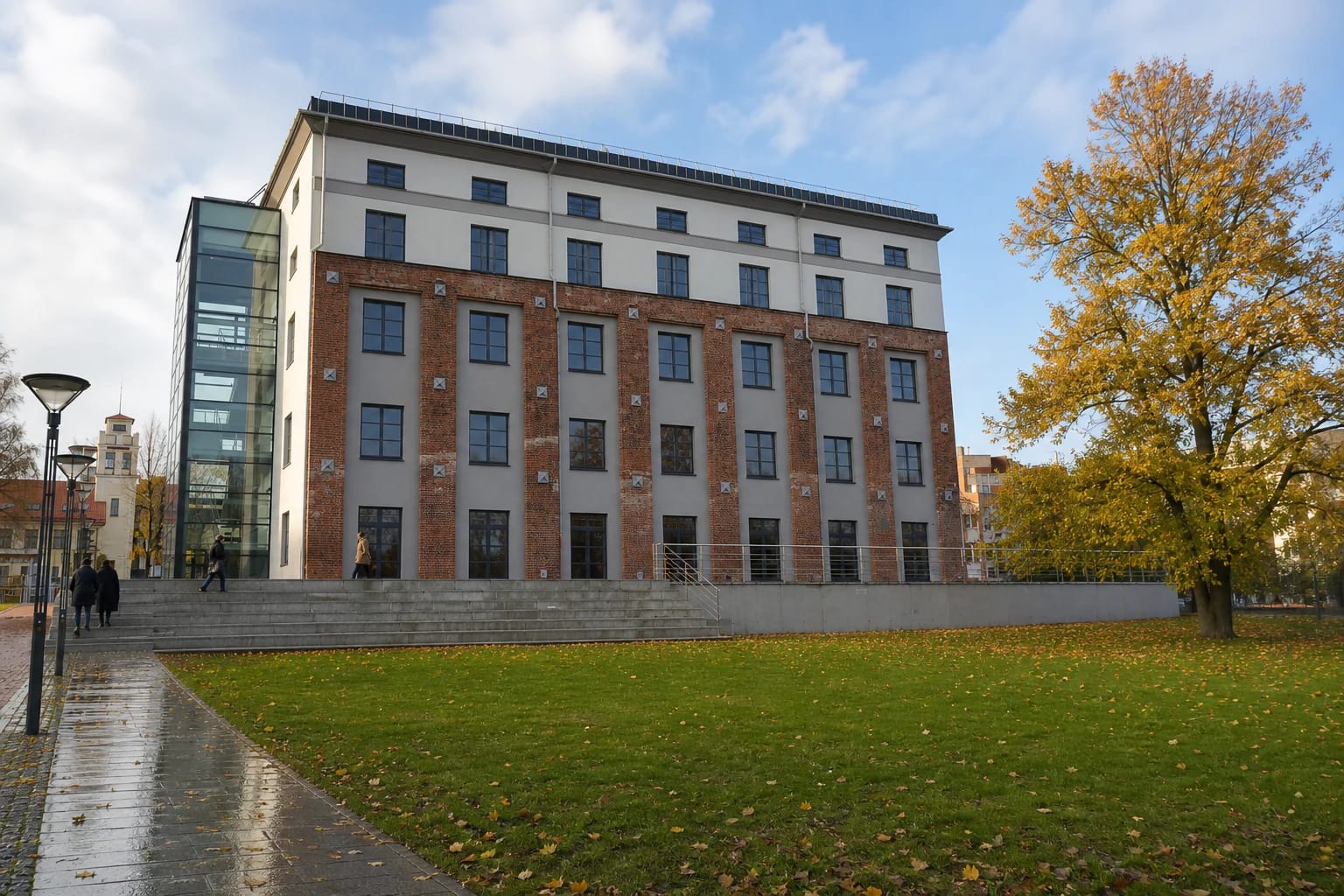
The tall rectangular factory block is clearest from the Jono Hill side. Restored red-brick piers and grey rendered panels give rhythm to the lower facade, lighter upper storeys rise above them, and a glazed stairwell is inserted at one end. The large, regularly spaced windows reveal the building's former production role even though studios, offices, and creative rooms now lie behind them.
The 2011-2014 reconstruction functionally joined the old five-storey, basemented block to a new two-storey extension. The cinema occupies the lower level of the newer part. Inside, old brick surfaces and metal structural elements meet dark contemporary fittings, glass, exposed technical ceilings, and adaptable event infrastructure.
This is not a decorative imitation of an old factory. Its strongest architectural idea is the legible relationship between old and new: the industrial scale and masonry rhythm remain, while the interior has gained technically flexible infrastructure for performance, cinema, and work. Even if you are attending only an event, walk around the Jono Hill side for a few minutes, where the factory volume and terraces are easier to understand than at the main doors.
From tobacco production and a prisoner-of-war camp to a creative incubator
The site chronology prepared by the Ieva Simonaitytė Public Library states that Lelb Werblowsky's tobacco and cigarette factory was built on this plot in 1912 and operated until 1939. Architectural and construction accounts, however, associate parts of the present block with 1917 or 1926, and later expansion with 1935. The most careful reading treats 1912 as a documented beginning of factory activity and site development, not an unquestionable date for every wall visible today.
A German prisoner-of-war camp occupied the factory grounds in 1945. The library account records four single-storey barracks and about 815 prisoners held at one time, who cleared the ruined city. This is a documented and difficult layer of the site, and it should not disappear beneath an uncomplicated story of a creative rebirth.
Klaipėda Tobacco Factory operated in the present five-storey block from 1954 to 1997. Philip Morris acquired the state cigarette enterprise in 1993-1994, and production at the old site subsequently ended. The library chronology dates the municipality's acquisition to 2001. After extended planning and reconstruction in 2011-2014, a creative-business and arts incubator occupied the complex in 2014. Some older KUFA copy uses 2015 as the operational start, but the current official presentation counts the community from 2014.
Tickets, opening hours, and preparing for an event
KUFA has no single visitor ticket and no one set of public opening hours for every activity. Some programme entries are free, some require registration, and plays, films, and festivals can use different ticketing services. Even a free event may have limited capacity. Before travelling, check the particular event page, organiser, start time, age guidance, and ticket or registration terms.
Administrative hours, coworking access, and the building's technical operating schedule are not the same as admission time for an auditorium. During research, no single clearly dated set of general 2026 visitor hours was available, so older summer schedules should not be copied into a current itinerary. The specific event listing is the safest guide; KUFA publishes +370 46 311 010 and info@kulturosfabrikas.lt for questions.
For a popular evening event, arrive 15-25 minutes early. That allows time to find the correct hall, validate a ticket, and use a cloakroom if the organiser provides one without interrupting a performance by arriving late. Door times, cloakroom service, seat selection, and refund rules belong to the individual organiser.
Arrival, accessibility, and a walk around Jono Hill
The current visitor address is 5A Bangų Street. Historical sources still use 7 Bangų Street because that was the old factory-plot address; for navigation, use the current KUFA name and 5A. The map point at 55.708258, 21.141569 marks the site, not a reserved parking bay or the door to a particular hall.
KUFA stands beside the old town, making it practical to arrive on foot and combine an event with the Jono Hill bastions, half-timbered quarters, or the Danė waterfront. Parking arrangements in the centre can change and become busy during events. The venue description does not promise a visitor space at the door, so consult Klaipėda's current parking map and allow time for a short walk.
The building has several levels and events take place in different rooms. During research, KUFA's official venue catalogue did not provide a complete 2026 accessibility route from the street to every auditorium position. If you need step-free access, wheelchair seating, an accessible toilet, companion arrangements, or hearing assistance, contact both KUFA and the event organiser before buying a ticket.